The entrepreneur: the person who takes the decisions and carries the risk
Definition
Entrepreneur: A person who takes the financial risk of setting up and running a business, combining land, labour and capital to produce a good or service in the hope of earning profit.
- In a new business nobody else is paid to take decisions, so the owner chooses the product, the price, the suppliers and the staff.
- The entrepreneur also carries the financial risk, because money spent on inventories, equipment and premises is lost if customers do not buy.
- Profit is the reward for accepting that risk, which is why the entrepreneur keeps whatever is left once every cost has been paid.
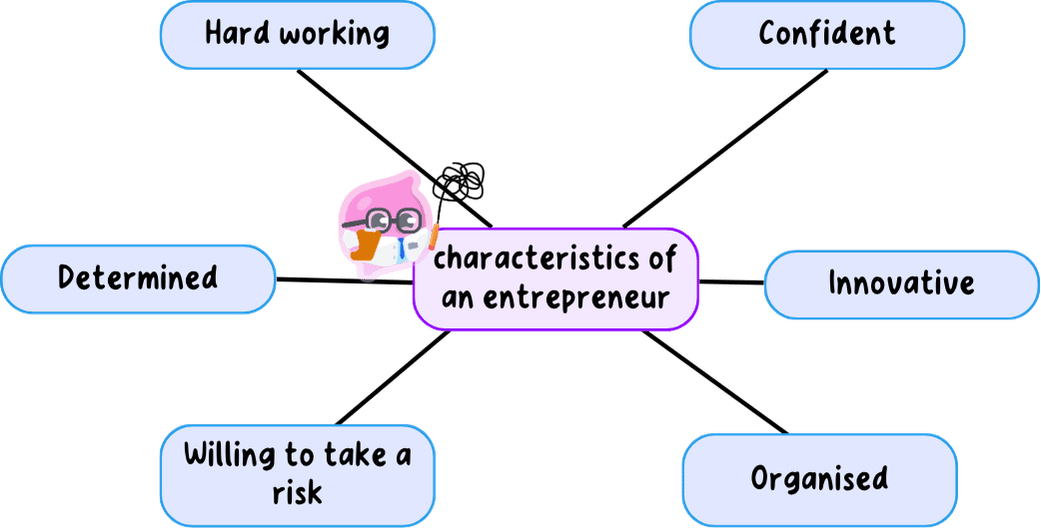
- Six characteristics come up again and again in successful entrepreneurs: hard working, confident, determined, innovative, willing to take a risk, and organised.
- Willing to take a risk is often written as risk taker, and the two mean the same thing.
Common Mistake
- Owning a business is not itself a characteristic, so describe what the person is like and how that behaviour helps the firm survive.
- Do not confuse a characteristic with a motive, because wanting independence explains why someone started up rather than what they are like.
- Risk-taking is not gambling, so an owner who spends recklessly is showing a weakness rather than a strength.
Risk-taking: weighing the possible loss before committing the money
- Willingness to take risks: the entrepreneur accepts that the business may fail and invests savings, and often gives up a secure salaried job, anyway.
- Successful entrepreneurs take calculated risks, meaning they compare the size of the possible loss with the size of the possible gain before spending.
- Testing a product on a market stall for £200 before signing a shop lease worth £20,000 a year limits the loss if demand turns out to be weak.
- Refusing every risk is also damaging, because an owner who will not spend on inventories or advertising can never serve more customers than the few who happen to walk past.
Hard work and determination: the owner is the whole workforce at first
- Hard-working: a start-up cannot afford employees, so the founder makes the product, serves customers, delivers orders and keeps the accounts, frequently for 60 or 70 hours a week.
- Those unpaid hours keep wage costs out of the business, so the level of sales needed to cover costs stays low while the firm becomes known.
- Determination: rejections arrive constantly, from banks refusing a loan, buyers refusing shelf space and suppliers refusing credit to a firm with no trading record.
- An entrepreneur who reworks the recipe and pitches to a fourth buyer gets distribution, while one who stops after the first refusal reaches no customers.
- Independence and self-motivation: nobody sets the targets or checks the work, so the discipline to open on a wet Tuesday has to come from the owner.
- Optimism keeps that effort going, but it has to be balanced by realism, because an over-optimistic sales forecast leads the owner to buy inventories that never sell and to run out of cash.
Example
- James Dyson worked through thousands of prototypes over several years before his bagless vacuum cleaner reached the market, and at first no established manufacturer would sell it.
- He funded that development with borrowed money, so determination mattered more than the original idea, which had existed for years before it earned a single pound.
Creativity and innovation: giving customers a reason to switch
- Creative and innovative: a new firm has no reputation and no loyal customers, so it has to offer something the established rivals do not.
- Without that difference the only weapon left is a lower price, and a small firm buying in small quantities pays more per unit than a large rival, so it loses a price war.
- Innovation does not have to mean inventing a product, because changing how a service is sold or delivered counts as well.
- Just Eat cooked nothing, but by moving takeaway ordering onto one website it earned commission from thousands of restaurants that could not build their own.
- Creativity is also needed for problems, since an entrepreneur refused a bank loan has to find another route to finance such as crowdfunding or a family loan.
Organisation: controlling cash, inventories and time
- Good organiser: the owner has to know what the business owns, what it owes and when each bill falls due.
- A firm can be making a profit and still close, because profit is measured over a year while a supplier has to be paid on the day the invoice is due.
- Planning when money will come in and go out shows the shortage in advance, so the owner can arrange an overdraft before the payment date rather than after it.
- Organisation also means ranking jobs by their effect on the business, so chasing a £3,000 unpaid invoice comes before redesigning the logo.
- Disorganisation shows up as late deliveries, missed orders and wrong prices, which lose the repeat customers a young business cannot afford to keep replacing.
Communication and leadership: persuading the people the business depends on
- Effective communicator: the same idea has to be sold to several audiences, each of which can stop the business.
- Banks and investors provide the capital the firm cannot generate from its own sales in year one, and suppliers decide whether to grant trade credit.
- Customers have no reason to trust an unknown name, and employees who accept less than a large firm would pay need a reason to join and stay.
- Self-confidence carries that persuasion, because a lender comparing two applications backs the owner who answers questions on costs and competitors without hesitating.
- Listening is the other half of communication, since complaints and staff suggestions are free market research telling the owner exactly what to change.
- Leading by example replaces money as a motivator early on, because staff who see the owner working the busiest shift are more willing to do the same.
Exam technique
- Stopping at the label is the commonest weakness here, because "she is determined" says nothing until you add what she kept doing and what the business gained from it.
- Choose the traits the stimulus gives you evidence for rather than the list you memorised, and quote the action from the case that proves it.
- Do not offer "good with people" and "a natural leader" as two separate points, because they read as one idea rather than two.
Self review
- Define an entrepreneur.
- What is the difference between a calculated risk and a gamble?
- Name two groups an entrepreneur must persuade and say what each one provides.
- Why can a profitable new business still be forced to close?
- Explain how being creative helps a new firm compete with an established rival.