Sector importance is a share, not an amount
- A sector's importance is measured by its share of total employment and its share of national output, and because the three shares add up to the whole economy, a rise in one is always a fall in another.
- As an economy develops the balance usually shifts from primary to secondary and then towards tertiary, although the change takes decades and no country moves in a straight line.
- Low-income economies are usually dominated by the primary sector, and high-income economies by the tertiary sector, where services can provide around four in five jobs.
The primary sector: large in a poor economy, small in a rich one
- There is little capital to do anything else. Most people in a low-income economy work in farming, fishing or mining, because factories and offices need machinery, power and skills the economy does not yet have.
- Many of these economies also earn most of their export income from one or two raw materials, which keeps the primary sector large and leaves it exposed when the world price of that material falls.
- Higher yields need fewer workers. Machinery, fertiliser and better seed let the same harvest be produced by a fraction of the labour, so the sector's share of employment falls.
- Food takes a smaller slice of a richer household's spending. Farming therefore grows more slowly than the rest of the economy, and its share of output falls even in years when the tonnage it produces is rising.
- Resources run out. Coal seams in the older industrial economies became expensive to work, so the mines closed and the primary sector shrank with them.
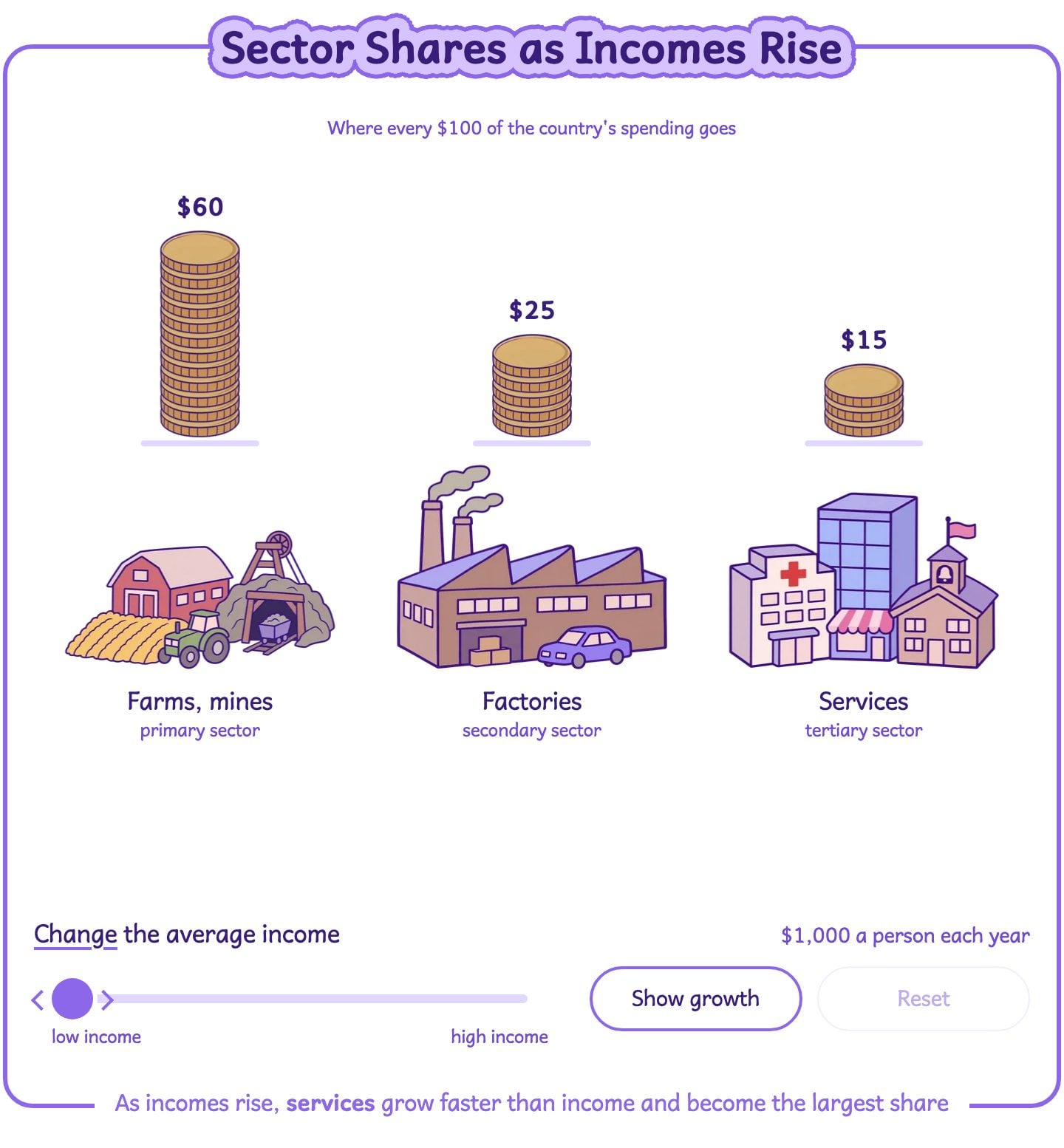
Drag the income slider and watch services take a growing share while the primary sector shrinks.
Industrialisation: why the secondary sector grows in developing economies
Definition
Industrialisation: The growing importance of the secondary sector, so that manufacturing takes a larger share of a country's output and employment.
- Tractors and better seed let one worker grow the food that once took several, so workers leave the land for towns and are available to staff factories.
- Low wage costs attract manufacturers from higher-wage countries, so Nike contracts production of its trainers to plants in Vietnam rather than making them in the United States.
- Governments encourage manufacturing with roads, ports, power and grants, which cuts the cost of getting materials in and goods out so new factories can compete on price.
Example
- China's factory boom drew hundreds of millions of workers off the land and into coastal manufacturing cities over three decades.
- Apple designs its products in California but has them assembled in those plants, so the same decision raised manufacturing's share of employment in one economy while lowering it in the other.
Deindustrialisation: why the secondary sector shrinks in developed economies
Definition
Deindustrialisation: The falling importance of the secondary sector, so that manufacturing provides a smaller share of a country's output and employment.
- Cheaper production overseas: imports undercut home-produced goods on price, so domestic factories lose orders, cut output and eventually close.
- Technology and automation: a modern car plant uses robots to weld and paint, so the same output needs fewer people and employment falls even in a good year.
- Rising incomes: once people own the goods they need they spend extra income on holidays, restaurants and streaming, so service firms expand and hire faster than factories do.
- More households with every adult in paid work, longer journeys to work and more leisure time push the same way, raising demand for childcare, transport, insurance and eating out.
- Government policy: stricter emissions rules raise costs for heavy industry, while support for skills and research pushes firms towards design and software.
Common Mistake
- Deindustrialisation does not mean the country makes fewer goods.
- A developed economy can be producing more goods by value today than it did fifty years ago, even though manufacturing's share of jobs has fallen a long way.
- A share can fall while the amount produced rises, so check whether the question is asking about share or about output.
What sector change means for a business
- A shrinking sector means falling demand for its suppliers, so an engineering workshop selling parts to shipyards loses customers as the shipyards close while its fixed costs continue.
- Others add a service to a manufactured product, so an engine maker selling maintenance contracts earns revenue every year of the engine's life rather than only at the sale.
- A growing tertiary sector opens the way for new firms, because a courier can start with one van, but the same low start-up cost also means heavy competition on price.
Exam technique
- The commonest error here is writing that a sector "has died", so use the language of share and importance instead.
- "Labour is cheaper abroad" is not an explanation on its own, so add that imports then undercut home producers on price and factories lose orders.
- Match the reason to the economy in the question, since released farm labour explains growth in a developing economy and automation explains decline in a developed one.
Self review
- How is the relative importance of a sector measured?
- Define industrialisation and deindustrialisation.
- Why does farming employ so much of the workforce in a low-income economy?
- Give two reasons manufacturing's share of employment falls in a developed economy.
- State one way a manufacturer can respond to a shrinking secondary sector.