What a pricing method has to do
- Revenue is price multiplied by quantity sold, so a change in price moves both halves of that sum at once.
- Selling 2,000 units at £5 gives 2,000×£5=£10,0002{,}000 \times \pounds 5 = \pounds 10{,}0002,000×£5=£10,000, while cutting the price to £4 and selling 2,600 gives 2,600×£4=£10,4002{,}600 \times \pounds 4 = \pounds 10{,}4002,600×£4=£10,400, so the cut worked only because the extra sales outweighed earning £1 less on each unit.
- Whichever method is chosen, in the long run the price has to cover the cost of making and selling the product or the business makes a loss.
- The price also has to fit the image of the product, because a figure far below the rest of the market tells customers the quality is lower.
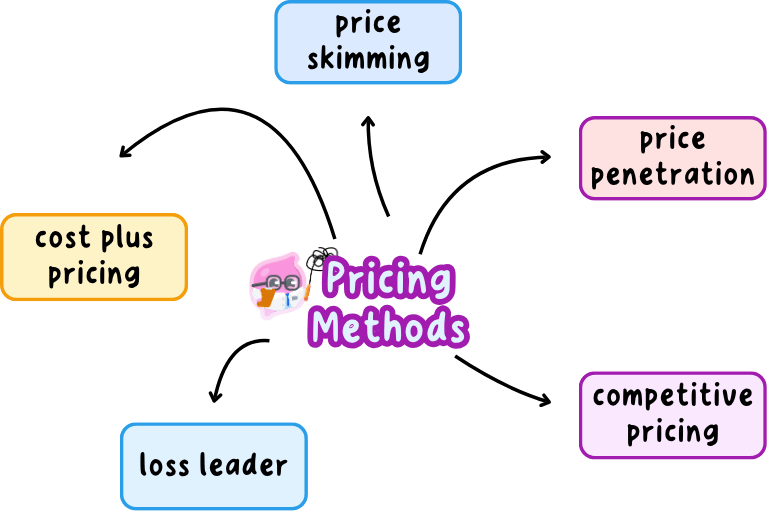
- There are five methods to choose between: cost-plus, competitive, penetration, skimming and promotional pricing. A loss leader is one form of promotional pricing rather than a sixth method.
Cost-plus pricing: cost per unit plus a mark-up
Definition
Cost-plus pricing: Setting the price by working out the cost of making one unit and adding a percentage mark-up for profit.
- The business works out what one unit costs to make, then adds a percentage mark-up on top of that cost as its profit.
Example
- Fixed costs are £40,000 a year, variable costs are £3 per unit and the firm expects to make 20,000 units.
- The 40% mark-up turns a £5 cost into a £7 price, so every unit sold earns £2 of profit.
- Benefits: it is quick, it needs no market research and every sale covers its own cost, which is why builders pricing a job and shops marking up bought-in goods rely on it.
- Limitations: the profit is only guaranteed if the output guess is right, because selling half the expected units doubles the fixed cost per unit from £2 to £4 and swallows the whole mark-up.
- It ignores both rivals and demand, so the firm can sit above the market price without noticing and charges the same £7 in a quiet February as in a crowded December.
Competitive pricing: match rivals, compete on other things
Definition
Competitive pricing: Setting the price at or very close to the level rivals charge for a similar product.
- The business sets its price at or very close to what rivals charge, which is normal where customers can compare in seconds, such as petrol and groceries.
- It protects sales volume, since a firm charging £1.50 for an item the shop next door sells at £1.20 loses those customers immediately.
- Competition then moves onto the other three Ps, so Tesco matches rivals on milk and bread and competes on delivery slots, opening hours and its loyalty card.
- It ignores the firm's own costs, so a business with higher costs than its rivals can match their price and still lose money, and thin margins can turn into a price war in which nobody profits.
Penetration pricing: a low launch price to win share
Definition
Penetration pricing: Setting a deliberately low price when a product is launched so it wins customers and market share quickly, then raising the price once it is established.
- The launch price is set deliberately below the established market price, so a new cereal at £1.50 against brands at £2.50 gives shoppers a clear reason to take a chance on it.
- Sales volume builds quickly and customers form the habit of buying it, while the extra volume brings economies of scale that make the low price easier to sustain.
- Winning share early matters because taking a customer off a rival later is far harder, so it suits mass-market products with close substitutes.
- Profit per unit is small, so a small firm can run out of cash before the volume arrives, raising the price later loses the customers who only came for the bargain, and a low price can signal low quality.
Price skimming: a high launch price for the keenest buyers
Definition
Price skimming: Setting a high price when a new product is launched to earn a large profit on each sale from customers who want it first, then lowering the price as rivals appear.
- The launch price is set high and aimed at the customers who want the product most, so a games console launched at £449 and cut to £349 a year later takes an extra £100 from every early buyer.
- A wide margin on early sales pays back development spending before rivals arrive, and it supports an exclusive image.
- Each planned price cut opens up a new group of customers without the firm changing the product at all.
- Sales volume is low so cost per unit stays high, the wide margin advertises the opportunity to competitors, and early buyers can feel cheated when the price falls.
- It only works where the product is genuinely different, protected by a patent, new technology or a strong brand.
Promotional pricing: a short cut to shift inventories
Definition
Promotional pricing: Reducing the price for a short, limited period to boost sales, clear stock or draw attention to a product.
- The price is cut for a limited period through a sale, a seasonal discount, a multibuy or a money-off voucher, then returns to its normal level.
- A loss leader is the strongest version of this: one item is priced at or below what it cost the business, to pull customers through the door in the expectation that they fill the rest of the basket at normal prices, which is why supermarkets discount milk and bread rather than luxuries.
- It clears inventories and brings cash in quickly, so cutting a £40 coat to £25 in January turns unsold coats into money and frees the rail for the new season.
- It revives a mature product whose sales have flattened, answers a rival's offer without a permanent price cut, and gets new customers to try the product.
- Profit per unit falls and the extra volume does not always make up for it, customers learn to wait for the next offer, and a product permanently on discount stops looking worth its full price.
Common Mistake
- Skimming starts high and comes down, while penetration starts low and goes up, so check which way the price is moving before naming the method.
- Skimming chases a large profit on each unit from few buyers, while penetration chases market share from many.
- Both are launch strategies, so neither fits a product that has been on sale for years, and neither is the same as a short promotional cut on an established line.
Recommending a pricing method: what tips the choice
- How different the product is: a product with a genuine unique selling point can skim, while one customers see as identical to its rivals is pushed towards competitive pricing.
- The objective and the finances: a firm chasing market share picks penetration and one chasing quick profit picks skimming, but only a business with reserves can survive years of thin margins.
- The stage of the life cycle: skimming and penetration belong at launch, competitive pricing in maturity, and promotional pricing when sales flatten or inventories have to go.
- Applied judgement: a small bakery selling handmade sourdough at £4.50 should use cost-plus rather than match a supermarket loaf at £1, because it can measure its cost per loaf and its customers are buying quality rather than the cheapest bread.
- Most businesses use more than one method at once, pricing new lines by skimming or penetration while pricing everyday lines against rivals.
Exam technique
- A pricing question wants the method named, so write cost-plus, competitive, penetration, skimming or promotional rather than saying the firm should lower its price.
- Work the mark-up on the £ cost per unit you are given and state the price it produces, rather than describing in general terms how profit is added.
Self review
- A product costs £8 a unit to make and the firm adds a 25% mark-up, so what is the price?
- Give one benefit and one limitation of competitive pricing.
- State the difference between skimming and penetration in terms of the launch price.
- Why can frequent promotional pricing damage a business?
- Which method would you recommend to a firm launching a phone with technology no rival has, and why?