The product life cycle: sales plotted against time
Definition
Product life cycle: The stages a product passes through from launch to withdrawal, shown as its sales over time and usually split into introduction, growth, maturity and decline.
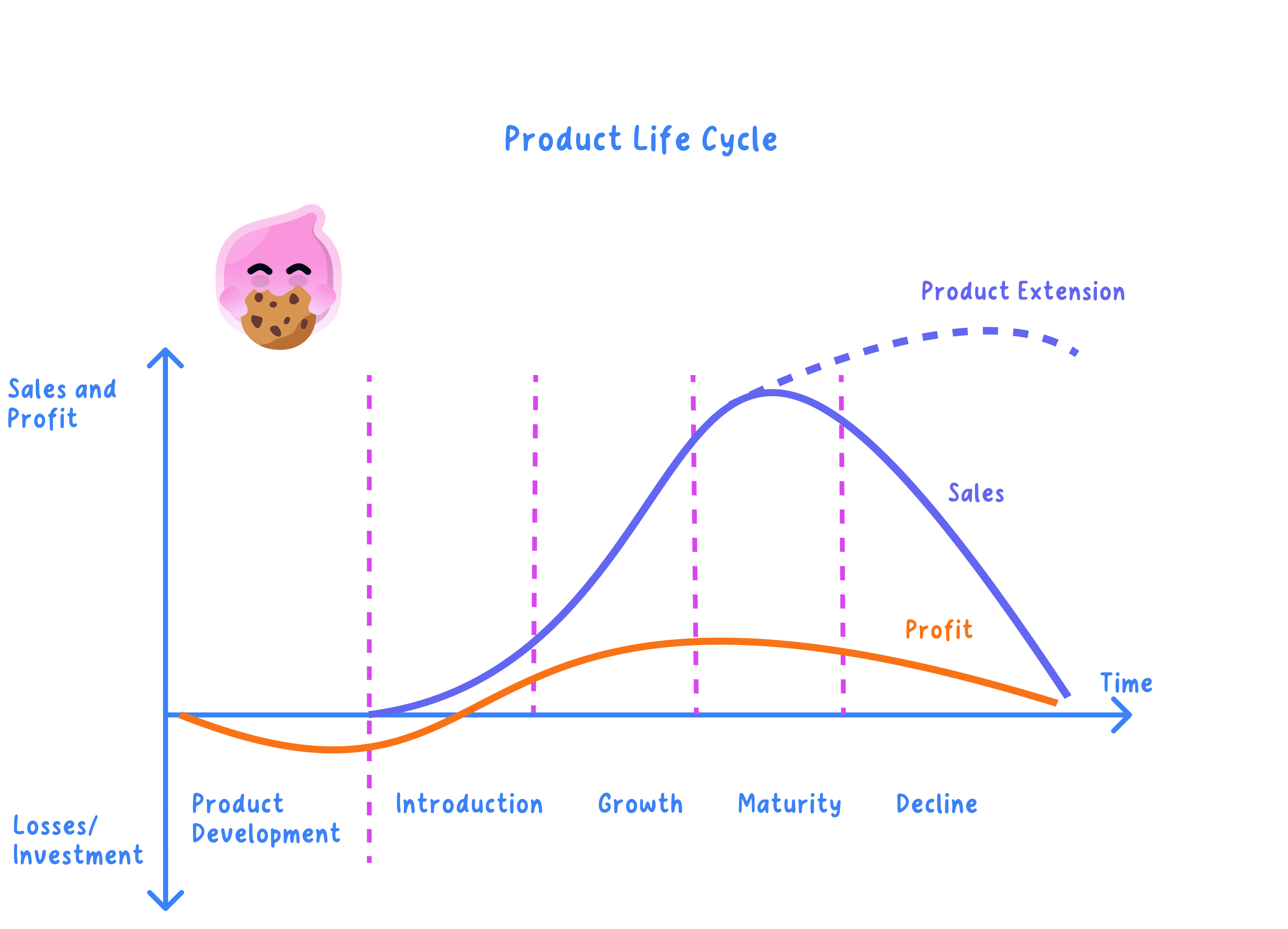
- The cycle is drawn with time on the horizontal axis and sales and profit on the vertical axis, and the space below that axis shows the losses the firm makes while it is still investing in the product.
- The sales curve rises slowly, then climbs steeply, then flattens into a plateau, then falls away, and those four shapes are introduction, growth, maturity and decline.
- An extension strategy shows on the diagram as the flat maturity section turning upwards again instead of falling, so label the point where it starts.
- Before the launch there is a product development stage when sales are zero and the firm is spending on research, design and testing, so money flows out with nothing coming in and the profit line sits below the horizontal axis.
- Sales are not the same as profit, so a product can be selling more every month and still be losing money because the launch costs have not been recovered, which is why the two curves are drawn separately.
- The length of each stage differs by product, so a fashion item may pass through the whole cycle in one season while a chocolate bar stays in maturity for decades.
What is happening in each stage
- Introduction: sales are low but rising, because few customers know the product exists and retailers stock it cautiously, so a loss is normal, cash flow is negative and many products are withdrawn without ever leaving this stage.
- A firm that spends £500,000 developing a product and takes £150,000 in first-year sales is £350,000 out of pocket even though sales grow every month.
- Growth: sales rise fast as word spreads and more retailers stock the line, so larger production runs spread fixed costs, profit rises fastest and cash flow turns positive, but visible success pulls in imitators.
- Maturity: sales reach their peak, profit is at or near its highest and cash flow is strongest, but most customers who want the product already own it, so extra sales can only be taken from a rival and price competition squeezes profit per unit.
- This is where a business earns the cash it uses to develop the next generation of products, so a firm with nothing in maturity struggles to fund a launch.
- Decline: sales and profit fall and cash flow weakens as tastes move on or a better rival appears, retailers give the shelf space to faster-selling lines, and the firm chooses between withdrawing the product, selling it on or extending it.
Common Mistake
- Do not assume a product in decline is making a loss, because falling sales can still cover costs and the firm only withdraws it once they do not.
- Maturity is the most profitable stage rather than a warning sign, so do not describe a product at its sales peak as failing.
- The cycle tracks one product, not the whole business, so Cadbury as a company is not in decline just because one bar is.
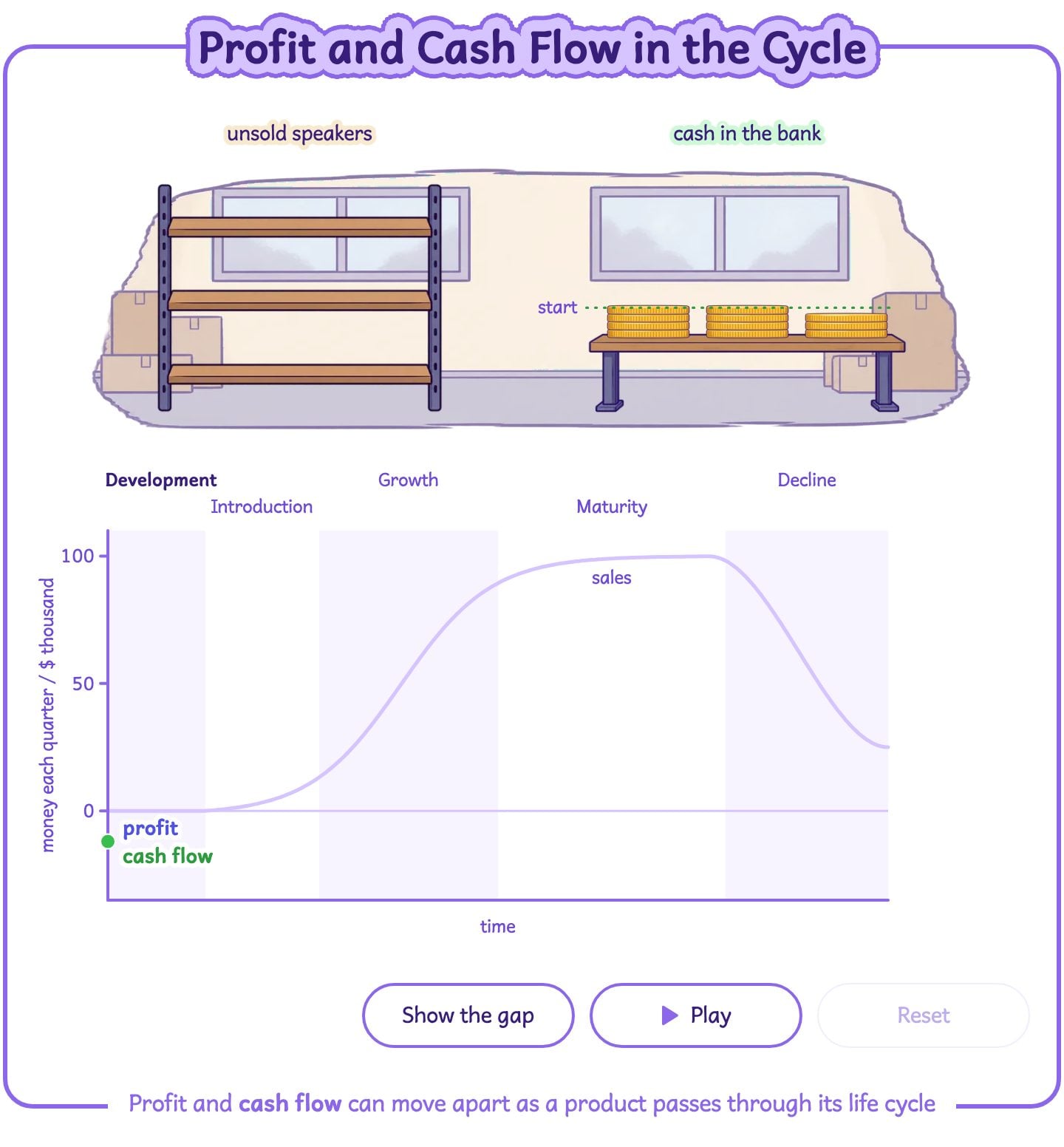
Move along the life cycle and compare how profit and cash flow differ at each stage.
Extension strategies: stretching out maturity
Definition
Extension strategy: An action taken to lengthen the maturity stage of a product and delay its decline, such as selling it in new markets, finding new uses, restyling it or changing its price.
- Selling in new markets: exporting the product or aiming it at a different segment reaches customers who have never bought it, so a saturated home market stops being a limit on sales.
- Finding new uses: promoting the same product for a different purpose adds demand without changing the product, as cereal brands do by advertising an evening snack as well as a breakfast.
- Restyling or updating: a new shape, colour, flavour or version makes the product feel current and gives owners a reason to replace what they already have.
- Changing the price: a cut from £3.00 to £2.40 wins price-sensitive shoppers, while moving to a premium price with better ingredients wins a different group altogether.
- New promotion or packaging: a fresh campaign, a move onto social media or a single-serve pack opens a buying occasion the old marketing never reached.
- Extension works best at the end of maturity, and it costs money, so a firm extending a product the market has genuinely finished with is spending on a lost cause.
Example
- Lucozade was sold for decades as a drink for people recovering from illness before it was repositioned as a sports drink for active people.
- Apple releases an updated iPhone every year, using restyling and added features to keep a mature product selling.
How the stages influence marketing decisions
- Product: developed and tested before launch, refined during growth as faults appear, extended in maturity and withdrawn in decline.
- Price: skimming or penetration at launch, falling through growth as rivals arrive, matched to competitors in maturity and discounted in decline to clear remaining inventories.
- Promotion: informative at launch so customers learn the product exists, persuasive in growth against imitators, reminding in maturity and cut back in decline.
- Place: a few outlets at launch, widening through growth, at its maximum in maturity and shrinking in decline as retailers drop the line.
- A business therefore aims to hold products at different stages at the same time, so the cash from mature lines covers the losses made by new launches.
Self review
- Name the four stages of the product life cycle in order.
- Describe in words what the sales curve does in each stage, and where an extension strategy appears on the diagram.
- Why is cash flow usually negative during introduction?
- Give three extension strategies and say what each one changes.
- How does promotion differ between the introduction stage and the maturity stage?