Price elasticity: how strongly sales react to a price change
Definition
Price elasticity of demand: How strongly the quantity customers buy responds to a change in the price of a product.
Price elastic demand: Demand that changes by a proportionally larger amount than the price change that caused it, so a small price rise produces a big fall in the quantity sold.
Price inelastic demand: Demand that changes by a proportionally smaller amount than the price change that caused it, so a price rise produces only a small fall in the quantity sold.
- Demand normally falls when a price rises and rises when a price is cut, but that rule says nothing about how big the change in sales will be, and elasticity is about the size of the response rather than its direction.
- Where demand is elastic, a small rise in price loses a large share of the customers, because most of them can buy something very similar somewhere else.
- Where demand is inelastic, customers keep buying when the price rises because they need the product, trust the brand, or have no realistic alternative to turn to.
- The same 10% price rise can therefore cost one business almost no sales and wipe out another's, so mass-market groceries and budget clothing behave very differently from medicines, fuel and water.
- The quickest test is to ask what a customer facing the higher price would buy instead, because an easy alternative means elastic demand.
Example
- Aldi's own-label groceries face elastic demand, because a shopper who dislikes the price buys the same item in Lidl or Tesco instead.
- Apple faces far more inelastic demand, because a customer with photos, apps and subscriptions tied to the system loses a great deal by switching.
What makes demand elastic or inelastic
- Availability of close substitutes: the more alternatives there are and the easier it is to switch, the more elastic demand becomes, so an own-label loaf beside five rival loaves is elastic while a prescription medicine has no substitute at all.
- Necessity or luxury: customers cut back on what they merely want long before they cut back on what they need, so a family facing a squeeze cancels the holiday before it stops buying milk.
- Brand loyalty and differentiation: a trusted brand or a unique selling point makes customers unwilling to switch, so demand becomes more inelastic and the firm gains room to raise its price.
- The share of income the item takes: a 10p rise on a 60p chocolate bar is barely noticed, while a £2,000 rise on a £20,000 car makes buyers reconsider entirely.
- Elasticity belongs to a particular product in a particular market rather than to a whole business, so a supermarket faces elastic demand on its bread and inelastic demand on a branded line only it stocks.
Note
- This syllabus does not assess the formula or any calculation of elasticity.
- The skill examined is deciding whether demand for a named product is elastic or inelastic and saying what the firm should do about it.
What elasticity means for the pricing decision
- If demand is inelastic, raising the price raises revenue, because the small loss of sales is outweighed by the extra earned on every unit still sold.
- A branded pack moving from £2.00 to £2.20 whose weekly sales fall only from 1,000 to 950 takes 1,000×£2.00=£2,0001{,}000 \times \pounds 2.00 = \pounds 2{,}0001,000×£2.00=£2,000 before and 950×£2.20=£2,090950 \times \pounds 2.20 = \pounds 2{,}090950×£2.20=£2,090 after, so revenue rises by £90 a week and the firm also saves the cost of making 50 packs.
- If demand is elastic, raising the price lowers revenue, so the business holds its price and competes instead on product quality, branding, promotion and a more convenient place to buy.
- A price cut is only worth making where demand is elastic, because only then does the extra volume more than replace the revenue given away, and the firm must also have the capacity to make the extra units.
- Making demand less elastic is itself a business objective, which is why firms invest in branding, product development and loyalty schemes that give customers a reason not to compare prices.
- Inelastic demand is not a licence to raise prices without limit, because customers who feel exploited eventually change their behaviour, and for essentials such as energy and water the government and regulators step in.
- Elasticity also decides which products to discount, so a supermarket cuts the price of the items shoppers compare closely and leaves the rest of the shelf alone.
Exam technique
- Saying customers are price sensitive is not enough on its own, so add the reason, such as three rival shops selling the same sandwich within 100 metres.
- Never claim that a price rise always increases revenue, since that only holds when demand is inelastic.
Self review
- What does it mean to say demand for a product is price elastic?
- Give four factors that make demand for a product more elastic.
- A firm facing inelastic demand raises its price, so what happens to its revenue and why?
- Why does building a strong brand make demand less elastic?
- Why should a business facing elastic demand compete through the other parts of the marketing mix?
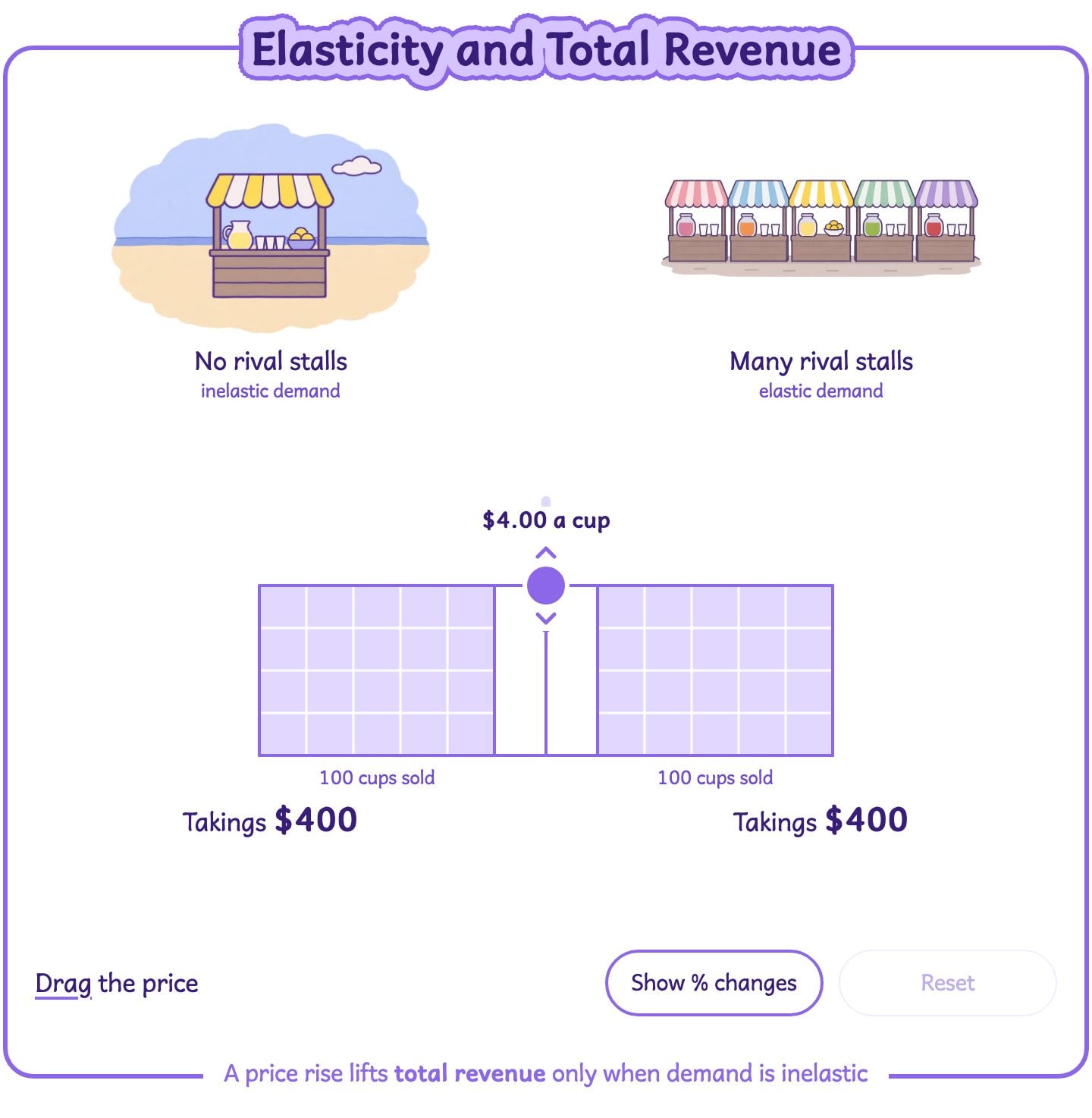
Change the price for elastic and inelastic demand and watch what happens to total revenue.