Place: the route a product takes to the consumer
Definition
Channel of distribution: The route a product takes from the producer to the final consumer, including any intermediaries.
Retailer: A business that buys goods in small quantities and sells them in single units to the final consumer, from a shop or a website.
Wholesaler: A business that buys in bulk from producers, stores the goods and resells them in smaller quantities to retailers.
Breaking bulk: Splitting large deliveries bought from a producer into smaller quantities that small retailers can afford to buy and have room to store.
- Place decides where and how a customer can buy the product, and a good product at a fair price earns nothing if it is not where the customer shops.
- The three channels are producer direct to consumer, producer to retailer to consumer, and producer to wholesaler to retailer to consumer.
- Every intermediary adds a mark-up, so the producer either accepts less per unit or the consumer pays more, and the producer's share of the shelf price falls as the channel gets longer.
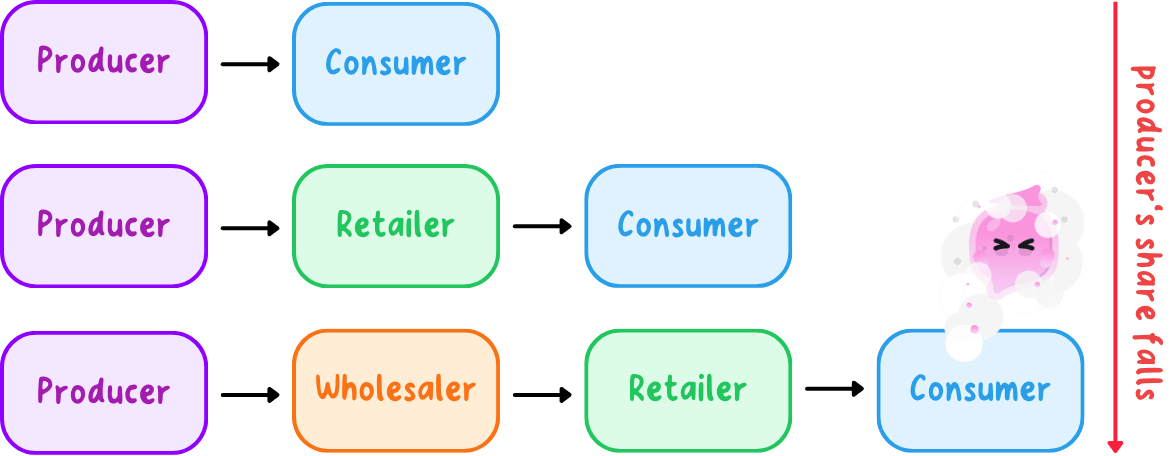
Direct to consumer: the highest margin and the smallest reach
- The producer sells straight to the consumer from a farm shop, a market stall, a factory outlet or its own website, which is the shortest of the three routes and so the quickest way for goods to reach the buyer.
- Profit per unit is highest, because a farm selling a vegetable box at £12 online keeps all £12 where a supermarket might have paid it £7.
- Control over price, display and packaging stays with the producer, which is why Apple sells through its own stores rather than let a retailer discount its products.
- Against that, it pays for storage, packing, delivery and returns itself, and much of that cost is fixed, so cost per unit is high at low volumes.
- Reach is limited to customers who will travel, all the stock risk stays with the producer, and posting a single £1.20 loaf would cost more than the loaf.
Through a retailer: wide coverage in exchange for bargaining power
- The retailer holds stock where shoppers already are, splits deliveries into single units, displays the product and handles payment and returns.
- One negotiation buys wide coverage, so a single contract with Tesco puts a product into more than 4,000 stores, which is why fast-moving branded goods take this route.
- The channel is also short enough for perishable goods to reach the shelf while they are still in date.
- The main disadvantage is the bargaining power of large retailers, which demand lower prices or longer credit and can threaten to delist the product.
- Retailers also stock cheaper own-label rivals on the same shelf, taking sales from the producer supplying them.
- Delivering to many small retailers separately raises transport cost per unit, and the producer loses direct contact with the consumer.
Through a wholesaler: the longest route and the lowest price per unit
- The wholesaler exists because producers sell in enormous quantities while small retailers buy in tiny ones.
- Breaking bulk lets a corner shop buy a box of 50 chocolate bars instead of a pallet of 10,000 it could neither afford nor store.
- It also stores the goods, sells to small shops on credit and reaches scattered outlets, so one delivery replaces hundreds of small drops.
- Transport and administration costs fall, and one wholesaler paying £20,000 on time is easier to manage than 400 shops each owing £50.
- The cost is two mark-ups, so the producer receives the lowest price per unit of the three channels.
- On a snack bar selling at £0.60 the retailer may have paid £0.40 and the wholesaler £0.30, so the producer takes half the shelf price.
- Control is lost, because the producer cannot stop a wholesaler supplying a shop that discounts the product or displays it badly.
- The extra stage is slow, ruling the channel out for fresh food and for fashion that must reach shops while the trend lasts, but it suits cheap everyday goods that need to be on sale in many small outlets.
Common Mistake
- Removing the wholesaler does not automatically save money, because the producer then pays for the storage, the small deliveries and the credit risk itself.
- The producer gains only if its own cost of doing those jobs is lower than the margin the wholesaler was taking.
Factors that decide which channel suits a product
- Perishability: fresh food and cut flowers lose value within days, so every extra stage eats into shelf life.
- Value and technical content: a £3,000 watch or a machine needing demonstration can carry the cost of direct selling, while a £0.60 bar cannot.
- Fragility and bulk: glass and furniture are damaged or costly to move each time they are handled, so fewer stages means less breakage.
- Spread of customers: buyers scattered across rural areas or other countries are reached more cheaply through wholesalers than through the producer's own vans.
- Size and finances: a start-up with £5,000 of capital cannot fund warehouses and a sales force, so intermediaries are its only realistic route.
Example
- Cadbury sends its chocolate bars through wholesalers and retailers, because a bar selling at under £1 could never carry the cost of being posted to one customer.
- The same firm sells gift boxes direct from its own website, where the order is large enough to be worth packing and delivering.
- One producer can therefore use two channels at once, chosen by what each product is worth.
Recommending and justifying a channel
- Start from the product itself, because its physical nature rules channels out before cost or preference is even considered.
- A dairy supplying fresh milk should sell producer to retailer, since the milk is out of date within days and a wholesaler stage would use up shelf life the retailer needs.
- Supermarket bargaining power is the price of that coverage, but reaching enough customers before the milk spoils matters more to a dairy than a higher price per litre.
- Objectives and finance settle the rest, because market share points to the longest channel while a high margin and a controlled brand point to selling direct, and a firm without capital for vans and warehouses has no direct option at all.
Exam technique
- When the command word is recommend, a tour of all three channels is not an answer, so finish with one named channel and the feature of that product that decided it.
- Saying a channel is cheaper is never enough on its own here: say cheaper for whom, and which cost has gone, the producer's own delivery and storage or an intermediary's mark-up.
Self review
- Name the three distribution channels on the syllabus, in order of length.
- State two jobs a wholesaler does that a producer would otherwise do itself.
- Give one reason a producer of fresh cream would avoid a wholesaler.
- Explain why selling direct raises profit per unit yet can still lower total profit.