Short-term cash-flow problems: four routes out
- A cash-flow problem is a shortage of cash to pay bills as they fall due, and it can hit a business whose order book and profit are both healthy.
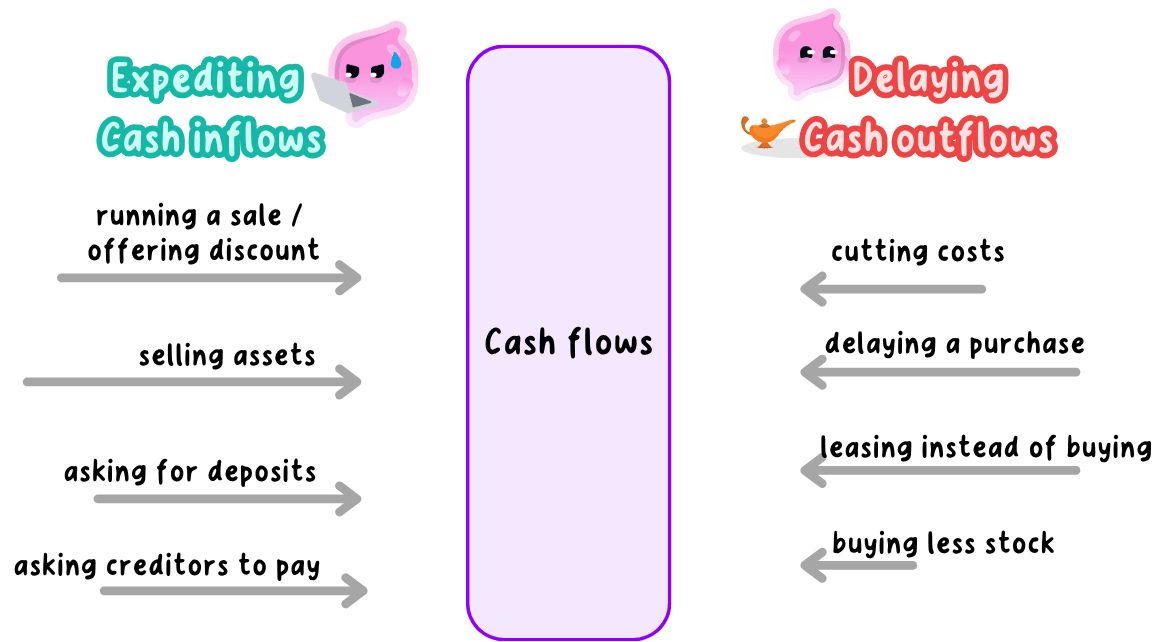
- Every remedy does one of four things: brings cash in sooner, pushes cash out later, turns an asset the firm already owns into cash, or borrows to bridge the weeks in between.
- A short-term problem is a timing gap of a month or two, and it is treated differently from a business that pays out more than it collects every single month.
- Each remedy has a price, so the point to learn is the fix and what it costs the business.
Getting cash in sooner
Definition
Debtor: A customer who has received goods or services but has not yet paid for them, so the money is owed to the business rather than held as cash.
- Chasing debtors with statements, reminders and phone calls turns a 60-day payer into a 30-day payer and pulls thousands of pounds forward by weeks.
- Pressed too hard, a good customer takes its orders to a competitor with easier terms, so the cash arrives and the sales leave.
- Offering a discount for early settlement, such as 2% off an invoice paid within 10 days, speeds payment but hands over £200 on a £10,000 invoice.
- Tightening credit terms for new customers, or asking for a deposit with the order, means the business is funding less of its customers' trading.
- Debt factoring sells the unpaid invoices to a finance company that pays most of the value at once and collects the debt itself.
- The factor keeps a percentage of every invoice, so the business trades part of its revenue for immediate cash and customers now deal with a debt collector.
Example
- Imagine company ABC has an unpaid invoice of £10,000. The company then decides to sell it to a factoring company called XYZ.
- XYZ advances ABC £9,000 immediately (90% of the value).
- XYZ later collects the full payment from ABC's customer and sends XYZ the remaining £1,000 but subtracts their fee (for example, £200).
- So, in the end ABC collected £9,800 and XYZ earned £200).
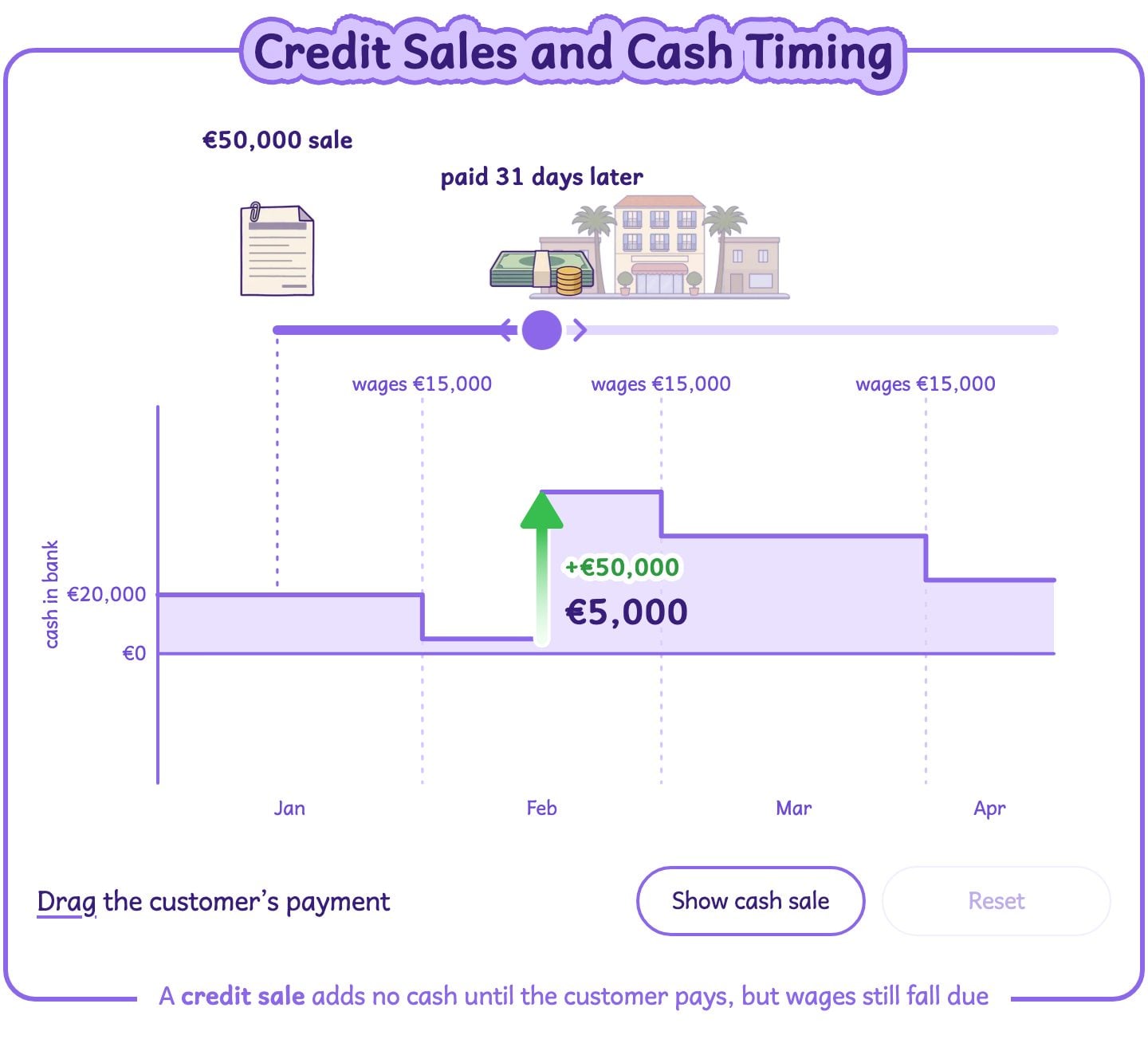
Compare cash and credit sales and see no cash arrives until the customer pays, though wages fall due.
Sending cash out later
- Delaying payments to suppliers is the quickest way to keep cash in the bank, because an invoice paid on day 60 rather than day 30 leaves the money working for another month.
- Suppliers lose patience, withdraw the credit period and insist on cash on delivery, which makes the next month far worse and can stop production altogether.
- Reducing inventories releases cash, because a shop that orders smaller quantities more often has less money sitting on its shelves.
- Hold too little and the business runs out of inventories during a rush, loses sales and gives up the discounts that come with bulk orders.
- Cutting or postponing spending works too, so a delivery van bought in June rather than March keeps £18,000 in the bank through the difficult months.
- Postponed maintenance and cancelled advertising cost the business later, since older equipment breaks down and sales fall when promotion stops.
Example
- Tesco takes cash from shoppers at the till the moment goods are sold, but pays many of its suppliers weeks later, so cash arrives well before it leaves.
- A small food producer selling to Tesco has the opposite problem, because it buys ingredients and pays wages long before the supermarket settles the invoice.
- The same trade can produce comfortable cash flow for one firm and a monthly crisis for the other.
Raising cash from assets the business owns
- Selling unused machinery, spare vehicles or surplus land converts an idle asset into cash within weeks.
- The asset has gone, so if trade recovers the business has to buy or hire a replacement at a higher price.
- Sale and leaseback means selling an asset the firm still needs, such as its warehouse, to a finance company and renting it straight back.
- The lump sum arrives at once and the business keeps using the building, but it now pays rent forever and gains nothing if the property rises in value.
Common Mistake
- Do not describe these remedies as ways of making more profit, because a 2% early-payment discount and a factor's fee both come straight out of what the business keeps.
- Selling an asset raises cash once and cannot be repeated, so it bridges a timing gap but does nothing for a firm that pays out more than it collects every month.
- Sale and leaseback is not free money either, because the rent becomes a new outflow in every future month's forecast.
Borrowing to bridge the gap
Definition
Overdraft: An arrangement with a bank that lets a business take out more money than it has in its account, up to an agreed limit, with interest charged only on the amount used.
- An overdraft is flexible because interest is charged only on the amount actually used and only for the days it is used.
- The interest rate is higher than on a loan, and the bank can withdraw the facility or demand repayment at short notice, which is when a struggling firm can least afford it.
- A short-term loan gives a fixed sum at a lower rate, which suits a shortage the owner can size and date in advance.
- Interest is paid on the whole sum for the whole period even in the months the money is not needed, and the repayments are extra outflows in later months.
- The owners can also put more of their own money in, which costs no interest but ties up their savings in a business that is already short of cash.
- Borrowing buys time rather than fixing anything, so a firm at its overdraft limit every month has a trading problem that only higher inflows or lower outflows will cure.
Exam technique
- Answering a cash-flow question with 'increase profit' or 'sell more' misses the point, because extra sales usually need inventories and wages paid out before any cash comes back.
- Watch the timescale in the case study, because an overdraft answers a one-month gap while a five-year loan does not.
Self review
- Name three ways of bringing cash in more quickly.
- What is the drawback of delaying payment to suppliers?
- How does debt factoring raise cash, and what does it cost?
- Why does an overdraft suit a one-month shortage better than a long-term loan?
- What does a business give up in a sale and leaseback deal?