Cash-flow forecast: a month-by-month plan for the bank balance
Definition
Cash-flow forecast: A table setting out the cash a business expects to receive and to pay out in each future month, and the bank balance it expects to be left with.
- It is built from expected sales, the credit terms agreed with customers and suppliers, and bills whose dates are already known.
- It records cash only, so a credit sale appears in the month the customer actually pays, not the month the goods were delivered.
- A start-up builds one from planned prices and quantities, while an established firm starts from last year's figures and adjusts for expected changes.
- It is a prediction of the future, not a record of the past, and it never shows profit.
Why the forecast matters
- It shows in advance which month the balance turns negative, so the owner can arrange an overdraft while there is still time to negotiate rather than borrowing in a panic at a higher rate.
- Banks and investors expect to see one before lending, especially to a start-up with no trading record to judge.
- It lets managers time large purchases, so a £4,000 machine is bought in a month when cash is strong instead of a month when wages are already tight.
- Comparing the actual figures with the forecast each month reveals problems early, such as customers taking 60 days to pay when the forecast assumed 30.
- Every figure is an estimate, so a forecast built on optimistic sales or on credit terms customers do not keep gives false comfort.
What a simple forecast looks like
- These are the forecast figures for Bramley Bikes, a bike shop planning the four months from March to June.
| £ | March | April | May | June |
|---|---|---|---|---|
| Inflows | 12,000 | 10,000 | 8,000 | 13,000 |
| Outflows | 9,500 | 14,000 | 11,000 | 10,500 |
| Net cash flow | 2,500 | (4,000) | (3,000) | 2,500 |
| Opening balance | 3,000 | 5,500 | 1,500 | (1,500) |
| Closing balance | 5,500 | 1,500 | (1,500) | 1,000 |
The mechanics: two formulas and a carry-forward
Definition
Net cash flow: The difference between the cash flowing into a business and the cash flowing out of it in a given period.
Opening balance: The amount of cash a business holds at the start of a month, which is the closing balance carried forward from the month before.
Closing balance: The amount of cash a business expects to hold at the end of a month, found by adding the net cash flow to the opening balance.
- The first is net cash flow=total inflows−total outflows\text{net cash flow} = \text{total inflows} - \text{total outflows}net cash flow=total inflows−total outflows, worked out for one month at a time.
- The second is closing balance=opening balance+net cash flow\text{closing balance} = \text{opening balance} + \text{net cash flow}closing balance=opening balance+net cash flow, where a negative net cash flow makes the balance smaller.
- Each month's closing balance is then carried across to become the next month's opening balance, which chains the columns together.
- For Bramley Bikes in March, £12,000−£9,500=£2,500£12{,}000 - £9{,}500 = £2{,}500£12,000−£9,500=£2,500 of net cash flow and £3,000+£2,500=£5,500£3{,}000 + £2{,}500 = £5{,}500£3,000+£2,500=£5,500 to carry into April.
- May is the month that bites, because £8,000−£11,000=−£3,000£8{,}000 - £11{,}000 = -£3{,}000£8,000−£11,000=−£3,000 and £1,500−£3,000=−£1,500£1{,}500 - £3{,}000 = -£1{,}500£1,500−£3,000=−£1,500, so the shop ends May overdrawn.
- Brackets in the table mean a negative figure, which is how accounts usually show them.
Analogy
- The closing balance behaves like the fuel left in the tank at the end of a journey, because whatever is left is exactly what you set off with on the next leg.
- A month that burns more fuel than it takes on leaves less in the tank, so a weak month makes the month after it harder before trading even starts.
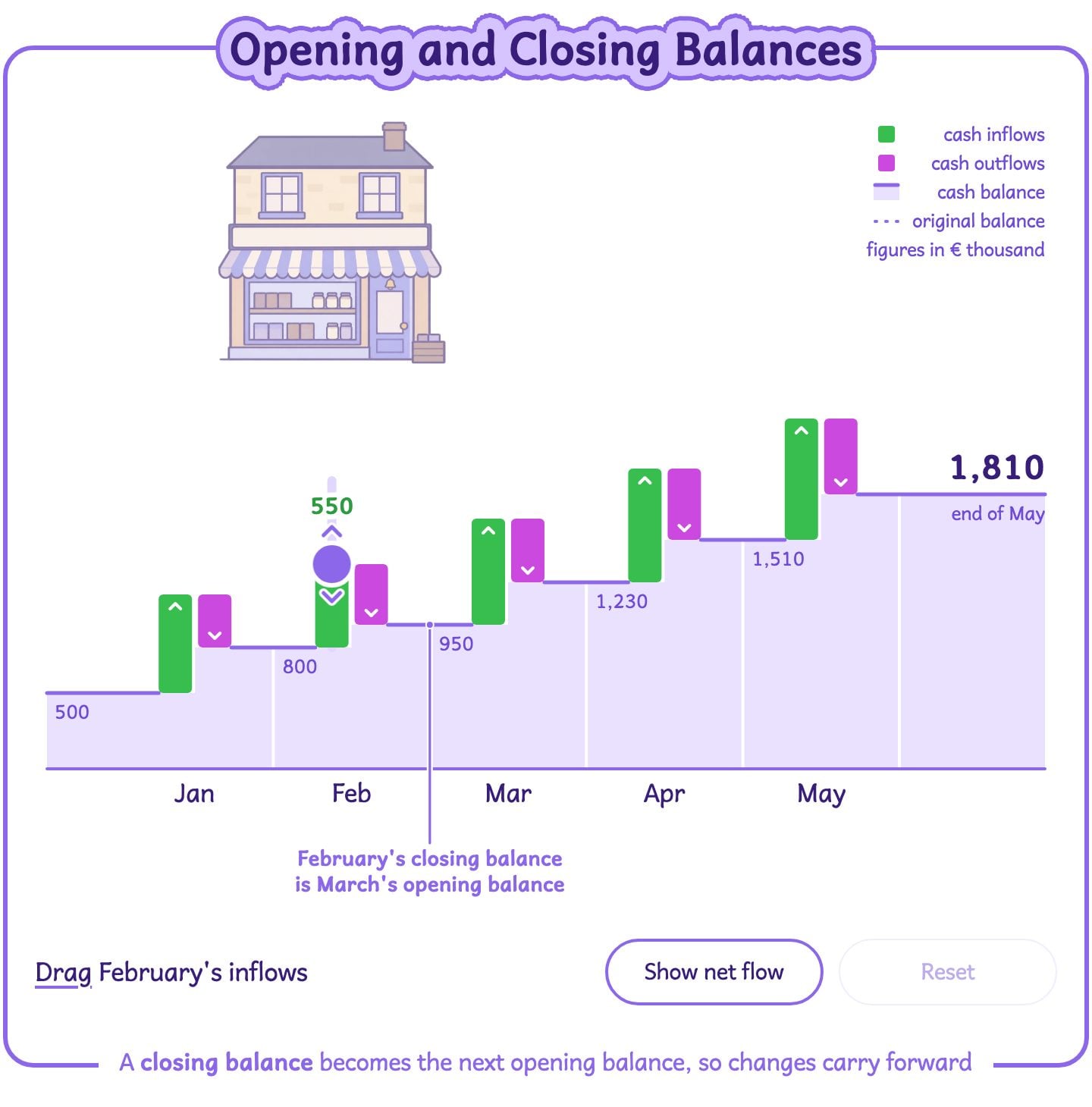
Change one month's cash flow and notice the closing balance becomes the next month's opening balance.
Completing or amending a forecast
- Cambridge asks you to fill in missing cells or to redo a forecast after one figure changes, rather than to build a whole forecast from a blank page.
- If May's outflow cell is blank but net cash flow is given as −£3,000-£3{,}000−£3,000, rearrange the first formula: outflows=£8,000−(−£3,000)=£11,000\text{outflows} = £8{,}000 - (-£3{,}000) = £11{,}000outflows=£8,000−(−£3,000)=£11,000.
- If April's opening balance is blank but the closing balance is £1,500 and net cash flow is −£4,000-£4{,}000−£4,000, then opening=£1,500−(−£4,000)=£5,500\text{opening} = £1{,}500 - (-£4{,}000) = £5{,}500opening=£1,500−(−£4,000)=£5,500.
- Amending works the same way, except that changing one cell changes every column to its right.
- Suppose the owner delays the £4,000 machine from April to June, so April outflows fall to £10,000 and net cash flow becomes £10,000−£10,000=£0£10{,}000 - £10{,}000 = £0£10,000−£10,000=£0, leaving a closing balance of £5,500.
- May now opens at £5,500 and closes at £5,500−£3,000=£2,500£5{,}500 - £3{,}000 = £2{,}500£5,500−£3,000=£2,500, so the negative month has gone.
- June outflows rise to £14,500, giving net cash flow of £13,000−£14,500=−£1,500£13{,}000 - £14{,}500 = -£1{,}500£13,000−£14,500=−£1,500 and a closing balance of £2,500−£1,500=£1,000£2{,}500 - £1{,}500 = £1{,}000£2,500−£1,500=£1,000.
- June ends on exactly the same £1,000 as before, which shows that delaying a payment moves cash between months but creates none.
Common Mistake
- A negative net cash flow is not a loss, it means more cash left the business than arrived that month.
- One wrong cell feeds into every later column, so check each closing balance before carrying it forward.
- Adding a negative net cash flow to an opening balance makes the balance fall, and dropping the minus sign is the classic slip.
- A negative closing balance is not a sign that you have gone wrong, it is the forecast telling the owner to arrange finance before that month arrives.
Interpreting the forecast
- Read the closing balance row first, because it answers the only question that matters: will there be money in the bank at the end of each month.
- Bramley Bikes needs an agreed overdraft of at least £1,500 before May, and it must arrange it in March or April rather than on the day the balance runs out.
- One negative month surrounded by positive ones is a timing gap, which short-term finance can bridge.
- Negative net cash flow repeated month after month is a trading problem, and borrowing only postpones it because inflows must rise or outflows must fall.
- A balance that stays far above the bills for months is also worth noticing, since idle cash earns almost nothing and could be spent on inventories or equipment.
Self review
- State the formula for net cash flow.
- If the opening balance is £800 and net cash flow is minus £1,200, what is the closing balance?
- Total inflows are £8,000 and net cash flow is minus £3,000, so what were total outflows?
- Why does a credit sale appear in a later month of the forecast than the month of delivery?
- Why does delaying a payment from April to June leave the June closing balance unchanged?