Working capital: the money that funds day-to-day trading
Definition
Working capital: The money a business has available to pay its day-to-day running costs such as wages, suppliers, rent and energy bills.
- It is measured as working capital=current assets−current liabilities\text{working capital} = \text{current assets} - \text{current liabilities}working capital=current assets−current liabilities, using figures taken from the statement of financial position.
- It is a snapshot on one day, unlike cash flow, which is measured over a period of weeks or months.
- It funds the gap between paying for materials and wages now and being paid by customers later, which is why it is sometimes called circulating capital.
- Machinery, vehicles and buildings are not bought out of working capital, because long-term assets are funded by long-term finance such as a loan or share capital.
What counts on each side
Definition
Current assets: Items owned by a business that are cash or are expected to be turned into cash within one year, such as inventory and money owed by debtors.
Current liabilities: Debts a business must repay within one year, such as amounts owed to suppliers, an overdraft and tax due.
- Current assets are cash, trade receivables, which is the money customers owe for goods already delivered, and inventories of materials and finished goods, ranked from the most liquid to the least.
- Current liabilities are the amounts due within a year, mainly trade payables owed to suppliers, an overdraft, tax owed and the next 12 months of loan instalments.
- A florist holding £1,500 of cash, £2,000 owed by wedding customers and £3,500 of inventories has current assets of £1,500+£2,000+£3,500=£7,000£1{,}500 + £2{,}000 + £3{,}500 = £7{,}000£1,500+£2,000+£3,500=£7,000.
- Owing £3,200 to suppliers and £1,300 on its overdraft gives current liabilities of £4,500, so working capital is £7,000−£4,500=£2,500£7{,}000 - £4{,}500 = £2{,}500£7,000−£4,500=£2,500.
Common Mistake
- Working capital is not cash, because most of it is usually tied up in inventories and in customers who have not paid yet.
- It is not the capital used to start the business either, which is a long-term source of finance.
- Take current assets minus current liabilities and never the other way round, or the sign of the answer is wrong.
What too little working capital does to a business
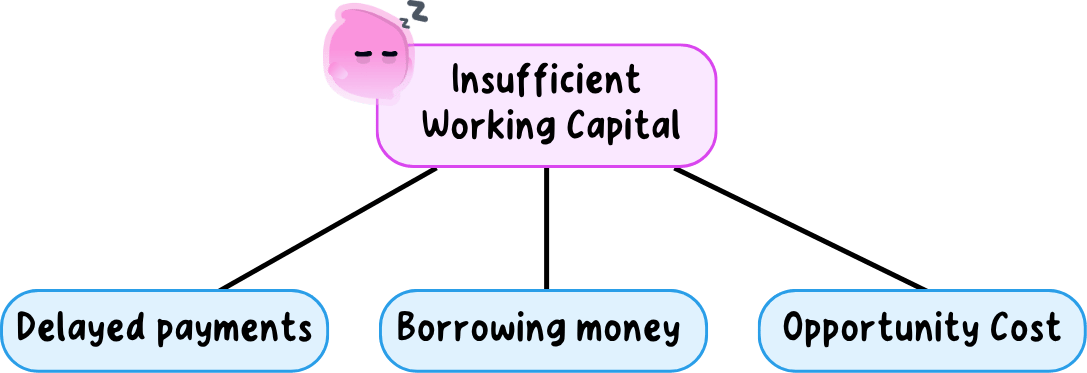
- The bills falling due within the year cannot all be met, so suppliers withdraw their credit terms while wages, rent and tax are paid late.
- The firm is pushed into emergency borrowing at high interest, which raises costs and cuts the profit it does make.
- It cannot take a large order or a bulk discount, because it has no money to buy the materials the order needs.
- A shortage that lasts leads to insolvency, so a business can be closed by its creditors while its order book is still full.
Example
- A supermarket such as Aldi takes cash at the till on the day it sells and pays its suppliers weeks later, so it can trade on very little working capital.
- A housebuilder pays for land, bricks and wages for many months before a single home is sold, so it has to hold a far larger amount to do the same value of trade.
- How much working capital a business needs therefore depends on how long its money stays tied up before customers pay.
What too much working capital costs
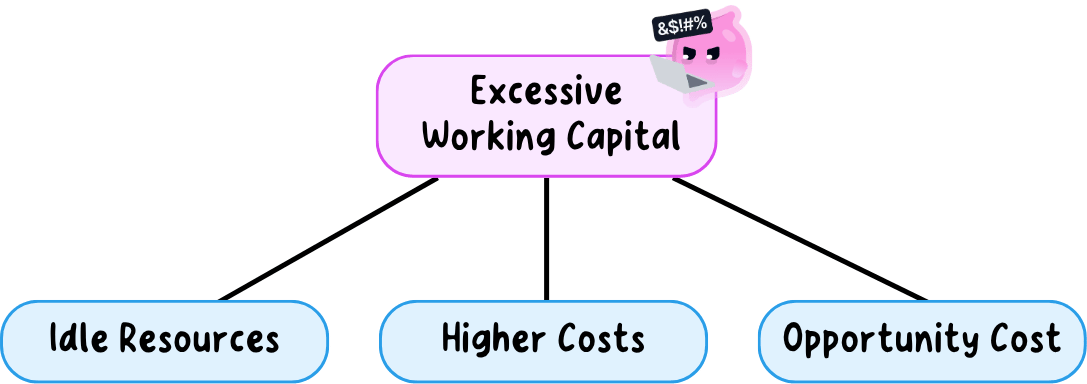
- Cash in a current account earns almost no interest, so money that could have bought a second delivery van or funded a new shop is earning nothing.
- Excess inventories tie up money and risk going out of date, so a clothing retailer holding too much ends up discounting last season's ranges.
- A large trade receivables figure means the business is lending to its customers free of charge, and some of those debts are never paid.
- The target is enough to cover the coming months' bills with a margin for surprises, rather than the largest figure possible.
Common Mistake
- Paying suppliers later improves the cash position but does not improve working capital, because the unpaid bill stays in current liabilities.
- Holding on to £800 owed to a supplier raises cash by £800 and raises current liabilities by £800, so the subtraction gives exactly the same answer as before.
- Only actions that change one side without changing the other, such as selling inventories that have been sitting unsold, move the figure itself.
The working capital cycle
- The working capital cycle is the time between paying for materials and collecting the cash from the customer, so the longer that gap runs the more working capital the firm has to hold.
- Collecting from customers sooner or ordering in smaller quantities moves money round that cycle faster but creates no extra working capital, so a firm whose cycle is permanently too long needs fresh money from the owners or a long-term loan rather than another short-term fix.
Exam technique
- When figures are given, list what belongs in each column before subtracting, because machinery is a long-term asset and does not belong among the current assets.
- Say what the shortage stops the firm doing, such as buying the materials for its next order, rather than writing that it has cash-flow problems.
Self review
- State the formula for working capital.
- Give two examples of current assets and two of current liabilities.
- Current assets are £7,000 and current liabilities are £4,500, so what is working capital?
- Why can a profitable business with too little working capital still fail?
- Give one cost of holding too much working capital.
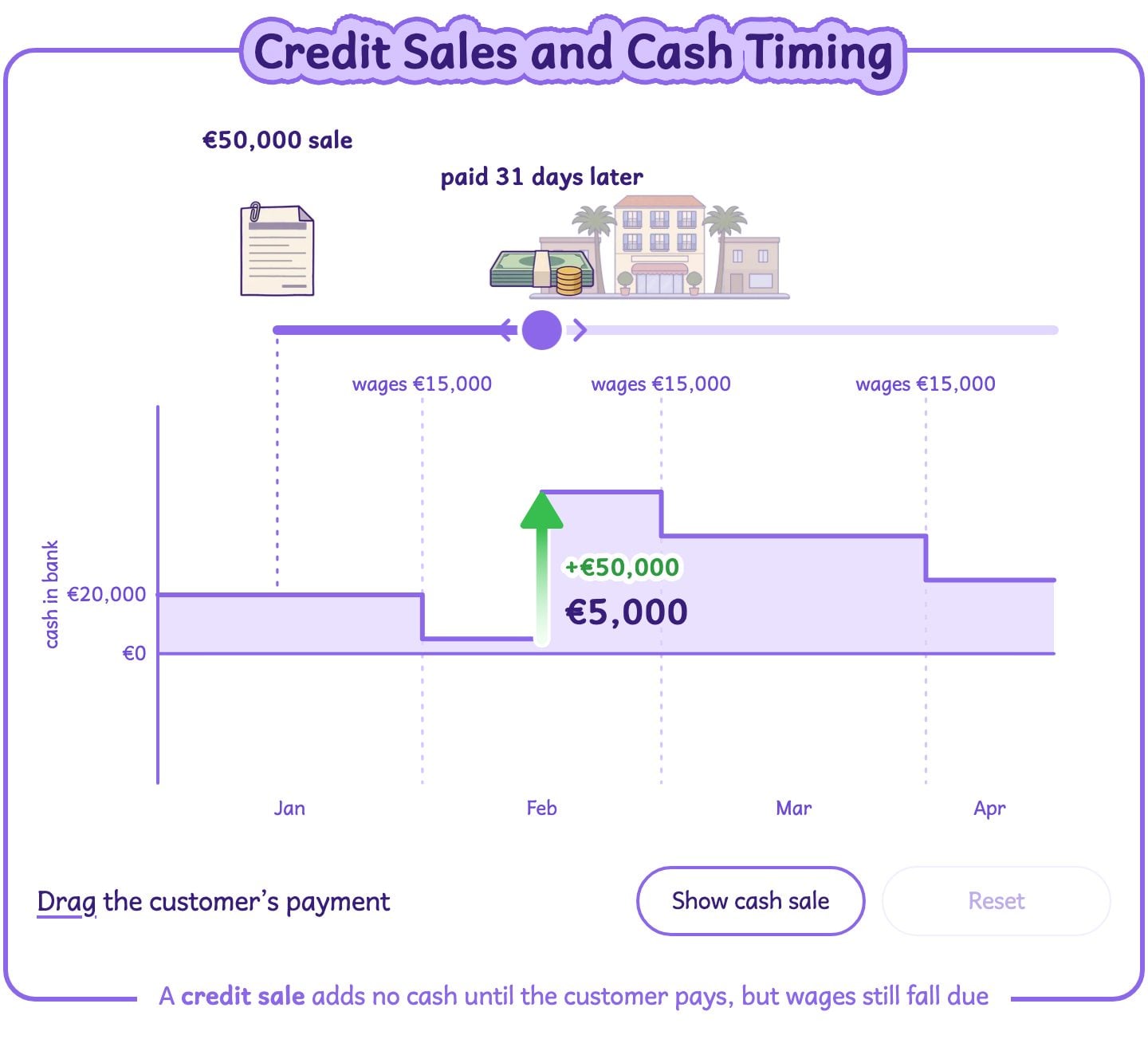
Follow a credit sale through the cycle and see how long cash is tied up before payment.