Lean production: cutting waste of every kind
Definition
Lean production: An approach to making goods and services that cuts waste of every kind, including wasted materials, time, space and effort, while keeping output and quality the same.
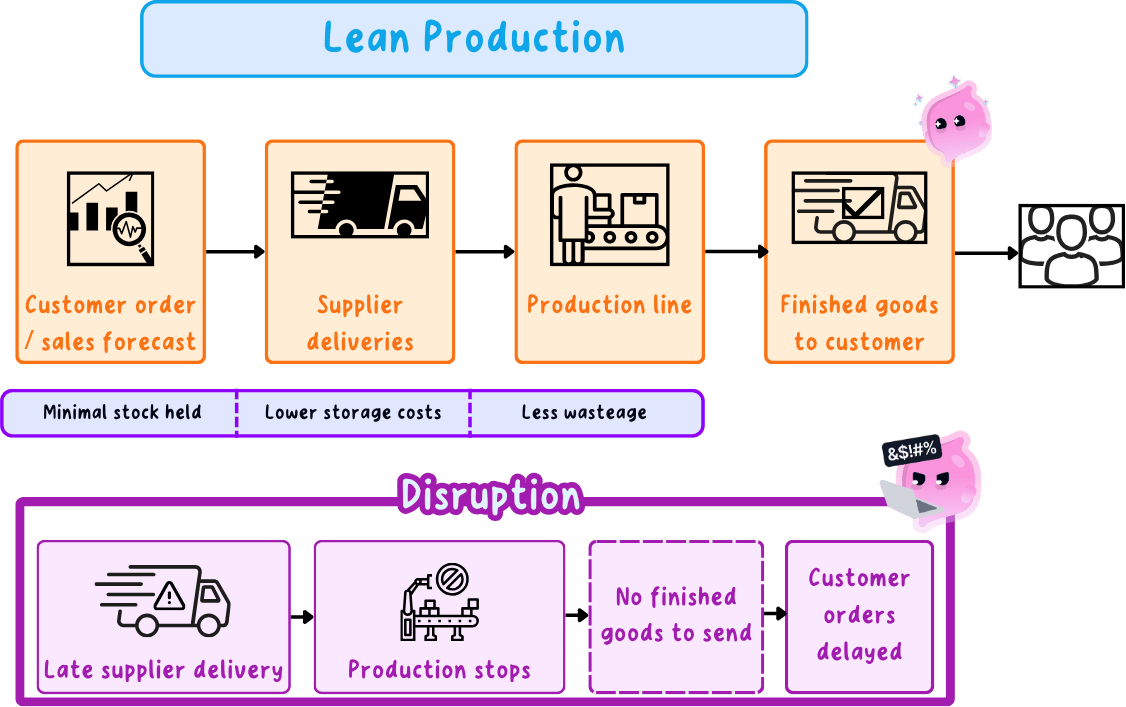
- Waste means anything the business pays for that the customer would not pay extra to have.
- The main kinds are excess inventory, time spent waiting, faulty units that must be remade, unnecessary movement of goods around the site, warehouse space that could be producing, and units made before anyone has ordered them.
- Each of those raises total cost while output stays the same, so unit cost rises and profit per unit falls.
- Lean production is therefore not the same as producing less: the output and the quality are held steady and the resources used to reach them are cut.
- The two methods named on this syllabus are just-in-time inventory control and Kaizen, and a lean business normally runs both together.
Just-in-time inventory control: how it works
Definition
Just-in-time (JIT) inventory control: A method of organising supply so that materials and components arrive from suppliers only as production needs them, so the business holds little or no inventory.
- Instead of ordering a month of materials and storing them, the business schedules small deliveries that arrive on the day, or even the hour, they are needed on the line.
- Finished units then go straight out to the customer rather than into a finished goods store.
- It only works with reliable suppliers close enough to deliver often, accurate demand forecasts, and computer links that tell the supplier what is needed and when.
- Supermarket shelves are run this way, restocked from lorries arriving through the day rather than from weeks of stored goods.
- What the business gains: warehouse rent, heating, insurance and handling wages fall, and the floor space released can be used for production instead.
- Holding less inventory also means less spoilage and less obsolescence, because nothing sits long enough to go off or go out of date.
- Faults are found sooner, since a bad batch goes straight into production rather than being discovered weeks later at the back of a storeroom.
- The exposure this creates: with no buffer inventory, one late delivery, one strike at a supplier or one blocked road can halt the whole line within hours.
- Idle workers still have to be paid and late orders can cost the firm the customer, so the saving on storage can be wiped out by a single failed delivery.
- Frequent small deliveries also cost more in transport per unit and give up the discount that comes with bulk ordering, and a sudden jump in demand cannot be met from inventory the business does not hold.
Common Mistake
- Just-in-time is not risk-free: it removes the safety net at the same time as it removes the cost, and both halves are part of the content.
- One late supplier can halt the line within hours, because there is no buffer inventory to keep production going.
- The method depends entirely on suppliers, so a firm whose supplier is 400 miles away or often late cannot run it safely.
Kaizen: how continuous improvement works
Definition
Kaizen: Continuous improvement, in which employees at every level regularly suggest and try small changes to the way work is done, so that many minor savings build up over time.
- Ideas come from the people doing the job, gathered through suggestion schemes and short team meetings held during the working week.
- Each change is small and cheap, such as moving a tool bench, swapping the order of two tasks or relabelling a shelf, and it is tried out and kept only if it works.
- What the business gains: hundreds of small savings compound into a large fall in unit cost, without the capital spending a new machine would need.
- Problems are solved where they happen, because the operator sees the jam in the machine long before a manager would.
- Being asked for ideas gives workers recognition and responsibility, so absence and labour turnover fall as well.
- It needs a culture in which suggestions are genuinely acted on, because staff stop contributing once they see their ideas ignored.
- Meetings and training also take workers off the job, so the time has to be paid for before the savings arrive.
Example
- Toyota built both just-in-time delivery and Kaizen into its production system, and shop-floor teams are expected to put forward improvements as part of the working week.
- Its plants therefore hold hours rather than weeks of components, which keeps storage costs and unit costs low enough to price competitively.
- The same system left it exposed in 2011, when an earthquake in Japan cut off component suppliers and assembly lines stopped because there were no inventories to fall back on.
Benefits of lean production overall
- Unit costs fall because the same output now carries less wasted material, time and space, which lets the firm cut its price or widen its margin.
- Less cash is tied up in inventories and storage, which improves working capital and reduces the need to borrow.
- Quality improves because faults are found and fixed quickly, so returns and refunds fall and the brand's reputation strengthens.
- Products move through the factory faster, so customers are served sooner and the business can respond to a change in demand within days rather than months.
- Using less material and energy cuts the environmental impact of production as well as the bills, which matters to customers who compare firms on that.
- The costs of getting there are real: suppliers must be reliable, staff must be retrained, and the business runs with almost no slack when something goes wrong.
Exam technique
- Keep the words 'same output, less waste' inside your definition, because lean production is regularly written up as producing less.
- Just-in-time is a way of handling inventory and Kaizen is a way of working, so do not answer a question about one by describing the other.
- Kaizen means many small changes suggested by staff, so an answer about installing a new production line is describing something else entirely.
Self review
- Define lean production in one sentence.
- Name three kinds of waste lean production tries to remove.
- State two conditions a business needs before just-in-time can work.
- Explain what happens to a just-in-time factory when one supplier delivers late.
- Where do Kaizen ideas come from, and why does that make them cheap to obtain?