Efficiency: more output from the same resources
Definition
Efficiency: Making a given output using as few resources as possible, so that the cost of each unit is as low as it can be.
Unit cost: The average cost of making one unit, found by dividing total costs by the number of units produced.
- A business becomes more efficient in one of two ways: it makes the same output using fewer resources, or it makes more output from the resources it already has.
- Whichever route it takes, the result is measured in the same place, the cost of one unit.
Example
- A firm spending £50,000 to make 10,000 units has £50,000÷10,000=£5£50{,}000 \div 10{,}000 = £5£50,000÷10,000=£5 per unit.
- If better organisation lets it make 12,500 units for £55,000, the figure falls to £55,000÷12,500=£4.40£55{,}000 \div 12{,}500 = £4.40£55,000÷12,500=£4.40, so every unit now costs 60p less to produce.
Benefits of increasing efficiency
- Wider profit per unit: if the selling price stays at £7 while unit cost falls from £5 to £4.40, profit on each sale rises from £2 to £2.60 without a single extra customer.
- Room to compete on price: the saving can be passed on instead, which is how Aldi undercuts larger supermarkets and still earns a profit on each item.
- Demand met without extra spending: more output from the existing factory means orders can be filled without buying another machine or renting another site.
- Less waste and fewer faults: materials that are not scrapped and units that do not have to be remade cut costs twice, once on the wasted material and once on the labour used to put it right.
- Faster delivery: shorter production times let a business promise next-day delivery, which wins orders from customers who will not wait a fortnight.
- Pushed too hard, though, an efficiency drive raises workloads and cuts jobs, so motivation falls and absence rises, which takes back part of the saving.
Common Mistake
- Total costs and unit cost do not have to move in the same direction.
- In the worked figures above total costs rose from £50,000 to £55,000, yet the cost of each unit fell from £5 to £4.40 because output rose faster than spending.
- Do not call a business less efficient simply because its total costs went up.
How a business increases efficiency
Definition
Labour productivity: Output per worker over a given period of time.
- Automation and technology: machines work at a constant speed, take no breaks and can run overnight, so output per hour rises and labour cost per unit falls.
- Robots welding car bodies repeat the same weld to the millimetre, so faults and reworking fall as well.
- The cost is the purchase price and the maintenance contract, so the saving only pays back over several years of high output.
- Improved labour skills through training: a trained worker completes a task faster, makes fewer mistakes and can be moved between jobs when a stage falls behind.
- Training costs money and takes staff off the job while it happens, and better-trained workers can be tempted away by rivals.
- Better factory layout: arranging machines in the order of the production sequence cuts the distance part-finished goods travel and the time they queue between stages.
- A kitchen laid out so staff never cross between counter, oven and packing station serves more meals an hour with the same team.
- Motivation: well-motivated staff work faster and more carefully, so job rotation, job enrichment, teamworking and bonus payments all raise output per worker.
- Motivation also cuts absence and labour turnover, so the business spends less on recruiting and training replacements.
Note
- These four methods work together: new machines only raise output if the workers using them are trained and willing.
- Each one costs money up front, so a business short of cash usually starts with layout and motivation rather than automation.
Why businesses hold inventories
Definition
Inventories: The stocks a business holds, made up of raw materials and components, part-finished goods and finished goods waiting to be sold.
Buffer inventory: Extra stock held above normal needs so that production or selling can continue if demand rises unexpectedly or a delivery is late.
- To meet unexpected demand: a spell of hot weather or a large unplanned order can be supplied from inventories, and without them the sale goes to a rival and the customer may not come back.
- To stop production halting if a delivery is late: a buffer of raw materials keeps the line running while a supplier catches up, so workers are not paid to stand idle.
- To buy in bulk at a discount: ordering 10,000 units at a time rather than 1,000 may cut the supplier's price by 5%, which lowers the cost of every unit made.
- To cope with seasonal demand: a toy manufacturer produces steadily all year and stores the output, so it can supply shops through the Christmas rush without buying machinery it would use for six weeks.
- Retailers also hold finished goods simply so customers can take the product away today, since a bare shelf sells nothing.
What holding inventories costs
- Storage: warehouse rent, heating, lighting, security and insurance all have to be paid whether the goods sell or not, along with the wages of the staff who move them.
- Cash tied up: £200,000 of goods sitting in a warehouse is £200,000 that cannot be used to pay wages, buy equipment or settle a supplier's bill.
- If that money was borrowed, the business also pays interest on inventories that are earning nothing.
- Spoilage and damage: food, flowers and medicines pass their date, and goods are broken or stolen in storage, so the money spent on them is lost entirely.
- Obsolescence: a phone or a fashion line goes out of date while it is stored, so the inventories left have to be sold at a discount that may not even cover their cost.
- Every business therefore sets the level of inventories it holds by balancing the cost of running out against the cost of holding too much.
Exam technique
- Storage costs and cash tied up are two different drawbacks, so keep them apart: rent and insurance are money the business spends, while cash tied up is money it already holds but cannot use for anything else.
- Inventories are not only raw materials, so check what the business in the case actually holds, because a shop holds finished goods while a factory holds materials, part-finished work and finished units.
Self review
- Work out the unit cost when total costs are £36,000 and output is 9,000 units.
- Give two benefits a business gains from becoming more efficient.
- Explain how a better factory layout raises output per worker.
- State four reasons a business holds inventories.
- Why is obsolescence a bigger risk for a phone retailer than for a builders' merchant?
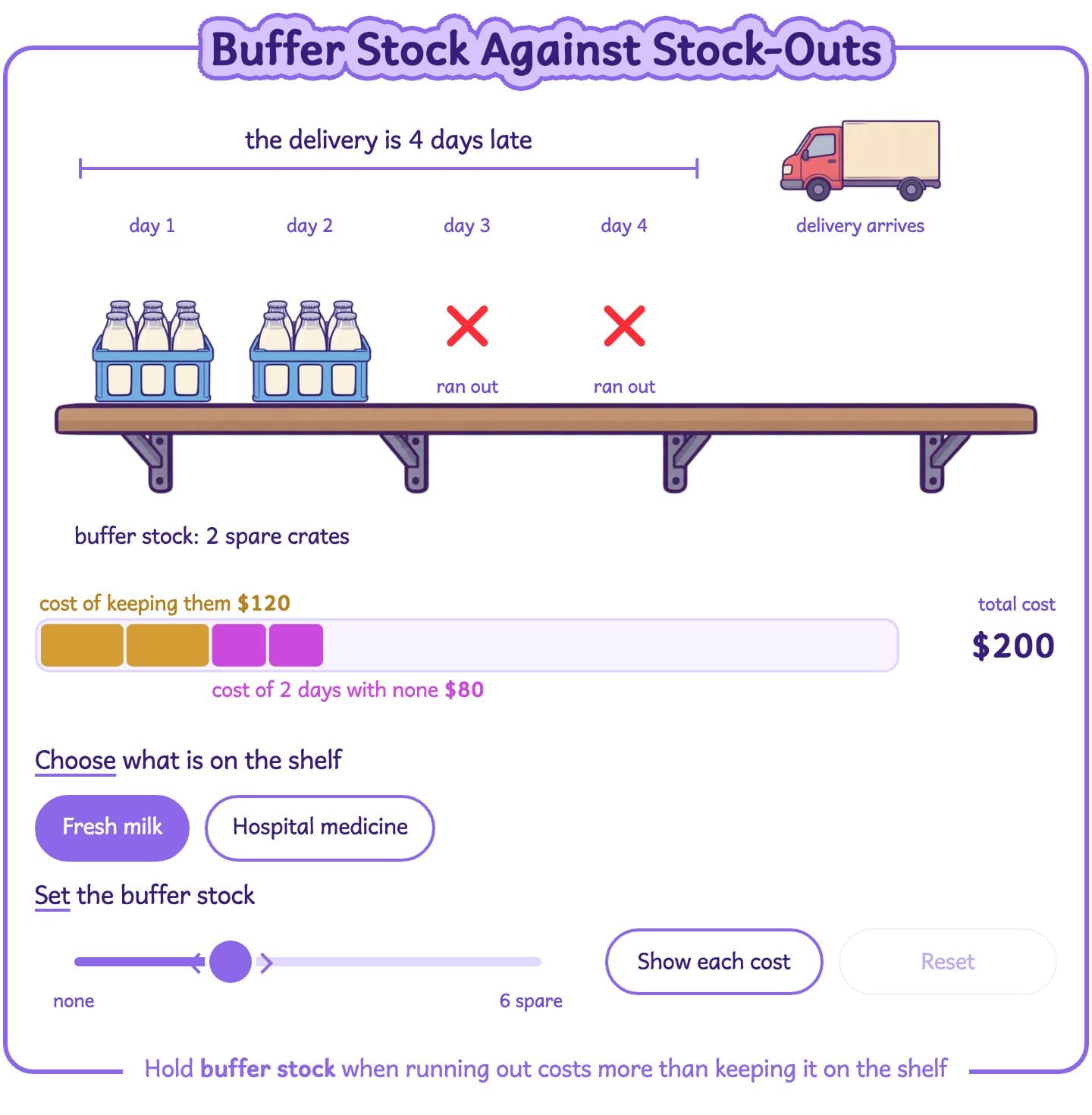
Adjust the buffer stock and weigh the cost of holding it against the cost of running out.