Three ways of organising production
- The three methods are job, batch and flow production, and the choice between them comes down to two questions: how many identical units the business needs to make, and how much variety its customers expect.
- As output volume rises the method changes and unit cost falls, but the flexibility to give each customer something different is given up in exchange.
- One firm often uses more than one method: a car plant runs a flow line for standard models and job production for a custom paint finish.
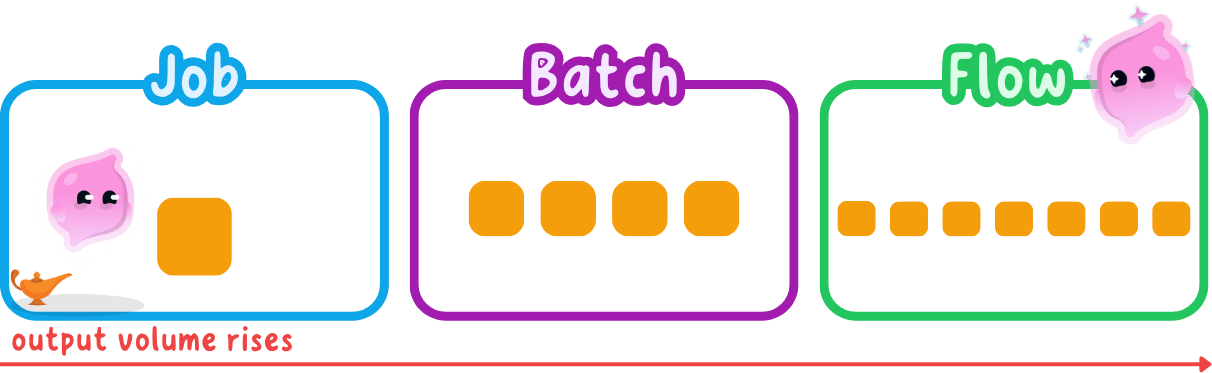
Job production
Definition
Job production: Making one item at a time, finished to the individual customer's own requirements before the next is started.
- Features: one item is completed at a time to a specification the customer has set, usually by skilled workers using general purpose tools rather than dedicated machinery.
- Wedding cakes, tailored suits, fitted kitchens, ships and a haircut are all produced this way.
- Benefits: the product matches exactly what the customer asked for, so a high price can be charged and margins are wide even on small volumes.
- The design can be changed part way through, the work is varied so skilled staff stay motivated, and start-up costs are low enough for a one-person business.
- Limitations: unit costs are high because skilled labour is expensive, materials are bought in small quantities at full price and there are no economies of scale.
- Production is slow, lead times are long, and the business depends on a few skilled workers who are hard to replace if they leave.
Example
- Rolls-Royce builds each car against an individual order, so a buyer can choose paint, leather and details that appear on no other vehicle.
- Hand finishing by skilled staff replaces a fast line, so output is counted in thousands a year while a mass manufacturer counts millions.
- The price recovers that cost, which is the condition job production depends on: customers must be willing to pay for something made for them alone.
Batch production
Definition
Batch production: Making a group of identical items together, with the whole group completing one stage before it moves on to the next and before a different batch is started.
- Features: a group of identical units passes through each stage together, and the machines are cleaned and reset before the next, different batch begins.
- A Greggs bakery might make 300 white loaves, reset, then make 300 wholemeal, and paint, tinned soup and clothing sizes work the same way.
- Benefits: the business keeps a range of varieties while buying materials in larger quantities, so unit costs sit well below job production.
- Batch sizes can be raised or cut to follow demand, and workers can specialise on one stage, which raises output per worker.
- Limitations: machines earn nothing during changeover, and the cleaning and resetting time between batches is paid for but produces nothing.
- Part-finished and finished batches have to be stored, which ties up cash, and one error in the settings can spoil an entire batch rather than a single item.
Common Mistake
- Do not decide the method from the type of product, because the same good can be made all three ways.
- A cake is job production when it is made for one wedding, batch production when a bakery bakes 300 of the same kind, and flow production in a factory running identical cakes all day.
Flow production
Definition
Flow production: Making large numbers of identical items continuously, with each unit moving along a production line from one stage to the next without stopping.
- Features: identical units move continuously along a line, each worker or machine performing one small task, and the line can run around the clock where demand allows.
- Cars, canned drinks and newspapers are made this way, and the process is capital-intensive rather than labour-intensive.
- Benefits: unit costs are the lowest of the three because huge volumes spread the fixed cost of the line thinly and materials are bought at bulk discounts.
- Quality is highly consistent, output is fast and predictable, and few workers are needed, so labour cost per unit is small.
- Limitations: the line costs millions to install, which most firms cannot finance, and it only pays for itself if demand stays high for years.
- A breakdown at one point stops everything, the product cannot be varied for individual customers, and the repetitive work lowers motivation and raises labour turnover.
- Reading the three side by side: as volume rises the skill demanded of the workforce falls and the cost of setting up rises, so job production uses skilled craft workers and very little equipment, batch production uses semi-skilled workers and machinery that has to be reset between runs, and flow production uses workers who mind machines on a line that costs millions to build.
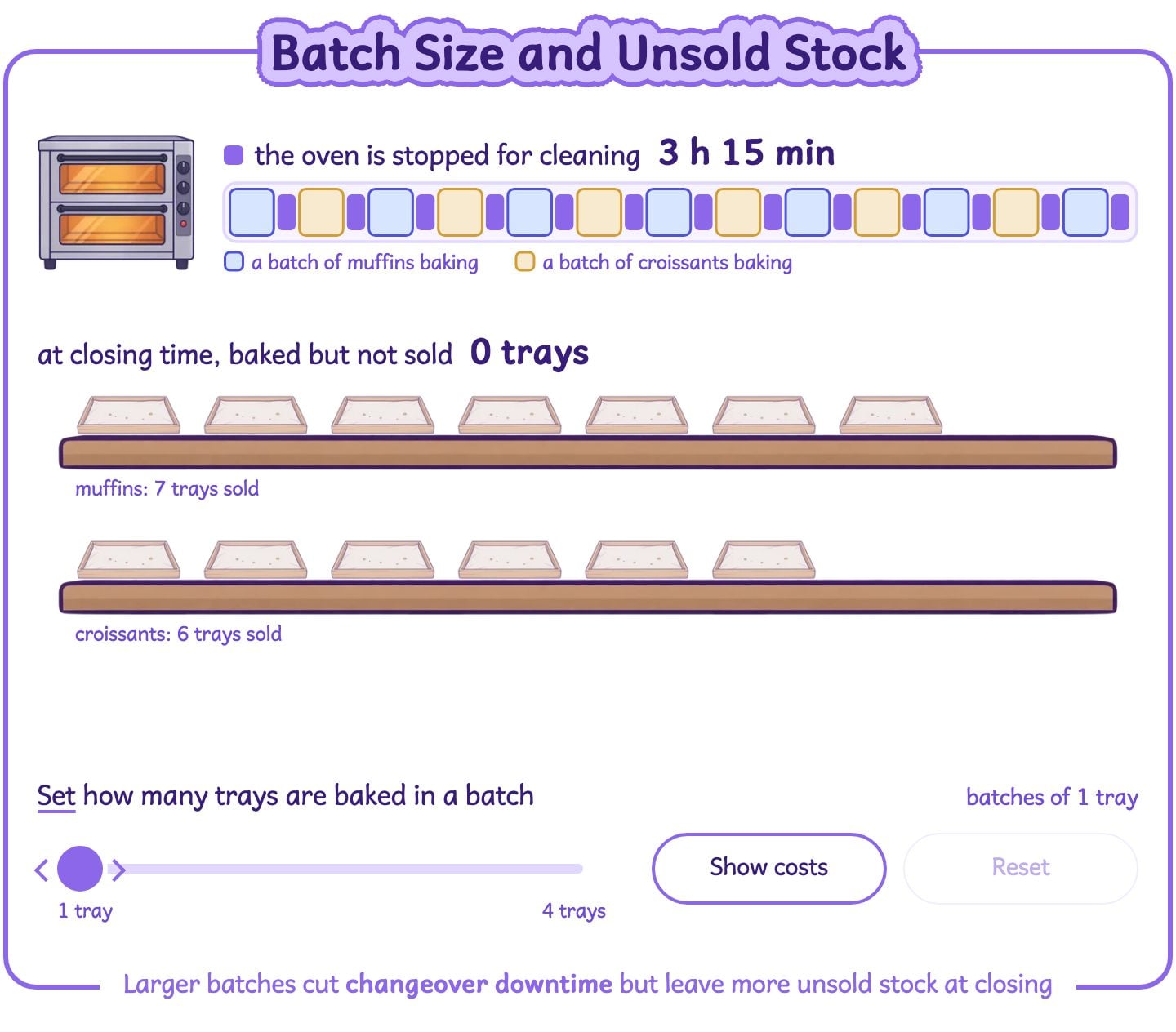
Increase the batch size and see changeover downtime fall while unsold stock at the end rises.
Recommending a method for a given situation
- Size and steadiness of demand: tens of thousands of identical units ordered every month point to flow, while a handful of individual orders point to job.
- Finance available: a business that cannot raise the capital for a line has no realistic choice beyond job or batch, whatever the unit cost figures suggest.
- What customers are buying: where the selling point is that each item is different, flow production would destroy the very thing customers pay for.
- Applied judgement: a bakery selling 300 loaves a day across four varieties should use batch production, because a flow line needs a volume it will never reach and job production would push the cost of a loaf above the £1.50 its customers will pay.
- The same firm may move from job to batch to flow as demand grows, so the right answer depends on the stage the business has reached rather than on the method alone.
Exam technique
- Count the identical units in the case before naming a method, because volume and variety are the only clues that separate the three.
- Do not recommend flow production simply because unit costs are lowest, since the set-up cost is the reason most businesses cannot use it.
- Batch is not 'a mixture of the other two', so describe it properly as identical items moving through each stage together with a reset in between.
- Justify the recommendation with a figure from the case, such as the order size or the price customers pay, rather than a general preference.
Self review
- Define batch production and give one example of it.
- Why is unit cost higher in job production than in flow production?
- Give one limitation of flow production that has nothing to do with cost.
- What happens to output and cost during a changeover between batches?
- Which method would you recommend to a firm building one racing yacht a year, and why?