Human needs: the ladder Maslow described
Definition
Hierarchy of needs: Maslow's model that arranges human needs into five levels, from physiological needs at the base to self-actualisation at the top, where each level must be largely met before the one above it motivates.
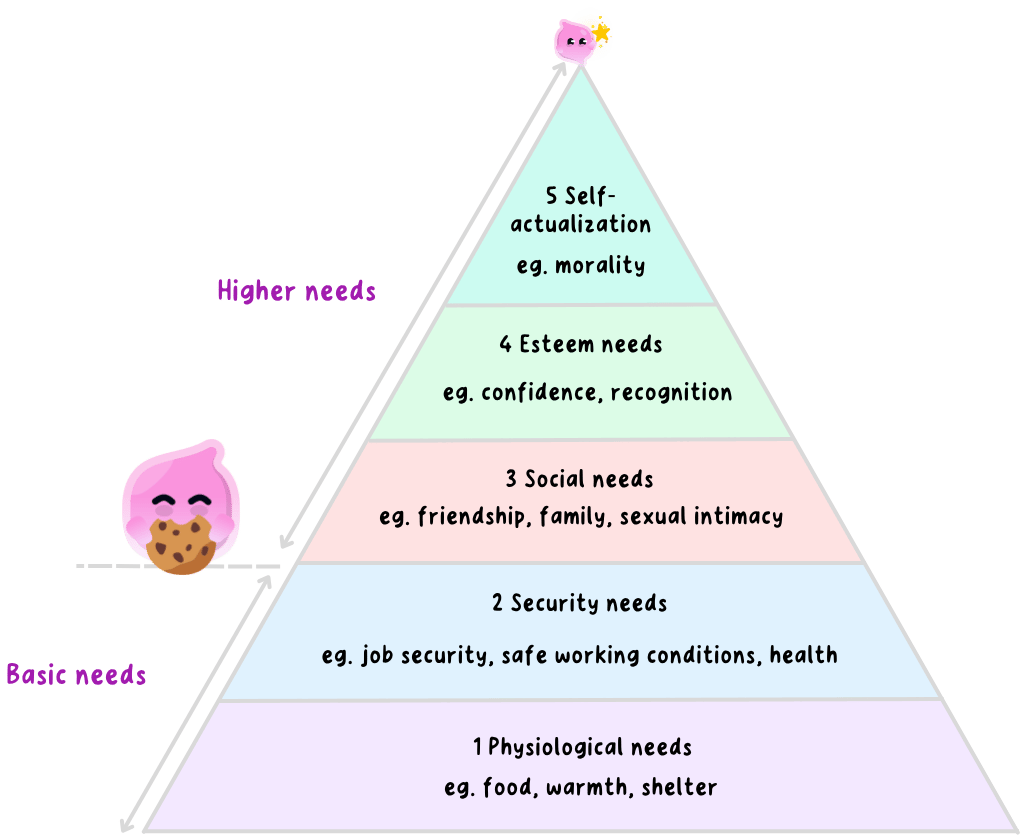
- Abraham Maslow argued that human needs do not all press on a person at once but arrive in a fixed order, which he set out as five levels usually drawn as a pyramid.
- The levels run from physiological needs at the base through safety, social and esteem needs to self-actualisation at the top.
- The central rule is that a level must be largely satisfied before the level above it starts to motivate, so a worker worried about the rent is not moved by the offer of a smarter job title.
- The partner rule is that a need already met stops driving behaviour, so more of something staff already have buys no extra effort.
- Motivating someone therefore means finding the lowest level that is still unmet and working on that level, not the one the manager finds easiest to give.
Analogy
- The hierarchy works like a set of stairs, because a worker only notices the next step once both feet are firmly on the one below.
- Take the lower step away, for example by announcing redundancies, and the worker drops back down whatever was on offer higher up.
Physiological and safety needs: the basics and a secure job
- Physiological needs: food, water, warmth, rest and shelter, met at work by a wage that covers rent and bills, by rest breaks and by hours that leave time to sleep.
- If pay falls short the worker takes a second job, arrives exhausted and makes mistakes, so the employer loses output and quality at once.
- Once pay comfortably covers the basics another £10 a week adds very little willingness to work, which is what Maslow means by a satisfied level.
- Safety needs: protection from physical harm and confidence that the income will still be there next month.
- A business meets them with guards on machinery, protective equipment and safety training, and with permanent contracts, sick pay and a pension scheme.
- Insecurity is costly, since staff expecting redundancy spend working time applying elsewhere and stop suggesting improvements that will not save their jobs.
Social and esteem needs: belonging, then recognition
- Social needs: friendship, company and acceptance, met by organising work into teams, daily briefings, a shared break area and pairing new starters with a mentor.
- A worker who feels part of the group will cover a shift or stay to finish an order, while isolated single-person stations block the level and give nobody a reason to stay.
- Esteem needs: respect from other people and self-respect, earned through achievement and status.
- A business meets them with praise, promotion, job titles and real responsibility such as putting one worker in charge of the stock count, all of which cost far less than a pay rise.
- The level is blocked when a manager takes the credit for a team's work, and the experienced worker responds by keeping good ideas to themselves.
Example
- A new recruit at a Tesco distribution centre cares most about the hourly rate and whether the forklifts around him are driven safely, which are the bottom two levels.
- Five years later, on a permanent contract and settled in a team, the same worker is chasing a team leader title and the chance to train others, which sits at the esteem level.
Self-actualisation: using the whole of a person's ability
Definition
Self-actualisation: The top level of Maslow's hierarchy, reached when an employee is using their abilities to the full and achieving everything they are capable of.
- A business reaches this level by handing over demanding projects, paying for professional qualifications and letting people decide the method rather than dictating it, as Netflix does with experienced staff.
- It is the hardest level to supply, because many jobs have fixed tasks and a checkout operator cannot be given creative control over scanning shopping.
- Maslow argued it is never permanently satisfied, so unlike the lower levels it can keep motivating indefinitely.
- Ignoring it is how firms lose their best people, because a capable employee with nothing left to learn leaves for a competitor offering the same pay and a harder job.
Limitations: the hierarchy is hard to apply to a real workforce
- People do not climb in the same order, since an entrepreneur will give up a secure salary and risk the mortgage to build a business, putting achievement above safety.
- There is no way to measure which level an employee has reached, so a manager is guessing and may spend on the wrong reward.
- Money refuses to sit in one level, because a pay rise buys food, buys security and signals status to colleagues all at once.
- Some workplaces cannot reach the upper levels at all, because a call centre script leaves no room for creative freedom whatever the manager wants.
Exam technique
- Get the five levels in the right order, because an answer that puts esteem below social contradicts itself as soon as it explains which need comes first.
- Self-actualisation does not mean being happy at work, so keep it for being stretched to the limit of your ability.
Self review
- List Maslow's five levels in order from the base upwards.
- Give one action a business can take at each of the safety and esteem levels.
- Explain why a satisfied need stops motivating an employee.
- Why does announcing redundancies weaken the effect of a new training scheme?
- State three limitations of the hierarchy of needs.