Labour productivity: more output from the same workers
Definition
Labour productivity: Output per worker over a given period of time.
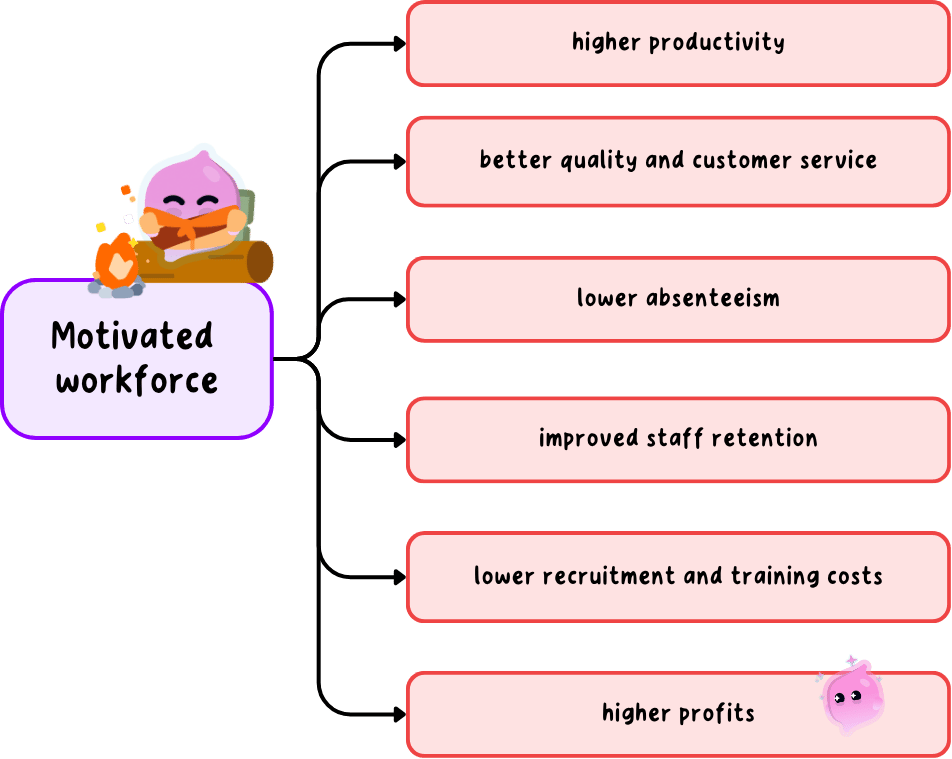
- Motivated workers waste less of the shift, so more units leave the line for the same hours paid and the same number of employees.
- Take a bakery where 20 staff produce 4,000 loaves a day, so labour productivity=4,000÷20=200\text{labour productivity} = 4{,}000 \div 20 = 200labour productivity=4,000÷20=200 loaves per worker.
- If motivation lifts output to 4,400 loaves with the same 20 staff, productivity rises to 220 loaves per worker without a single extra hire.
- The wage bill has not moved, so with a daily wage cost of £1,600 the labour cost per loaf falls from £1,600÷4,000=£0.40\pounds1{,}600 \div 4{,}000 = \pounds0.40£1,600÷4,000=£0.40 to £1,600÷4,400=£0.36\pounds1{,}600 \div 4{,}400 = \pounds0.36£1,600÷4,400=£0.36.
- That saving of nearly 4p on every loaf either widens the profit margin at the current price or allows a price cut to win sales from a rival.
- The same effect works in reverse, because a demotivated team that stretches a two-hour job into three forces the business to pay overtime or hire extra staff to meet the same orders.
Absenteeism: paying for workers who are not there
Definition
Absenteeism: The proportion of working days lost because employees are away from work when they were due to be there.
- A worker who dreads the shift takes every borderline sick day, while a worker who feels needed by the team comes in, so motivation shows up directly in the attendance figures.
- Absence is paid for twice, once in sick pay and again in cover, and agency staff normally cost several pounds an hour more than the missing employee's own wage.
- Cover is rarely as good as the missing worker, since an agency picker who does not know the warehouse layout is slower and picks the wrong items, so orders go out late or wrong.
- Absence also spreads, because the staff who do turn up carry the extra workload, resent it and become more likely to take a day off themselves.
- In production one missing worker can halt the whole line, because every later stage of a Toyota-style assembly line waits, so output falls by far more than that worker's own share.
Common Mistake
- Absenteeism means staff missing a shift they are still employed for, while labour turnover means staff leaving the business altogether.
- The two costs differ: absence is paid for in cover and lost output, while leaving is paid for in recruitment and training.
Labour turnover: keeping the staff you have already trained
Definition
Labour turnover: The proportion of a business's employees who leave and have to be replaced over a year.
- Motivated staff have less reason to look elsewhere, so fewer of them resign and the business keeps the people it has already paid to train.
- Every leaver triggers advertising, managers' time spent shortlisting and interviewing, and induction and training for the new starter, which can add up to roughly £1,500 for one shop assistant.
- A new starter also works below full speed for weeks and needs an experienced colleague beside them, so the firm loses output from two workers at once.
- Experience leaves with the person, including knowledge of which machine jams and which supplier delivers late, and none of it is written down.
- High turnover also discourages training, because a manager who expects a worker to leave within six months will not spend £800 on a course for them, which locks the firm into a low-skill workforce.
- Customers notice too, since a hairdresser whose familiar stylist has gone loses the personal relationship that brought repeat business.
Example
- A café employing 10 staff that loses four of them in a year has to recruit and train four replacements.
- At roughly £1,500 each that is £6,000 a year spent standing still, before counting the output lost while newcomers learn the job.
- Halving the number of leavers frees £3,000, which is enough to fund the training or the pay rise that keeps the rest.
Quality, service and easier recruitment
- A worker who takes pride in the job checks their own output, so faults are caught at the workstation rather than by an inspector at the end, which cuts wasted material and reworking.
- In a service business the worker is the product, so a motivated Greggs assistant who clears the queue quickly and gets the order right decides whether the customer returns tomorrow, and repeat custom costs nothing to win.
- A reputation as a good employer spreads through friends and online reviews, so more people apply for each vacancy and the firm can pick the best candidate instead of paying an agency fee to fill the job.
Exam technique
- Higher output is not the same as higher productivity, since hiring more workers raises output while leaving output per worker unchanged.
- Use the attendance or turnover figures the business actually gives you rather than writing about motivated workforces in general.
Self review
- Define labour productivity and explain how it is calculated.
- What is the difference between absenteeism and labour turnover?
- Explain the chain from higher productivity to a wider profit margin.
- State three costs a business faces each time an employee resigns.
- Why does absence by one worker often cost more than that worker's own daily output?