Taylor: money as the main motivator
Definition
Scientific management: Taylor's approach of studying and timing a job to find the quickest method, training every worker to use it and paying them according to what they produce.
- Frederick Winslow Taylor was an American engineer who studied factory work and concluded that workers were producing far less than they could.
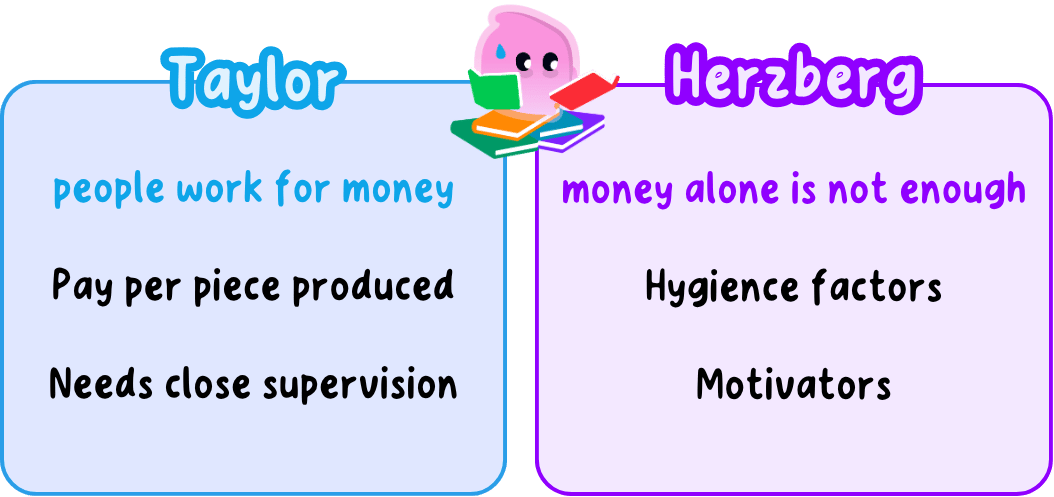
- His central assumption is that employees work for money and for nothing else, so effort will rise only if earnings rise with output.
- His method starts by observing and timing every movement in a job to find the single quickest way of doing it, then training every worker to use that one method.
- The job is broken into small repeated tasks, which shortens training and lets a new starter be productive within hours.
- Managers plan and set the standards while workers carry them out, so thinking and doing are separated.
- Pay is then attached directly to output through a piece rate, and close supervision checks that the standard method is being followed.
Definition
Piece rate: A wage paid for each unit a worker produces rather than for the hours they spend at work.
Piece rate and what the business gains
- The system only works where output can be counted, so it fits packing, picking and fruit harvesting but not nursing, teaching or answering customer emails.
- Output per worker rises quickly, training becomes cheap because a task of a few movements can be taught in a morning, and standard times let a factory promise a delivery date.
Example
- Suppose a packing firm pays £1.60 a crate, so a worker filling 55 crates earns 55×£1.60=£8855 \times £1.60 = £8855×£1.60=£88 while one filling 70 earns 70×£1.60=£11270 \times £1.60 = £11270×£1.60=£112.
- That extra £24 is the reward Taylor relies on, and the firm's labour cost stays fixed at £1.60 a crate however fast anyone works, which makes costing an order simple.
Criticisms of Taylor: what the stopwatch leaves out
- It treats people as machines, so the boredom of repeating one movement all day is ignored, and bored workers make mistakes, take days off and eventually leave.
- It assumes money is the only reason for working, which cannot explain why a well-paid packer leaves for a job with more variety at the same wage.
- Because managers set the method and workers only follow it, the knowledge of the person actually doing the job is thrown away and improvements are missed.
- Quality suffers, because a worker paid per crate has every reason to rush and none to check, so the firm pays for rejects and for the inspectors who find them.
Example
- A McDonald's kitchen is Taylor's method in practice, with a fixed sequence for assembling each product and a standard time for every stage.
- A new crew member is productive on the first day, which keeps costs low, but the same design gives crew almost no say over their work, which is why turnover in fast food is high.
Herzberg: two separate lists rather than one scale
- Frederick Herzberg asked professional workers to describe times when they had felt exceptionally good about their jobs and times when they had felt exceptionally bad.
- The two lists contained different things, so he argued that satisfaction and dissatisfaction have separate causes rather than sitting at opposite ends of one scale.
- The opposite of dissatisfaction is therefore no dissatisfaction rather than motivation, which is why the model is called the two-factor theory.
Definition
Hygiene factors: Herzberg's term for the things surrounding a job, such as pay, conditions, supervision and company rules, which cause dissatisfaction when they are poor but do not motivate when they are good.
Hygiene factors: removing the reasons to be unhappy
- The list includes pay, working conditions, company rules, the quality of supervision, relationships with colleagues and job security, all of which surround the job rather than form part of it.
- Get them wrong and workers are actively dissatisfied, so absence rises and people resign over a cold canteen or an unfair rota.
- Put them right and the complaints stop, but nothing has been added to the reason for working hard, so a 5% pay rise lifts the mood for a few weeks and then becomes the normal wage.
- Herzberg still insists these are dealt with first, because a worker angry about an unsafe machine will not care about being offered more responsibility.
Definition
Motivators: Herzberg's term for the things inside the job itself, such as achievement, recognition, responsibility and advancement, which create real satisfaction and drive.
Motivators: building drive into the work itself
- The list includes achievement, recognition for that achievement, the interest of the work, responsibility, advancement and personal growth.
- These come from the content of the job, so unlike a pay rise they do not become the new normal, because finishing one demanding project does not remove the appetite for the next.
- Herzberg's practical answer is job enrichment, meaning the worker is given a complete piece of work, the authority to decide how to do it and direct feedback on the result.
- A car technician who diagnoses a fault, orders the parts, does the repair and signs it off has an enriched job, while one who only removes wheels all day does not.
Common Mistake
- Pay sits on opposite sides of the two theories, since it is Taylor's main motivator but only a hygiene factor for Herzberg.
- Keep the two lists apart by remembering that hygiene factors surround the job while motivators are inside it.
Criticisms of Herzberg: the evidence came from one kind of worker
- His evidence came from professional workers on comfortable salaries, so the finding that pay does not motivate may not hold for someone struggling to cover the rent.
- The method invites bias, because people naturally take the credit for good times and blame the employer for bad ones, which alone could produce two separate lists.
- Job enrichment is slow and expensive, because workers need training before they can take on the wider job and output can dip while they learn.
- Not every worker wants it, since some see extra responsibility as extra work for the same pay, and jobs such as collecting trolleys offer little achievement however the tasks are arranged.
Exam technique
- Piece rate is not a bonus, since piece rate pays for every single unit while a bonus is a lump sum for reaching a target.
- Do not dismiss Taylor as out of date, because timed tasks and pay by results still run warehouses, packhouses and fast food kitchens.
Self review
- State the three main steps of Taylor's scientific management.
- A worker is paid £1.60 a crate and packs 65 crates, so what does the worker earn?
- Give two criticisms of paying workers by piece rate.
- Name three hygiene factors and three motivators.
- Explain why, according to Herzberg, a pay rise fails to cure boredom.