Segmentation: one market, several kinds of customer
Definition
Market segmentation: Dividing a market into groups of customers who share similar characteristics and needs, so that each group can be sold to separately.
- Each group produced by this process is a market segment, meaning customers who tend to react in the same way to the same product, price and advertising.
- A segment is always a group of people, never a group of products, so bath towels are not a segment while households with young children are.
- Segmentation works because customers buying the same type of product often want very different versions of it, so a family with young children, a student backpacker and a retired couple are all buying holidays but want almost nothing in common.
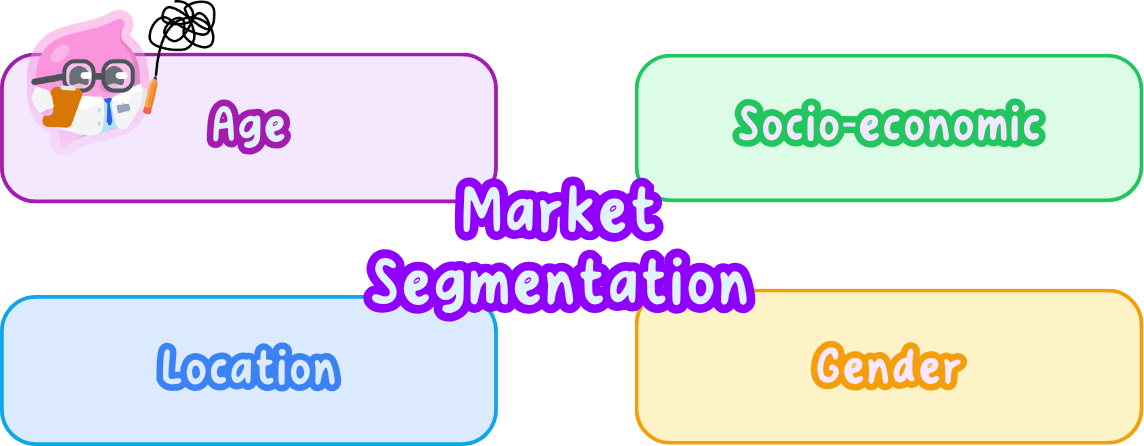
- The main bases used to divide a market are age, socio-economic grouping, location and gender, and most businesses combine two or three of them at once.
Example
- A supermarket cereal aisle is segmented two ways at once: bright boxes with cartoon characters at child height are aimed at children, which is age.
- A £0.75 own-label bag sitting next to £4 granola separates the same shoppers by what they can afford.
Age: different products for different life stages
- Segmenting by age sorts customers into bands such as young children, teenagers, families and the over-60s, and it works because what people need changes as their circumstances change.
- Lego sells sets graded by age on the box, from large bricks for toddlers to detailed adult kits, while McDonald's aims the Happy Meal at young children by including a toy.
- Age also decides where the promotion goes, because a business targeting teenagers advertises on social media while one targeting pensioners uses newspapers and daytime television.
- The buyer is not always the user, so toy adverts appeal to children while the packaging reassures the parents who pay.
Common Mistake
- Do not write that segmenting a market means selling to fewer people, because the business is not shrinking the market it sells to.
- It is splitting the same market into groups so that the product, the price and the advert fit each group closely, which normally raises total sales rather than lowering them.
- One business can serve several segments at once, as a supermarket does by putting a value range and a premium range on the same shelf.
Socio-economic grouping: what customers can afford
Definition
Socio-economic grouping: Dividing customers by income together with occupation and social position, from professional and managerial workers down to unskilled workers and those on state benefits.
- Retailers use this base inside a single shop by stocking tiers of the same product, so Tesco sells a value range, a standard range and a Finest range with their own packaging and price points.
- Whole businesses are built on one group, such as Aldi and Lidl on value-seeking shoppers, or Rolex on the wealthiest.
- Occupation and education are used alongside income because they shape tastes as well as budgets, so two households earning the same amount can buy very differently.
- The base also decides where a product is sold, because a luxury brand refuses discount stores to protect how customers see it.
Location: where customers live changes what they need
- Segmenting by location divides customers by country or region, or by whether they live in a city, a town or the countryside.
- Climate, culture and local habits change what sells, which is why McDonald's offers different menu items in India, Japan and the United Kingdom.
- Within one country the split is often urban against rural, so a chain opens small convenience stores in busy streets and large stores with car parks on the edge of town.
- It is the base small businesses use most, because a local plumber or hairdresser can only serve customers within a short travelling distance.
Gender: separate ranges for men and women
- Segmenting by gender means designing, packaging and advertising separate versions of a product for men and for women.
- Clothing and footwear are the clearest case because sizing and fit genuinely differ, so Nike runs whole separate ranges, while razors and deodorants are split by colour, scent and packaging rather than by what the product does.
- Gender also decides where the advertising is placed, because media audiences differ and the firm wants its message in front of the group it is aiming at.
- Many businesses have moved towards unisex ranges, because customers object when a near-identical product costs more in the version aimed at women.
Exam technique
- Naming the base without describing the group throws away half the answer, so write segmenting by age, targeting customers aged over 60, rather than just by age.
- Vague groups such as everyone or people who like nice things are no use, because they cannot be turned into a product, a price or a place to advertise.
- A definition of market segmentation needs both halves: dividing the market into groups, and those customers sharing similar characteristics or needs.
Self review
- What is market segmentation?
- Name four bases on which a market can be segmented.
- How does socio-economic grouping differ from using income alone?
- Give one example of a product segmented by location.
- Why is the buyer of a product not always the person it is aimed at?