Mass and niche markets: two ways to aim a product
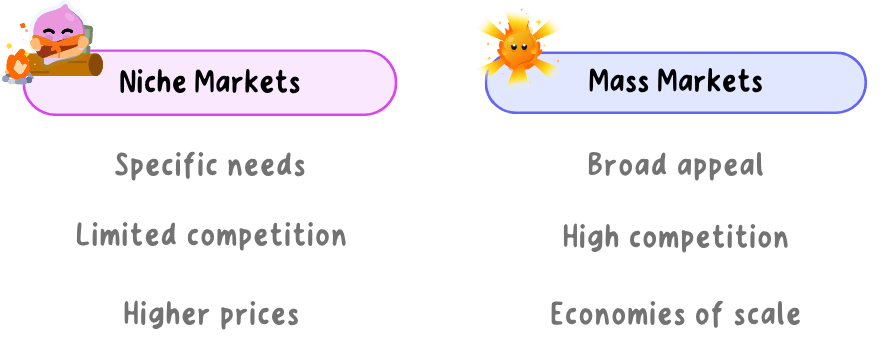
- Mass marketing sells one standardised product to as many customers as possible, so it lives on volume and low unit costs.
- Niche marketing tailors a product tightly to one small group, so it lives on a high profit per unit rather than on numbers sold.
- A niche sits inside a larger market rather than being a separate one, so mainstream trainers serve the mass footwear market while specialist climbing shoes serve a niche within it.
- The car market shows both at once, because Toyota builds standard models in huge numbers while Rolls-Royce builds a few thousand cars a year for very wealthy buyers.
Benefits of mass marketing: volume drives the unit cost down
Definition
Mass market: A large market in which a standardised product is aimed at most types of customer and sold in high volumes.
- The number of potential customers is enormous, so total revenue can be very large even when the profit on each unit is only a few pence.
- Economies of scale: producing on a larger scale cuts the average cost per unit through bulk-buying discounts, specialist machinery and fixed costs spread over more output.
- Factory rent of £200,000 a year spread over 100,000 units adds £2 to each unit, but spread over 1,000,000 units it adds only £0.20, which lets the firm cut its price or widen its margin.
- Risk is spread across a huge customer base, so losing a few thousand buyers barely affects a business selling to millions.
- Standardising simplifies production and builds wide brand recognition, so the machinery needed and the range of inventories held both stay simple, and a new product is stocked and tried straight away.
Example
- Aldi stocks a far narrower range than a full-size supermarket, so it buys each line in enormous quantities and negotiates lower prices from suppliers.
- Those lower buying costs let it charge less than rivals and still make a profit on each sale, which is mass marketing working as intended.
Limitations of mass marketing: thin margins under constant attack
- Mass markets attract the largest rivals, so the business is under constant pressure on price and can rarely raise its own without losing customers.
- Reaching a whole market is expensive, because national advertising, wide distribution and shelf space are paid for before the sales arrive, and much of the promotion reaches people who will never buy.
- A one-size-fits-all product cannot match anyone's needs exactly, which leaves gaps that niche competitors move into.
- High fixed costs raise the break-even output and retooling a production line takes months, so a mass producer is hurt quickly by a fall in demand and is slow to change.
Benefits of niche marketing: few rivals and a premium price
Definition
Niche market: A small, specialised segment within a larger market, made up of customers with particular needs that mainstream products do not meet.
- Large firms often ignore small segments because the volumes are too low to interest them, which leaves a specialist facing few or no direct rivals.
- Customers whose needs are met exactly will pay a premium price, because no cheaper product does the same job for them, so the profit on each unit is wide.
- Start-up costs are low, since a small production run needs little equipment and promotion can go where that one group already looks, such as a specialist magazine or an online forum.
- That makes a niche the realistic route for a new or small firm, which can enter with limited finance rather than fighting established giants.
- Serving one group closely builds strong loyalty and gives the firm direct contact with its customers, so it hears about changing needs early.
Common Mistake
- Do not assume niche marketing means a small business, because large firms run niche brands as well.
- Rolls-Royce serves a niche while belonging to a large motor group, so judge the approach by how narrow and specialised the target group is, not by the size of the firm.
Limitations of niche marketing: a capped market others can copy
- Total sales are capped by the size of the segment, so once the business supplies most of that group it cannot grow further without changing what it does.
- Low volumes bring few economies of scale, so materials are bought in small quantities at higher prices and each unit costs more to make.
- Suppliers may refuse small orders and retailers are reluctant to give shelf space to a product that sells slowly.
- Depending on one small group is risky, because if its tastes move or incomes fall the business has no other customers to fall back on.
- Success invites attack, since a profitable niche that grows draws in a large firm that copies the product and undercuts it on unit cost, which is what happened to small vegan food specialists once supermarkets launched their own plant-based ranges.
Exam technique
- Do not describe a niche as just a small market, because what defines it is a specialised group with needs that mainstream products do not meet.
- Giving a benefit of one approach and then its mirror image as a drawback of the other is one idea written twice, so make the second point a genuinely different one.
- Check the finance figures in the stimulus first, because a firm with £40,000 of capital cannot fund national distribution however attractive the mass market looks.
Self review
- Define a mass market and a niche market.
- How do economies of scale lower the unit cost of a mass-produced product?
- Give two limitations of mass marketing.
- Why can a niche business charge a premium price?
- Why does success in a niche often attract a larger competitor?