Targeting: choosing which segment to serve
Definition
Target market: The particular segment or segments of customers a business chooses to aim its product and its marketing at.
- Segmentation and targeting are two separate steps, because segmentation divides the market up while targeting picks the groups worth aiming at.
- Once a target market is chosen, every decision about the product, its price, where it is sold and how it is promoted follows from what that group wants.
- A worthwhile segment has to be large enough to be profitable, different enough from other groups to justify its own product, and reachable by promotion the business can afford.
- Targeting does not mean refusing other customers, since it only means the money is spent where it works hardest rather than being spread evenly over everyone.
Meeting needs precisely: better products and higher prices
- A product designed for one group can be built around exactly what that group wants, while a product designed for everyone has to compromise on every feature.
- Customers who find a product that fits their needs exactly are more likely to buy and more willing to pay a higher price, which is how a small bakery aimed at customers who value handmade sourdough charges well above the supermarket price for a loaf.
- Fewer products are left unsold, because the business makes what a known group has been shown to want rather than guessing at an average customer.
- Customers whose needs are met precisely come back and recommend the business, so segmentation feeds directly into customer loyalty and repeat sales.
Focused promotion: less waste for every pound spent
- Knowing who the customer is tells the business where to advertise, while advertising to a whole population wastes most of the budget on people who were never going to buy.
- A lower promotion cost per sale gives the firm either a wider profit margin or the room to charge less than rivals for the same product.
- The message itself can be written for that group, so the wording, images and offers speak to one kind of customer instead of trying to please everyone.
- Distribution improves in the same way, because a firm that knows where its customers shop can stock those outlets instead of paying to be everywhere.
Example
- Spending £4,000 in a local newspaper brings in 100 customers, so the cost of winning each one is £40.
- Spending the same £4,000 on advertising aimed at the chosen segment brings in 500 customers, so the cost per customer falls to £8.
Gaps and loyalty: room the big firms have left empty
- Studying a market segment by segment reveals groups whose needs no existing product meets, and a business entering such a gap faces little competition at first.
- Segmentation lets a small business compete against a much larger one, because it can serve a single group better than a national rival aiming at the average customer.
- Becoming the recognised specialist for one group builds loyalty, since customers keep returning to the supplier who understands what they need.
- Serving several segments with separate ranges spreads risk, which is why Unilever sells budget and premium brands in the same categories and keeps shoppers who trade down in a recession.
Common Mistake
- Do not use segment and niche as though they mean the same thing.
- Every market divides into segments, and a niche is one particular segment small and specialised enough that mainstream firms leave it alone, so a supermarket's value shoppers are a segment but not a niche.
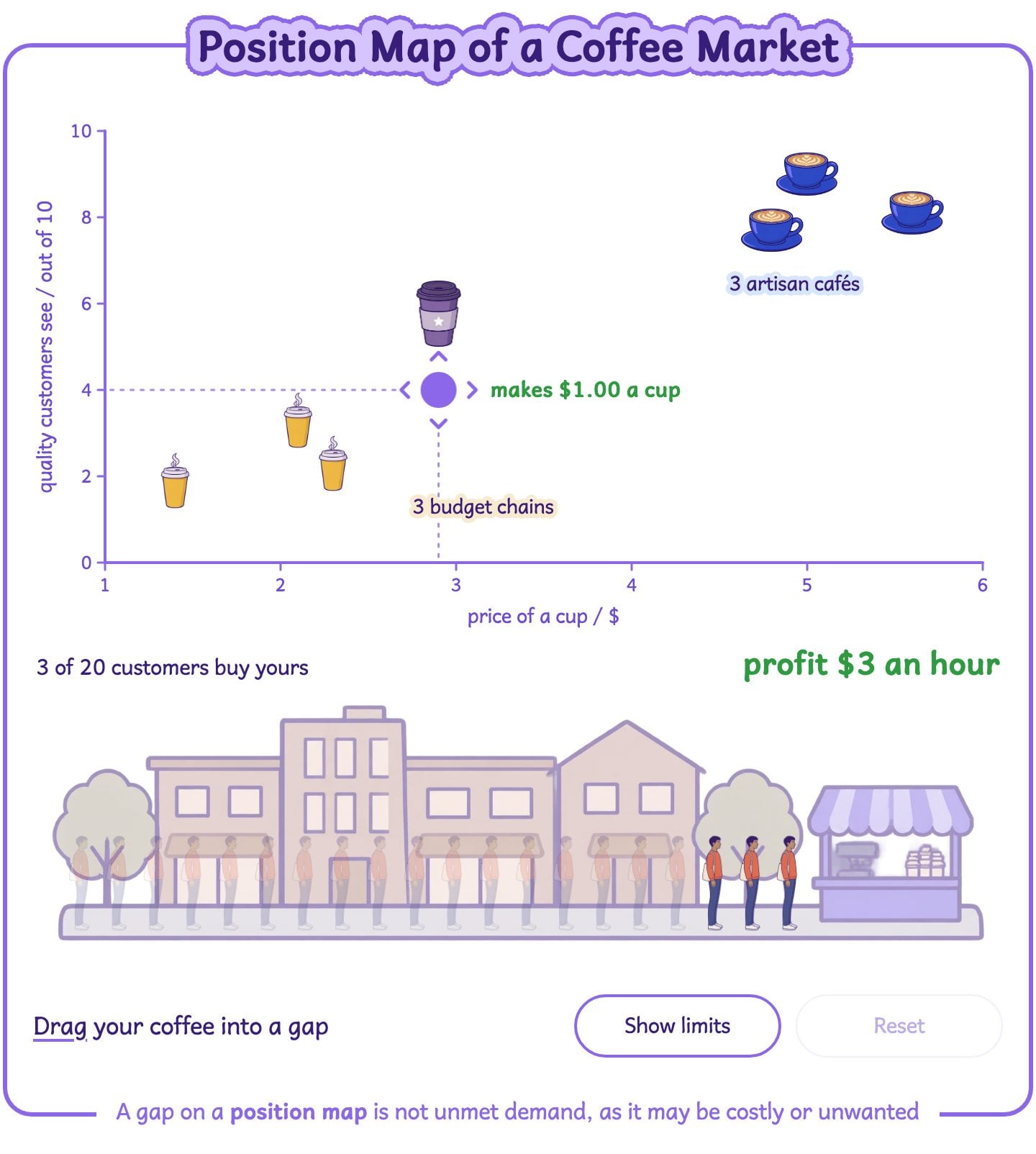
Look for gaps on the market map, then ask whether the gap is costly or customers do not want it.
Recommending a method: matching the base to the business
- The right base is the one that produces groups whose wants genuinely differ, because splitting customers in a way that does not change what they buy adds cost for nothing.
- Match the base to the product before anything else.
- Age suits toys, games and holidays, because what customers want changes sharply at each stage of life.
- Socio-economic grouping suits cars, watches and furniture, because affordability decides which model a customer even considers.
- Location suits restaurants, gyms and trades, because customers will only travel a short distance for them.
- Gender suits clothing and toiletries, where sizing, fit or scent differ between the groups.
- Justify the choice by carrying it through to a decision, so a luxury watchmaker segments by socio-economic group because only high earners can afford £2,000 watches, which tells it to advertise in premium magazines and sell through selected jewellers.
- Check the business can actually reach the group it has identified, because a segment the firm cannot afford to advertise to is of no use to it.
- Set the gain against the cost of finding the segments, because market research takes money and time before a single extra unit is sold, and a start-up with £5,000 of capital may end up guessing instead.
- Count the cost of serving the groups separately too, since a different version for each segment means shorter production runs that give up economies of scale, as well as separate packaging, adverts and inventory lines.
- A small firm with limited finance is usually better served by one clear base it can afford to act on than by a detailed split it cannot supply separate products for.
Exam technique
- The benefit most often written badly is targeted advertising, so say what it saves: fewer people reached who would never buy, which cuts the cost of winning each customer.
- A recommend and justify answer wants one method chosen and defended for the business in front of you, not a tour of every method that exists.
- Naming extra cost as the reason against a method says little on its own, so name which cost rises: market research, separate packaging, or shorter production runs.
Self review
- What is the difference between segmentation and targeting?
- Explain how targeted promotion lowers the cost of winning each customer.
- How does segmentation let a small business compete with a national rival?
- Name two costs a business takes on when it segments a market and serves each group separately.
- Which base of segmentation would you recommend to a new gym, and why?