Globalisation: one market instead of many
Globalisation: The growing movement of goods, services, money, people and ideas between countries, which makes economies increasingly connected and dependent on one another.
- Globalisation shows up inside a business as customers, suppliers, workers and competitors that come from outside the home country.
- Interdependence: economies are linked so closely that a shortage or a shutdown in one country reaches businesses in another within weeks.
- When chip factories in Asia cut output in 2021, car makers in Europe had to pause assembly lines, because a modern car cannot be finished without those components.
- Globalisation is a process rather than an event, so the degree of connection rises or falls as governments, technology and transport costs change.
- Picture every town's high street being knocked through into one enormous shopping street.
- A cafe in Bradford now stands beside a coffee chain from Seattle and a bean supplier from Colombia, so nothing about the cafe changed but the number of doors on its street did.
Reasons for globalisation: what made the world smaller
Containerisation: Moving goods in standard-sized steel boxes that fit lorries, trains and ships without unpacking, which cuts the time and cost of shipping.
Trade barrier: Any government measure that makes it harder or dearer for foreign goods to be sold in a country.
Deregulation: Removing or reducing government rules that restrict who may trade, invest or operate in a market.
- Cheaper and faster transport: bigger ships, cargo aircraft and motorway networks have driven the cost of moving each unit of freight down sharply.
- Once freight is only a small share of the selling price, it stops mattering whether a supplier sits 50 miles away or 5,000, so firms buy from wherever is cheapest.
- Containerisation: standard steel boxes are craned straight from ship to lorry, so less handling means a lower cost per item and far less damage in transit.
- Improved communications and the internet: email, video calls and shared software let a manager in London run a factory in Vietnam without leaving the office.
- Netflix streams the same programme to viewers in over 190 countries without shipping anything physical at all.
- Falling trade barriers: governments have cut tariffs and quotas and signed trade agreements, which lowers the cost of selling into another country.
- Trade blocs such as the European Union let member countries trade with each other without paying duties at the border.
- Growth of multinational companies: firms owning operations in several countries deliberately spread production and selling across borders, and trade and investment follow them.
- An Apple iPhone is designed in California, uses chips and screens made by suppliers across Asia, is assembled largely in China and is then sold worldwide.
- Remove cheap shipping, or add high import taxes, and the same design would be produced much closer to its customers.
Opportunities: bigger markets and cheaper inputs
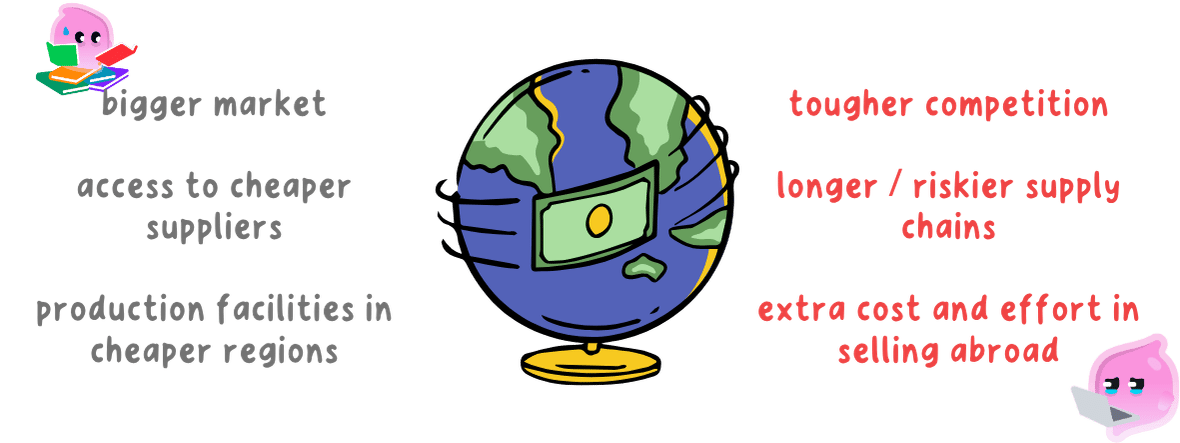
- Larger markets: a firm is no longer limited to the population of its home country, so a product with narrow appeal at home can still find enough buyers worldwide.
- Rising incomes in developing economies add customers who previously could not afford the product at all.
- Cheaper suppliers and inputs: buying materials from wherever they are cheapest lowers the variable cost of each unit, so the firm can cut price to win share or hold price and widen its margin.
- The same logic applies to production itself, so a business can put its factories in regions where land and labour cost less and ship the finished goods back to its customers.
- Aldi buys in very large volumes across borders and passes part of the saving on as low shelf prices, which is central to how it competes.
- Economies of scale: supplying many countries from one factory raises output, so fixed costs such as machinery and head office are spread over more units and average cost falls.
- Access to skilled labour abroad: a business can recruit engineers, software developers or designers in countries where those skills are more plentiful or less expensive.
- New ideas and methods: contact with foreign suppliers and rivals spreads production techniques such as just-in-time, which began at Toyota in Japan and is now used by manufacturers everywhere.
- Do not label globalisation simply good or bad for a business, because the same open border works in both directions at once.
- The agreement that lets a UK firm export to Germany duty free lets German rivals sell here duty free too, so say which side of that door the business in the question is standing on.
Threats: rivals arriving on your own high street
- Foreign competition entering the home market: a firm that once competed only with local rivals now faces imported goods and overseas entrants selling on its own high street.
- A domestic producer can lose sales without doing anything wrong, simply because a competitor abroad faces lower labour or energy costs.
- Price pressure: to keep customers the business must either cut its price, which reduces the profit made on each unit, or find a way to cut its own costs.
- Thinner margins leave less retained profit to reinvest in new products or equipment, which can weaken the firm further in later years.
- Greater exposure to overseas events: a recession in an export market cuts orders even when demand at home is perfectly healthy.
- A blocked shipping route, a port strike or a change in another government's trade rules can stop supplies arriving and halt production.
- The extra cost and effort of selling abroad: the firm has to meet another country's labelling and safety rules, translate its packaging and instructions, and find distributors it cannot supervise closely.
- Competition for staff and suppliers: a large foreign firm opening nearby bids for the same engineers, drivers and components, so wages and input prices rise for everyone in the area.
- A small business that cannot match the pay on offer loses trained workers and then carries the cost of recruiting and training replacements.
- Businesses meet these threats by raising quality, building a brand customers will pay more for, serving a niche that mass producers ignore, or cutting costs through automation.
The commonest slip here is answering a question about reasons for globalisation by describing what globalisation looks like, so keep more world trade as the description and cheap containers and shipping as the cause.
- Define globalisation in one sentence.
- Give three reasons why globalisation has increased.
- What is containerisation and why did it lower costs?
- Explain one way globalisation helps a business lower its costs.
- State two threats globalisation creates for a business selling only in its home country.