Tariffs and quotas: a tax and a limit
Definition
Tariff: A tax placed by a government on goods coming into the country, which raises the price importers must charge.
Quota: A physical limit on the quantity of a product that may be imported into a country in a given period.
- Both are trade barriers, meaning government measures that make it harder or dearer for foreign goods to be sold inside the country.
- A tariff works through price, because the tax is charged at the border and the importer normally passes it on in the price the customer pays.
- It is usually set as a percentage of value, so a 20 per cent tariff adds £100 to the cost of bringing in a £500 machine, and imports may still arrive in any quantity.
- A quota works through quantity, because a fixed number of units or tonnes is allowed in during a set period and once that limit is reached no more may legally enter.
- Supply of the foreign good is capped rather than taxed, so the shortage itself pulls the market price up.
- Both measures end up raising the price of the foreign good in the home market, but only a tariff produces revenue for the government.
- A quota gives the government a more certain result, since the volume of imports is fixed in advance, whereas with a tariff the volume still depends on how buyers react to the higher price.
Common Mistake
- Do not confuse the two: a tariff raises price and earns the government revenue, while a quota limits quantity and earns nothing.
- T for tariff and T for tax, Q for quota and Q for quantity.
- Calling a tariff a limit on imports, or a quota a tax, is the commonest error on this topic.
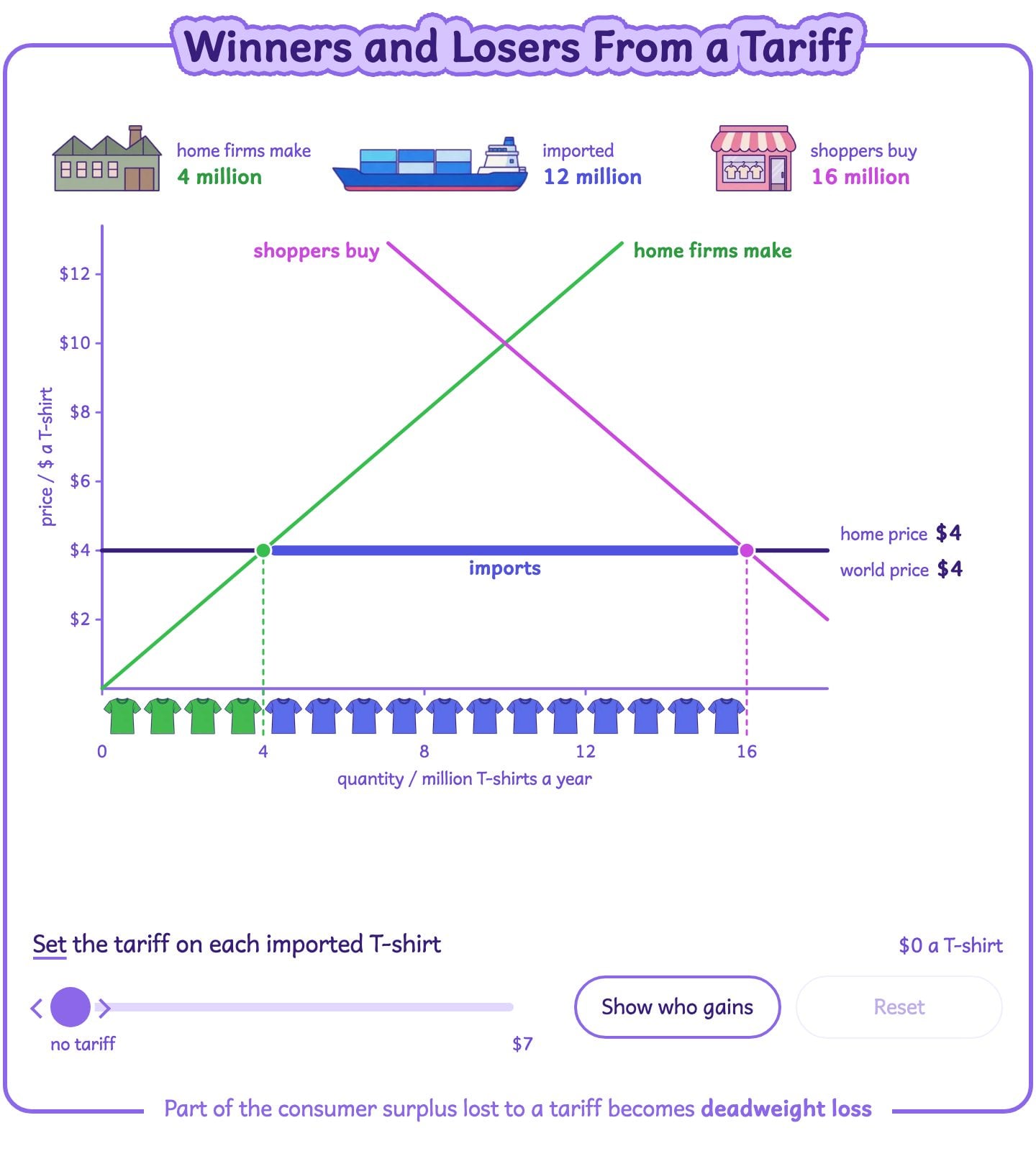
Add a tariff and see the price rise, imports fall and some consumer surplus become wasted.
Why governments step in: jobs, young industries and revenue
Definition
Infant industry: A newly established domestic industry that is still too small to match the costs of long-established foreign producers.
Dumping: Selling exports in another country at a price below what they cost to produce, often to drive local producers out of that market.
Balance of payments: A record of the money flowing into a country from selling exports set against the money flowing out to pay for imports.
- Protecting infant industries: a new domestic industry produces small volumes at first, so its average cost is high and an established foreign producer can undercut it easily.
- A tariff on the imported version lifts the foreign price, and a quota caps how much of it may arrive, either of which lets the young firms win enough orders to raise output and gain economies of scale.
- Protecting jobs: when cheap imports take sales from domestic factories, output falls, workers are made redundant and the government pays out more in benefits while collecting less income tax.
- Limiting the imports keeps domestic orders and therefore domestic employment, which matters most where one industry dominates a town or region.
- Preventing dumping: a foreign producer selling below cost can wipe out domestic competitors who cannot survive at that price, and then raise its own price once they have gone.
- A tariff aimed at the dumped product restores a price that reflects the real cost of making it, so competition is on efficiency rather than on who can absorb losses longest.
- Raising government revenue: a tariff is a tax, so every consignment that arrives pays money into the government's budget, which can then fund spending on schools, roads or health.
- Improving the balance of payments: if a country buys far more from abroad than it sells, money flows out faster than it flows in and the country runs a deficit.
- Cutting the volume of imports with a quota, or making them dearer with a tariff, moves spending towards home-produced goods and narrows the gap.
Example
- Steel is the classic case, because governments across the world have used tariffs on imported steel to keep mills such as Tata Steel's Port Talbot works running and their workers employed.
- Domestic car and appliance makers that buy steel then face a higher input cost, so one industry's protection becomes another industry's expense.
- Exporters often answer a barrier by moving inside it, which is part of why Japanese carmakers such as Nissan and Toyota build cars in Europe rather than shipping every one from Japan.
Facing a barrier: the exporter's position
- A tariff raises the price the exporter's goods reach the shelf at, so the product looks dearer beside local rivals and sales volume falls.
- The exporter can absorb the tariff by lowering its own price, which protects volume but cuts the profit made on every unit.
- Or it can pass the tariff on in full, which protects the margin but loses customers to producers inside the market.
- A quota is harder to work around, because no price cut will get an extra unit through once the limit for the year has been filled.
- Sales are capped no matter how strong demand is, which makes planning production and cash flow much more difficult.
- The exporter also carries the cost of the paperwork at the border, since customs declarations and inspections tie up staff time and delay deliveries whichever barrier is used.
- Exporters respond by switching effort to markets without barriers, by moving upmarket so buyers accept a higher price, or by setting up production inside the protected country so the goods never cross a taxed border.
Sitting behind a barrier: the protected producer's position
- Sales and market share rise, because customers who switch away from the dearer or scarcer import have to buy from someone.
- The firm can hold a higher price than it could against unrestricted imports, which widens its profit margin and leaves more retained profit to reinvest.
- Protection is not free for the same firm, because a tariff placed on imported raw materials and components raises its own input costs.
- Weaker competitive pressure reduces the push to cut costs and improve products, so a long-protected firm can become less efficient than the foreign rivals it is shielded from.
- Other governments often retaliate with barriers of their own, so a firm that sells at home and also exports can gain on one side of its business and lose on the other.
- Consumers pay more and choose from a narrower range, which is the cost the country carries in exchange for the protection.
Exam technique
- Vague phrases such as a block on trade explain nothing, so name the mechanism: a tariff is a tax on imports and a quota is a physical limit on the quantity allowed in.
- Say whose side of the border you are standing on, since the same tariff is a cost to the exporter and a shield to the producer inside.
- Protecting jobs only convinces when you carry it through, so write that imports fall, domestic orders rise and workers keep their jobs.
Self review
- Define a tariff and a quota in one sentence each.
- Which of the two raises revenue for the government, and why does the other not?
- What is dumping and why does a government act against it?
- Explain how a tariff on imports could improve a country's balance of payments.
- State two ways an exporter can respond to a tariff placed on its goods.