Business ethics: what is right, not only what is legal
Definition
Business ethics: The moral principles a business uses to decide what is right and wrong, beyond simply obeying the law.
- The law is a floor rather than a standard, so an action can be perfectly legal and still be judged wrong by customers, employees and the press.
- An ethical issue arises whenever the cheapest or most profitable option harms somebody, and the decision is left to the business rather than settled by a rule.
- Standards differ between countries, which is where most difficulty starts, because a practice that is normal in one market is unacceptable to customers in another.
Common Mistake
- Legal and ethical are not the same test, so do not treat every ethical issue as a law the firm has broken.
- Taking 90 days to pay a small supplier, offering contracts with no guaranteed hours and advertising sweets to young children are all lawful, and all attract criticism.
Child labour and working conditions
Definition
Child labour: Employing children in work that is harmful to them or that keeps them out of school.
- Child labour appears in the parts of a supply chain furthest from the brand: cocoa and cotton farms, garment workshops and small mines.
- Children are used because they are cheap and unlikely to complain, and because a supplier can subcontract an order quietly to a workshop the buyer has never visited.
- Working conditions raise the same question for adult workers: unsafe buildings, missing protective equipment, forced overtime and pay below what a person can live on.
- Not knowing is no defence in the public's eyes, because customers hold the brand on the label responsible for the factory it chose to buy from.
- Nike faced years of criticism in the 1990s over conditions at its supplier factories and eventually began publishing the list of factories making its products.
Paying fair prices to suppliers
Definition
Fair trade: Paying producers in developing countries a guaranteed minimum price that covers their costs, rather than the lowest price a buyer can negotiate.
- A large buyer negotiating with thousands of small farmers holds all the power, so it can push the price down to a level that does not cover the cost of growing the crop.
- A farmer paid below cost cannot replant, buy tools or send children to school, which is one reason child labour appears further down the same chain.
- A fair trade arrangement sets a minimum price the buyer will pay whatever the world market does, plus an extra premium the growers spend on their own community.
- Paying fairly raises the cost per unit, but it also secures supply, since growers who can survive on the price keep farming the crop the business needs.
- The domestic version is payment terms, since a supermarket that takes 90 days to pay a small supplier can push it out of business while breaking no law.
Other ethical issues a business faces
- Animal testing divides customers sharply, and a cosmetics firm that avoids it must fund alternative safety tests and may be shut out of markets that require animal data.
- Honest marketing covers exaggerated claims, hidden charges added at the checkout, packaging that suggests more product than the box holds and advertising aimed at young children.
- Bribery arises when a payment would win a contract, and refusing it can mean losing the order to a competitor who pays.
- It is a criminal offence in the UK and many other countries, so a prosecution can end careers and bar the firm from public contracts.
- Treatment of its own staff raises the same questions at home, from contracts with no guaranteed hours to paying the legal minimum rather than a wage people can live on.
The conflict between profits and ethics
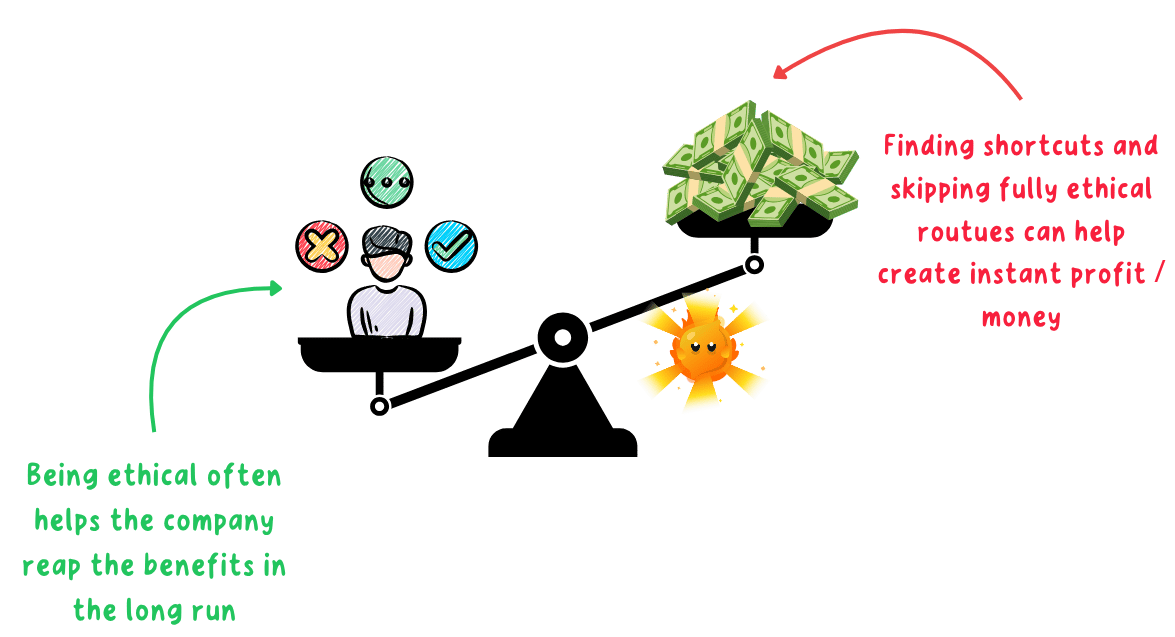
- The conflict is real rather than invented, because the ethical option nearly always costs money now while the reward, if it comes, arrives later and cannot be counted.
- Paying a supplier fairly raises the cost per unit, and if an ingredient goes from £2,000 to £2,300 a tonne that is a direct cut in profit unless the price rises.
- Refusing a bribe can mean handing the contract to a rival, and withdrawing a criticised product removes revenue immediately.
- The pull the other way is that unethical behaviour carries a bill of its own once it is discovered: boycotts, retailers delisting the product, staff leaving and fines.
- Behaving ethically can also earn money rather than only cost it, through customers who will pay more, buyers who insist on audited suppliers and staff who stay longer.
- Where the balance falls depends on how visible the firm is, who its customers are, how easily a cheaper rival can undercut it and whether its owners judge it on this year's profit or the next ten years.
Common Mistake
- The conflict is not solved by saying that ethics always pays in the end, because plenty of firms compete successfully on price alone.
- What changes the sum is being found out, which is why exposure risk sits at the centre of most ethical decisions a business makes.
How a business reacts and responds
- The starting point is a written code of ethics setting out what the firm will and will not do, so decisions do not depend on the individual manager taking them.
- The code reaches suppliers through contract conditions on hours, pay, safety and minimum age, checked by unannounced inspections rather than a form the supplier fills in.
- A failing supplier is usually given a deadline to improve before the contract ends, since walking away instantly costs its workers their jobs too.
- Some responses are visible to customers, such as stocking fair trade lines, labelling products as not tested on animals and publishing an annual report on suppliers.
- Inside the business, staff are trained on what to refuse and given a confidential route to report wrongdoing, because problems are cheapest to fix before a journalist finds them.
- When something is exposed, the response that limits the damage is investigating quickly, withdrawing the product, publishing what went wrong and saying what has changed.
Exam technique
- Show the cost of the ethical choice in the firm's own numbers, because an answer that says being ethical is good for business has skipped the conflict the question is about.
- A response has to be something the business actually does, so publishing a code, auditing suppliers or withdrawing a product is a response and caring more is not.
Self review
- Give one example of a decision that is legal but widely judged unethical.
- Why does child labour often appear far down a supply chain rather than in the brand's own factory?
- What does a fair trade arrangement guarantee a producer?
- Give two ways an ethical decision reduces profit and two ways it can raise it.
- State three things a business can do to respond to ethical issues in its supply chain.