Economies of scale: growing bigger, making each unit cheaper
Definition
Economies of scale: The fall in average cost per unit that a business enjoys as it grows and produces on a larger scale.
- The measure that matters is average cost, calculated as total cost÷output\text{total cost} \div \text{output}total cost÷output, because a growing firm's total spending almost always rises.
- A firm making 10,000 units for a total cost of £40,000 has an average cost of £40,000÷10,000=£4.00£40{,}000 \div 10{,}000 = £4.00£40,000÷10,000=£4.00 a unit.
- After expanding it makes 40,000 units for £120,000, so average cost is £120,000÷40,000=£3.00£120{,}000 \div 40{,}000 = £3.00£120,000÷40,000=£3.00 a unit.
- Total cost tripled while output quadrupled, which is exactly what an economy of scale looks like in figures.
- The £1.00 saved on every unit can be handed to customers as a lower price to win market share, or kept to widen the profit margin and fund further investment.
Common Mistake
- A lower average cost is not a lower total cost, since the firm above went from spending £40,000 to spending £120,000.
- Write that growth makes each unit cheaper to produce, not that a big business spends less money.
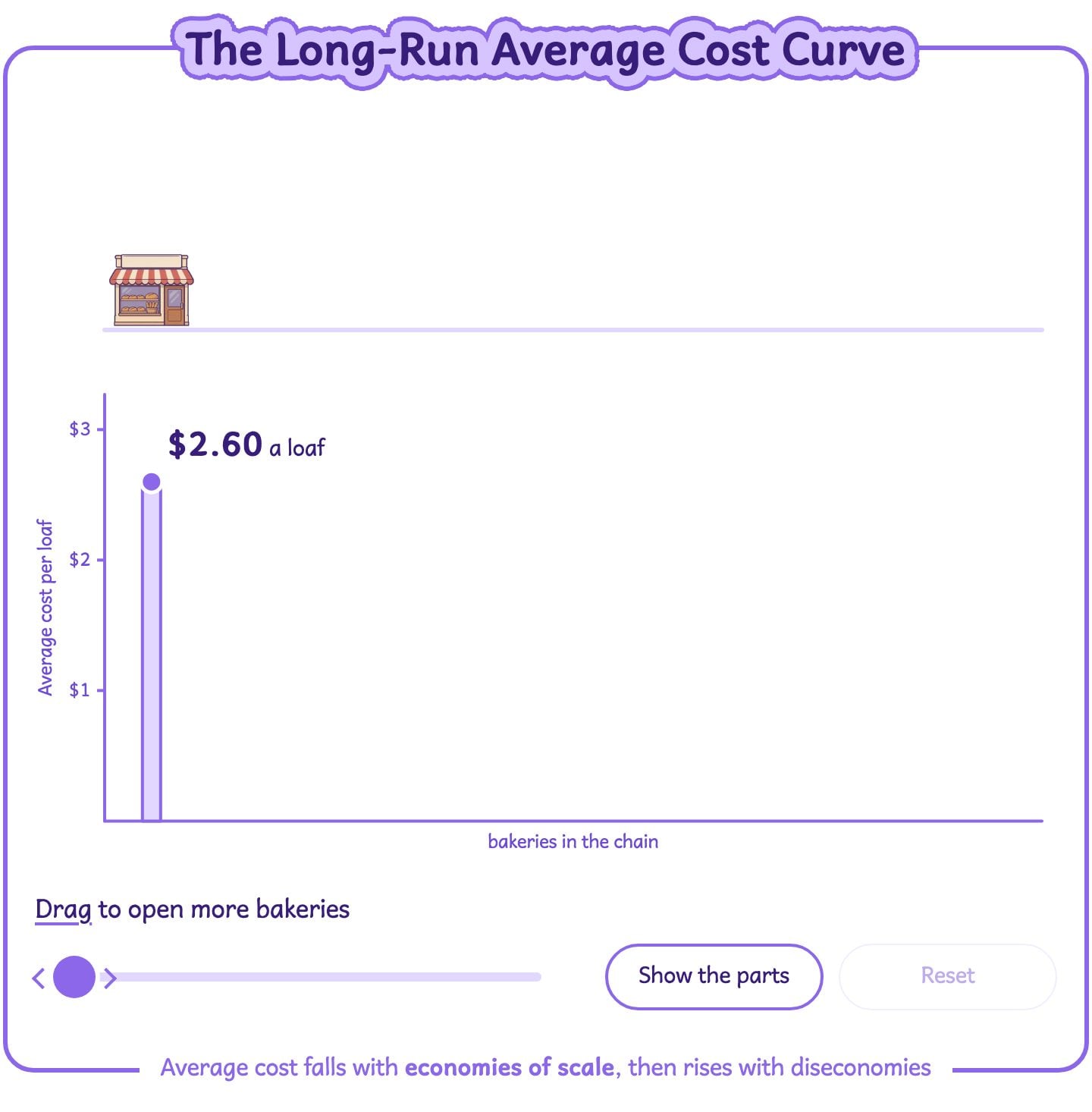
Slide output upwards and watch the cost per unit fall as economies of scale build up.
Purchasing economies: discounts for buying in bulk
- Suppliers cut the price per unit on very large orders because one big order is cheaper to process, pack and deliver than many small ones, and it keeps the supplier's own factory busy.
- Tesco orders baked beans by the pallet-load for thousands of shops at once, so it pays far less per tin than a corner shop buying a single case from a wholesaler.
- Suppose a component costs £2.00 each on small orders but £1.70 each on orders above 50,000 units.
- The £0.30 saved comes straight off the variable cost of every unit, so average cost falls by £0.30 without anything else changing.
- A small rival cannot order in those quantities, so its variable cost per unit stays high and it must either charge more or accept a thinner margin.
Marketing economies: one campaign, many more units
- The cost of an advertising campaign, of designing packaging and of running a sales team barely changes when a firm sells more, so it behaves like a fixed cost spread across output.
- A £2 million national television campaign spread across 20 million units adds £2,000,000÷20,000,000=£0.10£2{,}000{,}000 \div 20{,}000{,}000 = £0.10£2,000,000÷20,000,000=£0.10 to each unit.
- A smaller firm selling 2 million units would pay £2,000,000÷2,000,000=£1.00£2{,}000{,}000 \div 2{,}000{,}000 = £1.00£2,000,000÷2,000,000=£1.00 a unit for the identical campaign, which is why it usually cannot afford one at all.
- Unilever advertises brands such as Persil to the whole country and shares that cost over enormous sales, so its marketing cost per pack is measured in pennies.
Analogy
- Spreading a cost over more units works like sharing a taxi fare.
- One passenger pays the whole £20 fare, but four passengers going the same way pay £5 each for the identical journey.
- The campaign, the buyer's salary and the production line are the fare, and every extra unit sold is another passenger sharing it.
Financial economies: cheaper borrowing for bigger firms
- Banks treat a large, established business with buildings and machinery to offer as security as a lower risk, so they lend to it at a lower rate of interest.
- Borrowing £1 million at 5% costs £1,000,000×0.05=£50,000£1{,}000{,}000 \times 0.05 = £50{,}000£1,000,000×0.05=£50,000 of interest a year, while a small firm charged 8% would pay £80,000 for the same loan.
- Across 500,000 units that is £50,000÷500,000=£0.10£50{,}000 \div 500{,}000 = £0.10£50,000÷500,000=£0.10 a unit rather than £80,000÷500,000=£0.16£80{,}000 \div 500{,}000 = £0.16£80,000÷500,000=£0.16 a unit.
- A public limited company can also raise money by selling shares on the stock exchange, an option closed to a sole trader, so it is not forced to accept expensive borrowing.
Managerial economies: specialists instead of one person doing everything
- A large firm can employ a full-time buyer, a marketing manager and an accountant, each expert in one job, while the owner of a small firm has to do all three badly.
- Specialists negotiate better supply deals, waste less inventory and make fewer costly mistakes, so more units come out of the same resources.
- Their salaries are fixed costs, so a buyer paid £60,000 adds £60,000÷600,000=£0.10£60{,}000 \div 600{,}000 = £0.10£60,000÷600,000=£0.10 to each unit at an output of 600,000, but would add £60,000÷50,000=£1.20£60{,}000 \div 50{,}000 = £1.20£60,000÷50,000=£1.20 at an output of 50,000.
- This is why a specialist post that would bankrupt a small workshop is a bargain for a national manufacturer.
Technical economies: bigger machines and longer production runs
- Only a large firm can justify buying automated machinery and a flow production line, because such equipment produces far more units per hour and per worker.
- A £5 million production line spread over 10 million units adds £5,000,000÷10,000,000=£0.50£5{,}000{,}000 \div 10{,}000{,}000 = £0.50£5,000,000÷10,000,000=£0.50 to each unit, but over 500,000 units it would add £10.00 and never be worth buying.
- Long production runs also mean the machines are stopped and reset far less often, so a greater share of each paid hour is spent actually making things.
- Toyota builds cars on continuously moving assembly lines, where robots repeat the same weld thousands of times a day and the labour cost carried by each car is small.
Key Idea
- Marketing, financial, managerial and technical economies all run on the same mechanism: a cost that does not grow in step with output is divided among more units.
- Purchasing economies are the exception, because there the price of each unit of material itself falls.
- The size of the saving therefore depends on how large the cost being shared is and how far output rises.
Exam technique
- Naming a type of economy of scale says nothing on its own, so finish every point with the words average cost per unit falls and say why.
- Do not offer bulk buying twice under two different labels, because purchasing and technical economies must be explained by genuinely different mechanisms.
- Financial economies are about the cost of borrowing money, not about a firm having more money, which is a common mix-up.
Self review
- Which cost figure has to fall for a genuine economy of scale to exist?
- Name the five types of economy of scale.
- Explain how a marketing economy of scale lowers the cost carried by each unit.
- Why does a bank charge a large plc less interest than a new sole trader?
- A firm's total cost rises from £40,000 to £120,000 as output goes from 10,000 to 40,000 units, so what happens to average cost?