Fixed costs: the bill that arrives whatever you make
Definition
Fixed costs: Costs that do not change when the level of output or sales changes, such as rent, business rates, insurance and managers' salaries.
- Typical fixed costs are rent, business rates, insurance, the salaries of managers, loan interest and an advertising campaign booked for the whole year.
- Greggs runs more than 2,000 shops and owes the rent on every one of them on a wet Tuesday when nobody walks in, exactly as it does on the busiest Saturday of the year.
- Fixed means the cost does not change when output changes, not that the figure never changes at all.
- A landlord can raise the rent at the end of the lease, and renting a second unit makes fixed costs jump in a single step.
- Because fixed costs are owed at every level of output, a business that produces nothing at all still runs up a loss equal to those costs.
Variable costs: the bill that grows with every unit
Definition
Variable cost: A cost that rises and falls directly with the number of units a business produces.
- Typical variable costs are raw materials, ingredients, packaging, the electricity used to run the ovens, delivery fuel and wages paid at a piece rate.
- The variable cost of one unit stays much the same, so total variable costs are found by multiplying variable cost per unit by output.
- A bakery using £0.40 of flour, yeast and packaging in each loaf spends £0.40×2,000=£800£0.40 \times 2{,}000 = £800£0.40×2,000=£800 on materials to bake 2,000 loaves.
- At zero output total variable costs are zero, which is why the two types of cost behave so differently in a bad month.
- To classify any cost, ask whether making one more unit makes that cost rise: if it does the cost is variable, if it does not the cost is fixed.
Common Mistake
- One bill can contain both types: a delivery driver's basic weekly wage is fixed, while the diesel burned on extra rounds is variable.
- Do not call a cost fixed just because the monthly figure looks steady, because the test is whether it moves with output.
Total cost and average cost: adding up, then sharing out
Definition
Total cost: All the costs of producing a given level of output, found by adding fixed costs to total variable costs.
Average cost: The cost of producing one unit, found by dividing total cost by output.
- The first formula is total cost=fixed costs+total variable costs\text{total cost} = \text{fixed costs} + \text{total variable costs}total cost=fixed costs+total variable costs.
- Take a bakery with fixed costs of £800 a month and a variable cost of £0.40 a loaf that bakes 2,000 loaves.
Example
Total cost=£800+(£0.40×2,000)=£800+£800=£1,600
\text{Total cost} = £800 + (£0.40 \times 2{,}000) = £800 + £800 = £1{,}600
Total cost=£800+(£0.40×2,000)=£800+£800=£1,600
- The second formula is average cost=total cost÷output\text{average cost} = \text{total cost} \div \text{output}average cost=total cost÷output, and it answers a different question: what does one loaf cost?
Example
Average cost=£1,600÷2,000=£0.80 a loaf
\text{Average cost} = £1{,}600 \div 2{,}000 = £0.80 \text{ a loaf}
Average cost=£1,600÷2,000=£0.80 a loaf
- At this output the bakery needs a selling price above 80p simply to avoid losing money on each loaf it bakes.
| Loaves | Fixed cost | Variable | Total cost | Average |
|---|---|---|---|---|
| 0 | £800 | £0 | £800 | n/a |
| 1,000 | £800 | £400 | £1,200 | £1.20 |
| 2,000 | £800 | £800 | £1,600 | £0.80 |
| 4,000 | £800 | £1,600 | £2,400 | £0.60 |
| 8,000 | £800 | £3,200 | £4,000 | £0.50 |
Why average cost falls: spreading the fixed costs
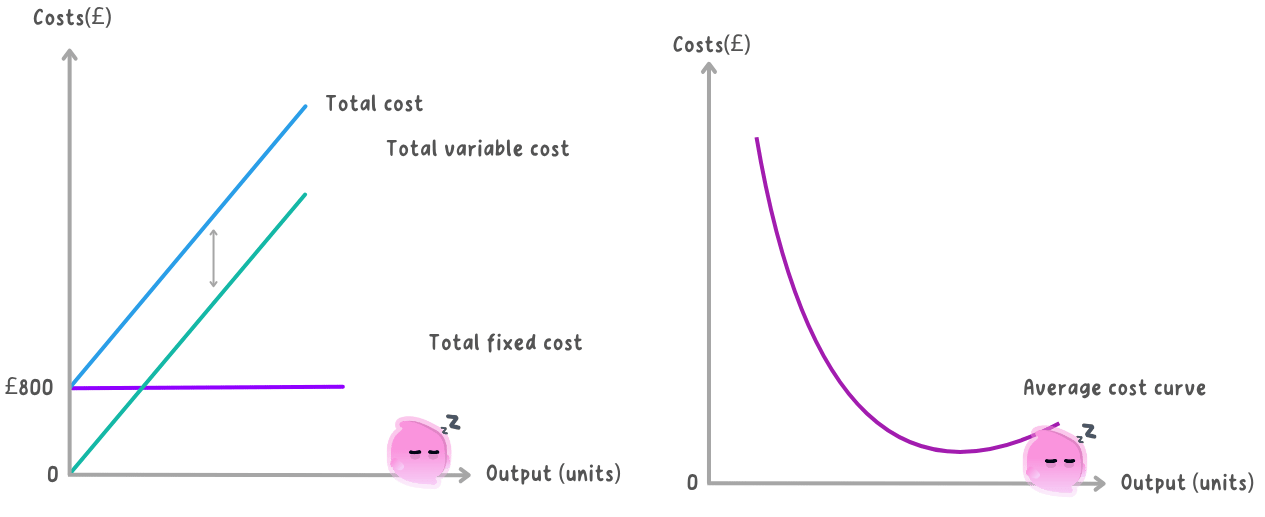
- The £800 of fixed costs is the same in every row of the table, so the share of it carried by each loaf shrinks as output grows.
- At 1,000 loaves each one carries £800÷1,000=£0.80£800 \div 1{,}000 = £0.80£800÷1,000=£0.80 of fixed cost, but at 8,000 loaves it carries only £800÷8,000=£0.10£800 \div 8{,}000 = £0.10£800÷8,000=£0.10.
- The variable part never changes, staying at £0.40 a loaf, so average cost falls towards £0.40 without ever reaching it.
- A bakery working at half capacity therefore has a far higher cost per loaf than the same bakery running its ovens all day, which is why quiet periods hurt profit twice over.
Common Mistake
- Falling average cost does not mean falling total cost: in the table total cost rises from £1,200 to £4,000 while average cost drops from £1.20 to £0.50.
- Fixed costs are added once to the whole month's bill, never once to every unit made.
Using cost data: continue or stop production
- A simple cost-based decision compares the revenue earned at a level of output with the total cost of producing it.
- With loaves priced at £1.00, selling 2,000 gives revenue of £1.00×2,000=£2,000£1.00 \times 2{,}000 = £2{,}000£1.00×2,000=£2,000 against total costs of £1,600, a profit of £400.
- If demand halves to 1,000 loaves, revenue is £1,000 while total cost is £800+£400=£1,200£800 + £400 = £1{,}200£800+£400=£1,200, so the bakery loses £200 that month.
- The loss looks like a reason to stop baking, but the £800 of rent and insurance would still be owed on empty premises, turning a £200 loss into an £800 loss.
- The short-term test is whether the money coming in covers the variable costs and leaves something over towards the fixed costs.
- Here £1,000−£400=£600£1{,}000 - £400 = £600£1,000−£400=£600 is left towards the £800 of fixed costs, so carrying on loses £600 less than closing the ovens.
- If revenue fell below the variable cost of the loaves, every extra loaf would deepen the loss and stopping production would be the cheaper choice.
- Over a longer period fixed costs can be escaped, because a lease can be ended and equipment sold, so a product that never covers its total cost should be repriced or dropped.
- Cost data guides smaller choices too: a new supplier quoting £0.35 a loaf instead of £0.40 saves £0.05×2,000=£100£0.05 \times 2{,}000 = £100£0.05×2,000=£100 a month, which is a quarter of the bakery's £400 profit.
Exam technique
- The commonest arithmetic slip is multiplying the fixed cost by output as well as the variable cost, so add fixed costs once and only once.
- Never answer a stop or continue question with 'yes, it is making a loss', because the fixed costs carry on either way and the real comparison is between two losses.
Self review
- Which type of cost is zero when output is zero?
- Calculate the total cost of 3,000 loaves at £800 fixed costs and £0.40 a loaf.
- State the formula for average cost and explain why it falls as output rises.
- Why can a business be right to keep producing in a month when it makes a loss?
- Give one cost that contains both a fixed and a variable part.