Diseconomies of scale: when growth starts to cost more
Definition
Diseconomies of scale: The rise in average cost per unit that happens when a business grows beyond its most efficient size.
- Growth lowers average cost through the economies of scale covered in the previous guide, but only up to a point, after which the difficulty of running a very large organisation takes over.
- A firm producing 40,000 units for a total cost of £120,000 has an average cost of £120,000÷40,000=£3.00£120{,}000 \div 40{,}000 = £3.00£120,000÷40,000=£3.00 a unit.
- It doubles output to 80,000 units, but total cost rises to £280,000, so average cost becomes £280,000÷80,000=£3.50£280{,}000 \div 80{,}000 = £3.50£280,000÷80,000=£3.50 a unit.
- Output doubled while total cost more than doubled, and that gap of £0.50 a unit is the arithmetic signature of a diseconomy of scale.
- Plotted against output, average cost is roughly U-shaped: it falls as the firm grows, flattens out at the firm's most efficient size, then climbs once diseconomies bite.
- The rise matters because rivals still operating at their efficient size now make each unit more cheaply, so the oversized firm must either accept a thinner profit margin or charge more and lose customers.
Common Mistake
- Do not say diseconomies mean total costs rise, because total costs rise whenever output rises even in a perfectly efficient firm.
- The claim being made is narrower and sharper: the cost of producing one unit goes up as the business gets bigger.
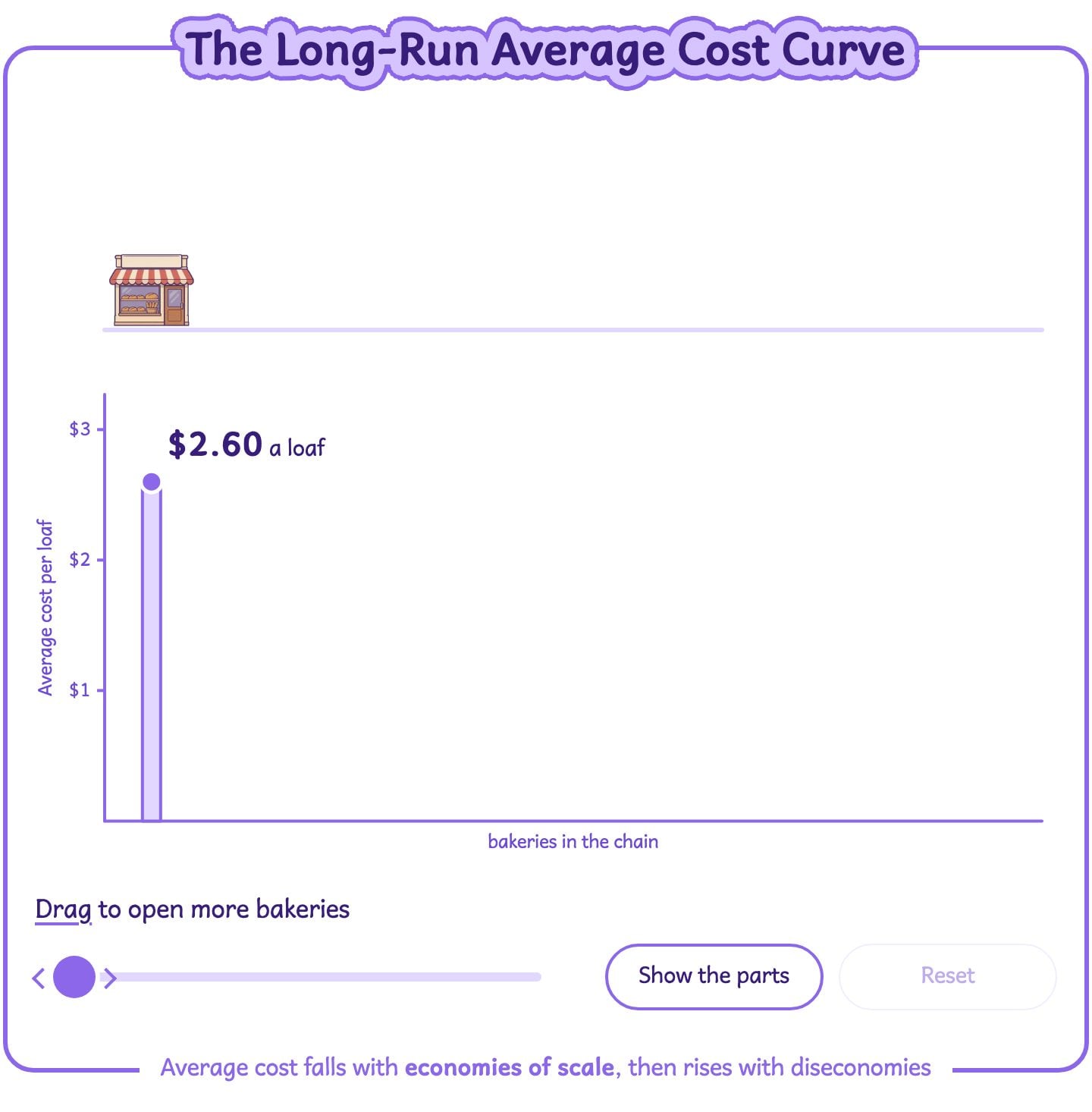
Keep increasing output and notice cost per unit turn upwards once diseconomies of scale set in.
Poor communication: messages that arrive late or wrong
- A bigger business has more layers of hierarchy and more sites, so an instruction passes through more people before it reaches the person who acts on it.
- Each handover is a chance for the message to be delayed, shortened or misunderstood, so the version that arrives on the factory floor may not be the one that left head office.
- A team given the wrong specification produces a whole batch that has to be scrapped or reworked, so the materials and wages for those units are paid twice and average cost rises.
- Decisions also slow down, because a change that one manager could approve in a small firm now needs meetings and written reports, and paid management time is spent passing information around rather than producing anything.
- Communication upwards suffers most, so a fault that shop-floor staff spot immediately can be repeated across hundreds of branches before senior managers hear about it.
Example
- Tesco grew to thousands of stores and found that head office decisions took far longer to reach individual shops than they had when the chain was small.
- Its Fresh & Easy chain in the United States was closed after several loss-making years, having been run from a head office thousands of miles from the shoppers it had misjudged.
- Both problems added cost without adding output, so the cost carried by every item sold rose.
Lack of commitment from employees: feeling like a number
- In a workforce of tens of thousands one person's extra effort is invisible, and staff who never meet a senior manager stop feeling that their work belongs to them.
- Motivation falls, so absenteeism rises, shifts have to be covered by agency workers, and labour turnover climbs as staff leave for employers who notice them.
- Every leaver has to be recruited and trained again, and advertising, interviewing and induction all cost money while producing no output at all.
- Lower effort also shows up directly in the cost of each unit, because a monthly wage bill of £200,000 that once produced 100,000 units costs £200,000÷100,000=£2.00£200{,}000 \div 100{,}000 = £2.00£200,000÷100,000=£2.00 a unit.
- If absence and low effort cut output to 80,000 units for the same wage bill, labour cost per unit becomes £200,000÷80,000=£2.50£200{,}000 \div 80{,}000 = £2.50£200,000÷80,000=£2.50.
- Careless work by uncommitted staff also raises the number of faulty units, adding waste and complaints on top of the wasted wages.
Weak coordination: departments and sites pulling apart
- A large business splits into departments and sites that each chase their own targets, so their plans stop lining up with each other.
- Marketing may promote a product that the factory cannot supply in time, leaving customers disappointed and unsold inventories left behind once the campaign has finished.
- Two sites that order the same material separately each lose the bulk discount the firm could have had, and both hold their own inventories, tying up cash and warehouse space.
- The usual response is to appoint extra managers whose only job is to keep the parts in step, and their salaries add to fixed costs without adding a single unit of output.
- Firms push back by delegating decisions to store or divisional managers, breaking the business into smaller self-contained units and investing in better internal communication.
Exam technique
- Writing that a firm has grown too big explains nothing, so build the chain instead: more layers, slower orders, more mistakes, higher average cost.
- Do not answer by reversing an economy of scale, such as saying the firm loses its bulk discount, because diseconomies come from managing people, not from buying badly.
- Falling sales in a recession is not a diseconomy of scale, since the cause has to be the size of the business itself.
Self review
- What exactly happens to average cost when a firm suffers diseconomies of scale?
- Name the three causes of diseconomies of scale set out in this guide.
- Explain how poor communication in a large firm adds to the cost of each unit produced.
- Why does a wage bill of £200,000 cost more per unit when output falls from 100,000 to 80,000 units?
- Give two ways a large business can reduce its diseconomies of scale.