Breaking even: nothing gained and nothing lost
Definition
Break-even: The position at which a business's total revenue exactly equals its total costs, so it makes neither a profit nor a loss.
- Total revenue is the money coming in from sales, found by multiplying the selling price by the quantity sold.
- Total costs are the fixed costs plus the variable costs of that output, and break-even is the single level of sales where the two figures meet exactly.
- Breaking even is not the same as doing well, because a business that only breaks even has paid every bill and left its owners with nothing for the risk they took.
- At any level of sales below break-even the business makes a loss, and at any level above it every extra sale adds to profit.
- Break-even is measured as a quantity of output or sales, so a break-even answer is normally given as a number of units rather than a sum of money.
Analogy
- Fixed costs behave like an empty tank that has to be filled before the engine will start.
- Every unit sold pours in whatever is left once that unit has paid for its own materials.
- Until the tank is full the business is running at a loss, however busy the shop looks.
- Everything poured in after it is full is profit, which is why sales beyond break-even are worth so much.
Contribution: what each sale leaves behind
Definition
Contribution: The amount each unit sold leaves behind once its own variable cost has been paid, found as selling price per unit minus variable cost per unit.
- The calculation is contribution per unit=selling price per unit−variable cost per unit\text{contribution per unit} = \text{selling price per unit} - \text{variable cost per unit}contribution per unit=selling price per unit−variable cost per unit.
- A kebab van charges £5 a kebab and uses £3 of pitta, meat and salad in each one, so £5−£3=£2£5 - £3 = £2£5−£3=£2 of contribution.
- That £2 is not profit, because the van still owes £600 a month for its pitch, licence and insurance whether it sells one kebab or a thousand.
- The £2 is money left over to help pay those fixed costs, which is where the word comes from: each kebab contributes £2 towards them.
- Total contribution is contribution per unit multiplied by units sold, so 250 kebabs generate £2×250=£500£2 \times 250 = £500£2×250=£500 towards the £600 of fixed costs.
Common Mistake
- Contribution is worked out from one unit's price and one unit's variable cost, never by taking all the costs away from all the revenue.
- Fixed costs play no part in the contribution sum, because contribution is the money that goes on to pay them.
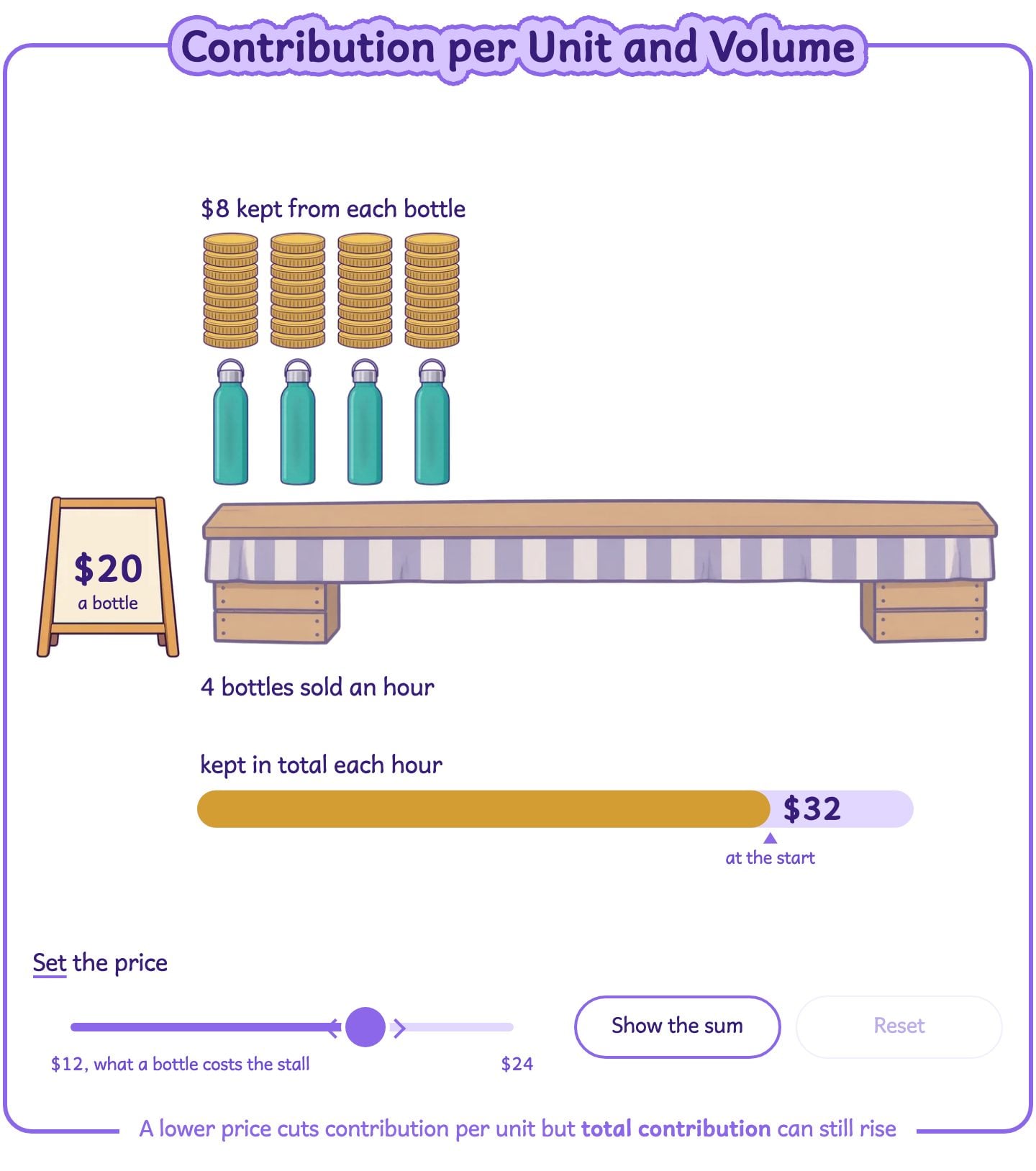
Lower the price and see contribution per unit shrink, then check if higher sales can still raise total contribution.
Filling the tank: from covering costs to making profit
- The £600 of fixed costs is the tank, and it fills £2 at a time before a single penny of profit can exist.
- After 100 kebabs the van has earned £2×100=£200£2 \times 100 = £200£2×100=£200 of contribution, so £400 of fixed costs is still unpaid and the van is £400 down.
- The tank is exactly full at 300 kebabs, when £2×300=£600£2 \times 300 = £600£2×300=£600 of contribution meets £600 of fixed costs and the van breaks even.
- Checked the long way round, 300 kebabs bring in £5×300=£1,500£5 \times 300 = £1{,}500£5×300=£1,500 of revenue against total costs of £600+(£3×300)=£1,500£600 + (£3 \times 300) = £1{,}500£600+(£3×300)=£1,500.
- From kebab 301 onwards the fixed costs are already paid, so the whole £2 of contribution on each further sale drops through into profit.
- Selling 400 kebabs gives £2×400=£800£2 \times 400 = £800£2×400=£800 of contribution, of which £600 covers the fixed costs and £200 is profit.
| Kebabs sold | Contribution | Fixed costs | Profit or loss |
|---|---|---|---|
| 0 | £0 | £600 | Loss of £600 |
| 100 | £200 | £600 | Loss of £400 |
| 200 | £400 | £600 | Loss of £200 |
| 300 | £600 | £600 | Break-even |
| 400 | £800 | £600 | Profit of £200 |
Why the idea matters to a business
- Break-even turns a page of cost figures into one target that the whole business can aim at, such as 300 kebabs a month.
- A new business can hold that target against the size of its market and ask whether that many customers really exist before it commits any money.
- Banks expect a break-even figure in a business plan, because a lender wants to know the minimum trade needed before the loan can be repaid.
- The size of the fixed costs decides how far away break-even sits, so a Greggs shop paying high town-centre rent must serve far more customers before it starts earning than a market stall with almost no fixed costs.
- Anything sold for less than its own variable cost has a negative contribution, so each sale makes the shortfall bigger and break-even can never be reached.
Exam technique
Break-even is not the point at which a business makes no money: revenue and total costs are both there and exactly equal, so every bill has been paid and nothing has been left over.
Self review
- Which two totals are exactly equal at break-even?
- Work out the contribution of a sandwich sold for £3.20 that uses £1.10 of ingredients.
- Explain in one sentence what contribution is used for before it becomes profit.
- Why does a business still make a loss when it has sold fewer units than its break-even level?
- Why does a shop with high rent have to sell more than a stall with low rent before it breaks even?