Aims and objectives: the destination and the milestones
Definition
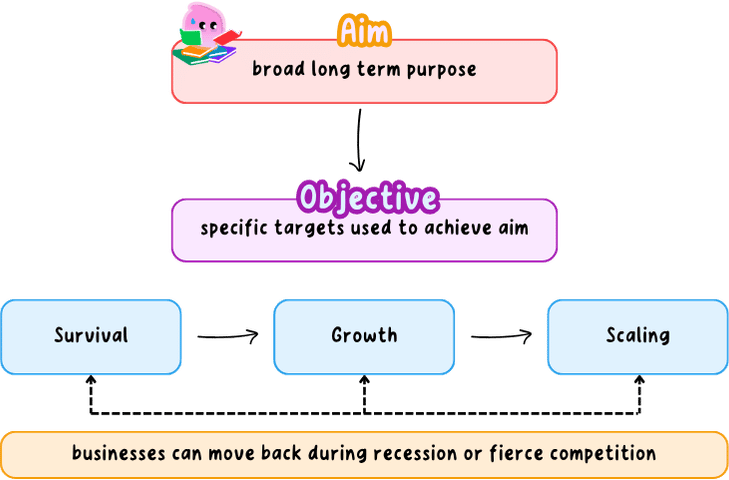
Aim: The long-term overall purpose a business is working towards, stated in words rather than numbers.
Business objective: A specific, measurable target with a deadline that a business sets in order to move towards its aim.
- An aim is written in words, so nobody can say on a fixed date whether it has been reached.
- An objective converts that aim into a number and a deadline, which is what makes progress checkable.
- Being the best bakery on the high street cannot be ticked off, but opening 150 new shops by December can.
- A business normally holds one or two aims and sets several objectives underneath each of them.
Example
- Tesco runs several thousand UK outlets, from large superstores down to small Express convenience shops.
- An objective of growing online grocery orders decides where the money goes: more order pickers, more delivery vans and further spending on the app.
- One target therefore settles hundreds of separate decisions that managers in different departments would otherwise answer differently.
Why a business needs objectives: the five jobs they do
- Direction: an objective tells every employee what the business is trying to achieve, so the day's work is aimed at the same result.
- Without one, staff pick their own priorities and the owner pays wages for activity that moves the business nowhere.
- A basis for decisions: managers judge each option by asking which one moves the business closer to the target, which narrows the choice quickly and lets the spending be justified to owners and lenders.
- Coordination: one shared target pulls marketing, finance, operations and human resources into the same plan.
- If marketing promises next-day delivery while operations switches to a slower courier to cut costs, the business breaks its promise and repeat sales fall.
- Motivation: a target a worker believes is reachable gives a sense of achievement when it is hit and can be tied to a bonus, which raises output per worker and cuts absence and labour turnover.
- Measurement and control: actual results are compared with the target, so managers can see whether the business is on course.
- A shortfall spotted in month three can still be put right by cutting costs or running a promotion, while the same shortfall found at the year end has already cost a full year of profit.
- Outsiders use the targets too, so a bank checks whether a firm hit the sales targets in its last business plan before agreeing another loan.
Objectives decide which decisions a business takes
- Two businesses facing an identical choice will decide differently depending on the objective each has set.
Example
- A newly opened restaurant whose objective is survival through its first year holds cash back, keeps borrowing low and turns down the offer of a second site.
- A chain whose objective is to raise market share takes the same site, prices below its rivals and accepts a year of losses to win the customers.
- Neither decision is right in itself, because each is right only against the objective the business chose.
Objectives also decide what a business turns down
- A firm targeting a 20 per cent profit margin will refuse a large order priced at a 5 per cent margin even though it would add revenue.
- With no stated objective the owner has no reason to say no, so the factory fills with work that barely covers its costs and leaves no capacity for better-paid orders.
Exam technique
- The commonest weak answer here is so the business can be successful, which just repeats the question, so name the job the objective does: decide, coordinate, motivate or measure.
- Increase profit written on its own is an aim, not an objective, so attach a figure and a date whenever you are asked to state one.
- Do not describe an aim as short term, because the aim is the long-term purpose and the objective is the measurable step towards it.
Self review
- What is the difference between an aim and an objective?
- State three of the five jobs objectives do inside a business.
- Why does an objective need a number and a deadline?
- Why might two businesses make opposite decisions about the same new site?
- Why would a firm refuse an order that would add revenue?