The business plan: the idea written down before the money is spent
Definition
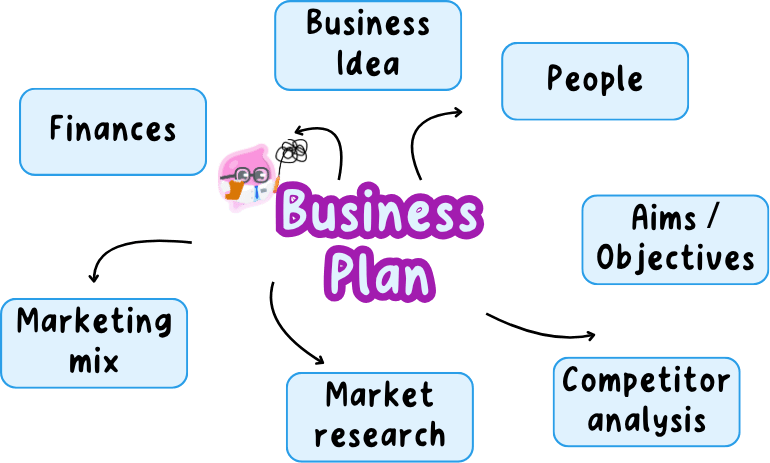
Business plan: A document written by the owner that sets out what the business will sell, who its customers will be, how it will be organised and how it will be financed, including forecasts of sales, costs, profit and cash flow.
- A plan is written before trading starts, so every number in it is a forecast, an estimate of what the owner expects to happen rather than a record of what has happened.
- It has two audiences: the entrepreneur, who asks whether the idea works and what has to be done first, and the lender, who asks whether the money will come back and when.
Note
- You do not need to understand every section listed below yet.
- Market research, the marketing mix, sources of finance, cash-flow forecasts and break-even are each explained fully in later articles.
- For now, learn which sections a plan contains and why each one is there.
The idea, aims and objectives: what the business is for
- Description of the business: the product or service, the legal form such as sole trader or private limited company, and the experience of the owner, since a baker of ten years is a smaller risk than someone new to the trade.
- Aims and objectives: measurable targets such as sales of £80,000 in year one, so the owner can later compare actual sales against the target.
- The unique selling point: the reason a customer would choose this business over the ones already trading, such as opening hours, delivery or a recipe rivals do not have.
Market research and the target market: evidence that customers exist
- This section names the target market by age, income or location, lists the main competitors and what they charge, and reports the research findings.
- A survey of 200 people in the town showing that 68 of them buy lunch out at least twice a week is the kind of evidence a bank looks for.
- Research is the section a bank tests hardest, because a sales forecast built on the owner's hope rather than on evidence makes every later number worthless.
The marketing mix: how those customers will be won
- Product and price: the range on offer, how it is branded, and the price of each item with the method behind it, such as pricing below local rivals to attract first customers.
- Place and promotion: where the product will be sold, whether a shop, a market stall or a website, and how customers will be told the business exists, with the cost of each method stated.
Operations, premises and staff: how it will actually be produced
- Production and premises: how the good or service is made, the equipment needed, how much can be produced in a day, and the site chosen with its rent.
- Suppliers and staffing: who will provide materials and on what credit terms, and how many people are needed and what they will be paid, since wages are usually the largest running cost.
The finance sections: how much is needed and whether it comes back
- Start-up costs and sources of finance: the total needed to open, split between the owner's own capital and any loan, overdraft or investment.
- Forecast revenue and costs: expected sales income set against fixed costs such as rent and variable costs such as ingredients.
- Cash-flow forecast: a month-by-month table of cash in and cash out, which reveals the worst month so the owner can arrange an overdraft in advance.
- Break-even output: the level of sales at which revenue exactly covers costs, which tells the reader how far sales can fall before the business makes a loss.
Example
- A cafe forecasts 900 customers a month at an average spend of £4.50, so the revenue line of the plan reads:
- Against forecast costs of £3,600 that leaves £450, so the loan repayment must be well under £450 a month.
How the plan helps the entrepreneur
- Writing it tests the idea on paper, so a founder who finds that forecast costs of £4,200 exceed forecast revenue of £3,800 can change the price or drop the idea before losing real money.
- It sets the order of work, since the plan shows that premises must be found before equipment is bought and staff hired.
- It becomes a yardstick once trading starts, because comparing actual sales of £2,900 against a forecast of £4,050 shows a problem in month one rather than at the end of the year.
Example
- A start-up loan scheme will not release any money until the applicant hands in a written plan and a cash-flow forecast.
- The plan is the only evidence the lender has, since the business has never sold anything.
How the plan helps the lender: reducing the risk of not being repaid
- A bank lending £25,000 is not sharing the profit, so its only concern is whether the interest and capital will be paid on time.
- The cash-flow forecast shows whether the business will have money in the account on the repayment date, which the profit forecast alone does not prove.
- The finance section shows how much of the owner's own capital is at risk, because someone risking £10,000 of their savings has a stronger reason to make the business work.
Limitations of a business plan
- Every figure rests on assumptions about customer numbers and prices, and a start-up has no past data to base them on, so the forecasts can be badly wrong.
- A plan dates quickly, because a new competitor opening nearby or a rise in supplier prices makes the sales and cost forecasts obsolete within months.
- Owners can also follow a plan too rigidly, sticking to a product the market has rejected because the document says so.
Exam technique
- A plan holds forecasts, not accounts, so do not write that it shows the profit the business made or that it guarantees the business will succeed.
- Answer for the reader the question names, because what convinces a lender (that the money comes back on time) is not what helps the owner (direction and the order of work).
Self review
- Name five sections of a business plan and say what each contains.
- Why does a bank read the cash-flow forecast rather than only the profit forecast?
- Give two ways the plan helps the entrepreneur once trading has started.
- State two limitations of a business plan written by a start-up.
- Why does a lender want to know how much of the owner's own money is invested?