Cash: the money a business can spend today
Definition
Cash: The notes, coins and bank balances a business can spend immediately, before any money still owed to it by customers is collected.
- Money owed to the business by customers who bought on credit is not cash until it reaches the bank account.
- Cash flows in from cash sales, from credit customers settling invoices, from loans and share issues, and from selling assets the firm no longer uses.
- Cash flows out to pay for materials, wages, rent, energy, insurance, loan repayments, interest and tax.
- The whole problem is timing, because a firm buys materials and pays wages weeks before its customers hand over any money for the finished product.
Example
- Greggs runs more than 2,000 shops and is paid the moment a customer buys, so cash arrives daily and roughly matches the wages and supplier bills going out.
- A shopfitting firm of the same size invoices business customers and may wait 60 days, so it must fund the wages from its own bank balance meanwhile.
- The two firms can take the same amount of money over a year and still face completely different risks of running out of cash.
The payments that will not wait
- Wages fall due every week or month, and staff who are not paid on the day stop working, so output falls at once.
- Suppliers invoice with a credit period, commonly 30 days, and expect the money on the final day whatever the state of the buyer's sales.
- Rent, energy and insurance are fixed amounts charged on fixed dates and do not fall because trade has been quiet.
- Loan repayments and tax are taken on dates set by the bank and the government, and a missed instalment damages the firm's credit record for years.
- None of these can be postponed by pointing at a full order book, which is why survival is measured week by week in cash.
Common Mistake
- Do not treat profit and cash as the same thing, because a business that is trading profitably can still be forced to close when it cannot pay a bill on the day it falls due.
- Cash sitting in unsold inventories or in customers who have not yet paid will not meet Friday's wage bill.
- Growing quickly makes the squeeze worse, because a bigger order needs more materials and wages paid out before any of it is collected.
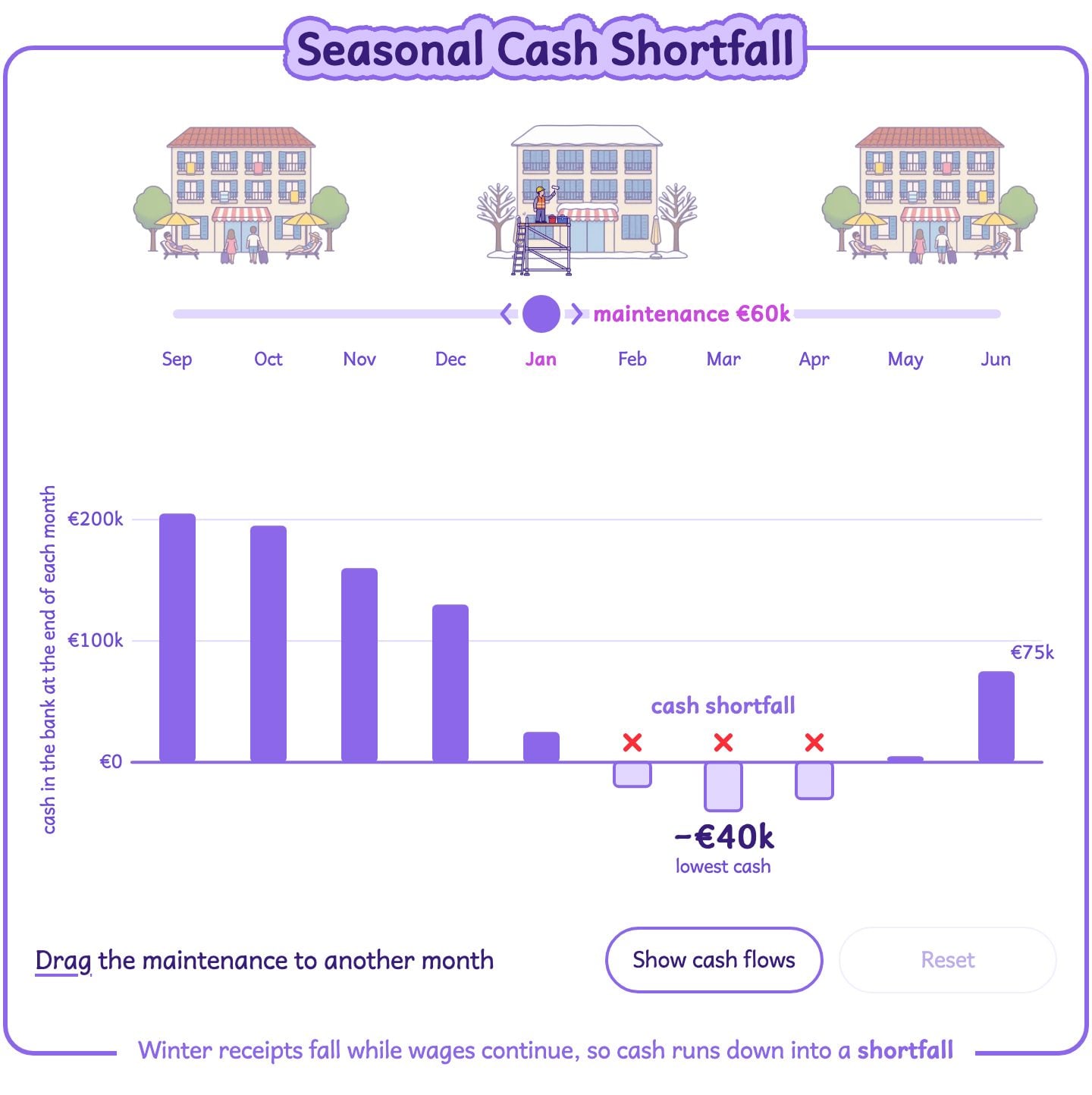
Step through the months and watch wages keep leaving while receipts fall, running the cash balance down.
Liquidity: being able to pay on the day
Definition
Liquidity: The ability of a business to pay its short-term debts as they fall due, which depends on having enough cash rather than on making a profit.
- Cash in the bank is perfectly liquid, inventories are less liquid because they must be sold first, and a factory or delivery fleet is the least liquid of all.
- A firm can own £2m of machinery and still not find £8,000 for Friday's wages, because machinery cannot be sold in a morning at anything near its book value.
- A spare cash balance absorbs shocks, so a broken oven or a failed delivery van can be replaced without halting trade, and it carries seasonal firms through quiet months.
- It also lets a firm take a supplier discount for paying a large order immediately, and it reassures banks deciding how much credit to grant.
- Idle cash still earns almost no interest, so the target is enough to meet the bills that are coming rather than as much as possible.
Example
- Northgate Joinery delivers a £40,000 kitchen order in March to a housebuilder that pays on 60-day credit, so no cash from that order reaches the bank until May.
- Materials of £16,000, wages of £9,000 and rent and energy of £3,000 are all paid during March, so £16,000+£9,000+£3,000=£28,000£16{,}000 + £9{,}000 + £3{,}000 = £28{,}000£16,000+£9,000+£3,000=£28,000 leaves the bank.
- Starting the month with £5,000, the closing balance is £5,000−£28,000=−£23,000£5{,}000 - £28{,}000 = -£23{,}000£5,000−£28,000=−£23,000.
- If the agreed overdraft limit is £10,000 the wage payment is refused, so a firm with a full order book cannot pay its staff.
Insolvency: what running out of cash does to a business
Definition
Insolvency: The position a business reaches when it cannot pay its debts on the day they fall due, which can force it to stop trading even if it is making a profit.
- Suppliers who are not paid stop delivering and insist on cash in advance, so the firm cannot buy materials, cannot produce and loses the sales it was counting on.
- Skilled workers leave for employers who pay on time, so the business loses the people it needs to finish profitable work.
- A lender can demand immediate repayment and, if it is not paid, force the business to close so its assets are sold to settle the debts.
- Assets sold in a forced sale raise far less than they are worth, so owners lose most of the capital they put in.
- A shortage of cash rather than a low profit figure is the usual immediate cause of failure, and new firms are most exposed in their first two years when they hold no reserves.
Exam technique
- Name the payment that fails, such as Friday's wage bill, and say what happens next, rather than writing that the business will lose money.
- Keep the word cash for money available today and do not swap it for capital, revenue or profit halfway through an answer.
Self review
- Name two payments a business can only settle with cash.
- What does it mean to say a business is insolvent?
- Why are inventories less liquid than a bank balance?
- A firm sells £40,000 of goods in March on 60-day credit, so how much cash does that sale bring in during March?
- Give one reason for holding a cash buffer and one cost of holding too much.