

What you'll learn
- Why tiny unicellular organisms can use diffusion, but larger organisms need transport systems.
- How xylem and phloem move substances through flowering plants.
- How transpiration is measured and affected by environmental factors.
- How blood, the heart and blood vessels transport substances in humans.
Why transport systems are needed
A unicellular organism is made of one cell. Many unicellular organisms, such as Amoeba, are small enough that substances can move in and out by diffusion alone.
Diffusion
Diffusion is the net movement of particles from a region of higher concentration to a region of lower concentration, down a concentration gradient.
Diffusion works well in small organisms because the diffusion distance is short and the surface area compared with the volume is large. This means enough oxygen, carbon dioxide, water and waste can cross the cell surface quickly enough.
Multicellular organisms are bigger, so many cells are far away from the outside surface. They also have a smaller surface area to volume ratio and a higher demand for substances. Diffusion alone would be too slow, so they need transport systems to move substances around the body or plant.
Comparing surface area to volume
-
For a cube with side length l=1 mml = 1\text{ mm}l=1 mm, use SA=6l2SA = 6l^2SA=6l2 and V=l3V = l^3V=l3. So SA=6 mm2SA = 6\text{ mm}^2SA=6 mm2 and V=1 mm3V = 1\text{ mm}^3V=1 mm3, giving a surface area to volume ratio of 6:1.
-
For a cube with side length l=10 mml = 10\text{ mm}l=10 mm, SA=600 mm2SA = 600\text{ mm}^2SA=600 mm2 and V=1000 mm3V = 1000\text{ mm}^3V=1000 mm3, giving a ratio of 0.6:1.
-
The larger cube has much less surface area for each unit of volume, and substances must diffuse further to reach the centre. This is why larger organisms need transport systems.
The transport problem
As organisms get larger, diffusion becomes too slow to supply every cell, so specialised exchange surfaces and transport systems are needed.
Transport in flowering plants
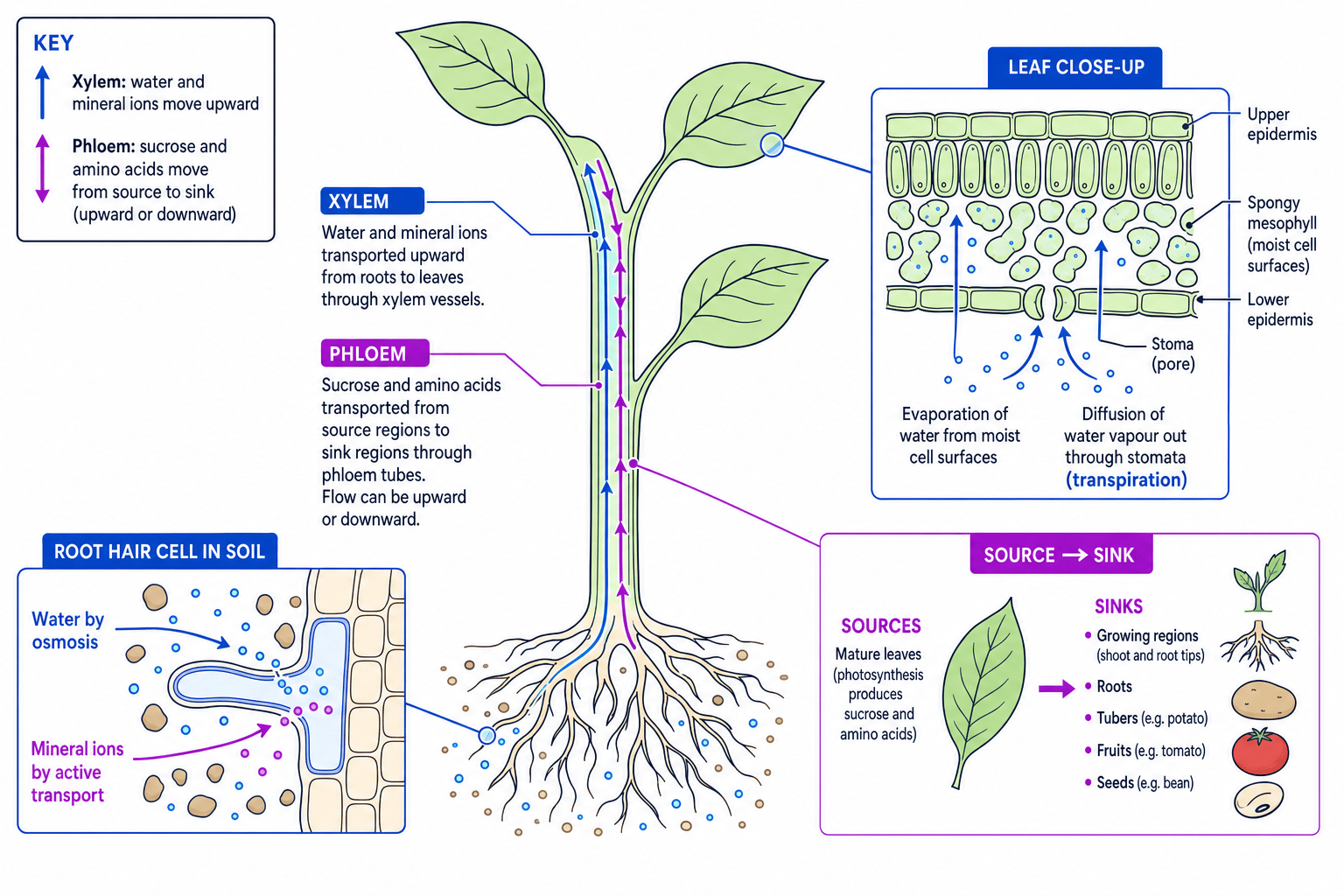
Flowering plants have two main transport tissues: xylem and phloem. A tissue is a group of similar cells working together for a function.
Xylem: water and mineral ions
Xylem transports water and mineral ions from the roots to the leaves and other parts of the plant. Movement in xylem is mainly upwards. Xylem vessels are long, hollow tubes, which helps water move through them efficiently.
Phloem: sucrose and amino acids
Phloem transports sucrose and amino acids between the leaves and other parts of the plant. This can be upwards or downwards, depending on where substances are made and where they are needed.
A source is a part of the plant that produces or releases sucrose, such as a mature leaf. A sink is a part that uses or stores sucrose, such as roots, fruits, seeds or growing shoots.
This diagram links the main plant transport tissues, root hair uptake and transpiration.
Xylem versus phloem
Do not mix up the substances: xylem carries water and mineral ions, while phloem carries sucrose and amino acids.
Water absorption by root hair cells
The next plant water details are Paper 2 only, but you should still learn them fully.
Root hair cells are adapted for absorption because they have a long projection, giving a large surface area. Water enters root hair cells by osmosis.
Osmosis
Osmosis is the movement of water molecules from a dilute solution to a more concentrated solution through a partially permeable membrane.
Mineral ions often move from the soil into root hair cells by active transport. Active transport moves substances against a concentration gradient and requires energy from respiration.
Transpiration
Transpiration
Transpiration is the evaporation of water from the surface of a plant, especially from moist cell surfaces inside leaves, followed by diffusion of water vapour out through stomata.
When water evaporates from leaf cells, more water is pulled up through the xylem from the roots. This helps maintain the movement of water and mineral ions through the plant.
Factors affecting transpiration rate
The rate of transpiration changes with environmental conditions:
- Higher humidity decreases transpiration because the air already contains more water vapour, so the diffusion gradient is smaller.
- Higher wind speed increases transpiration because moist air is blown away from the leaf surface.
- Higher temperature increases transpiration because water evaporates faster.
- Higher light intensity usually increases transpiration because stomata open for gas exchange during photosynthesis.
Practical: investigating transpiration
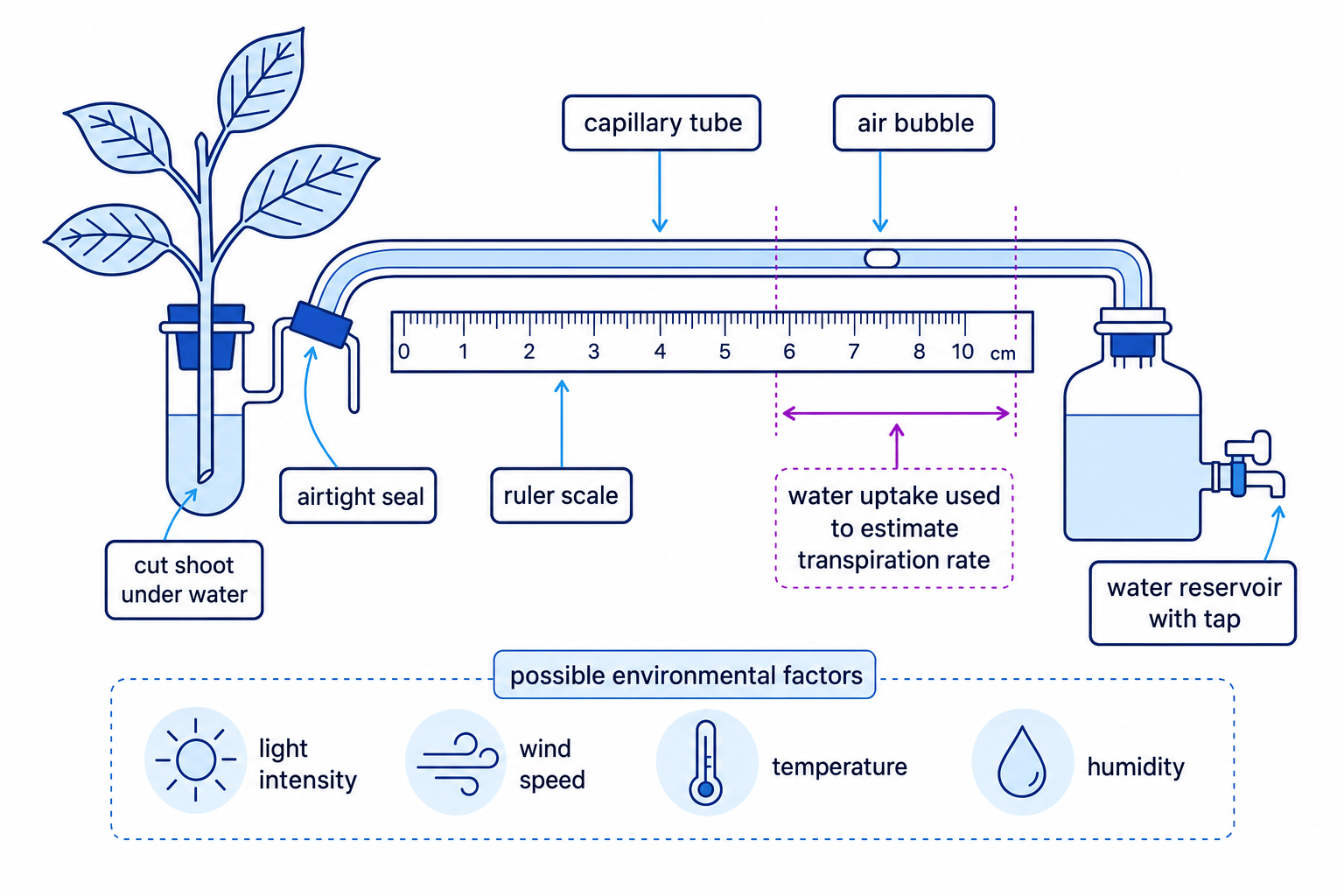
A potometer estimates transpiration rate by measuring water uptake by a leafy shoot. Water uptake is used as an estimate because most water taken up by the shoot is lost by transpiration.
The potometer setup below shows how bubble movement in a capillary tube can be used to estimate water uptake.
Method
- Fill the potometer completely with water so there are no air bubbles.
- Cut the leafy shoot under water to stop air entering the xylem.
- Attach the shoot securely and make all joints airtight.
- Introduce one air bubble into the capillary tube.
- Record how far the bubble moves in a set time.
- Change one environmental factor, such as wind speed or light intensity, and repeat.
- Reset the bubble using the reservoir, repeat readings and calculate a mean.
The independent variable is the environmental factor you change. The dependent variable is the rate of water uptake. Control variables include leaf area, temperature, time, light intensity and wind speed, depending on which factor is being tested.
Calculating transpiration rate
-
In still air, the bubble moves 12 mm in 4 minutes. Use rate=distance movedtime\text{rate} = \frac{\text{distance moved}}{\text{time}}rate=timedistance moved, so the rate is 124=3 mm min−1\frac{12}{4} = 3\text{ mm min}^{-1}412=3 mm min−1.
-
With a fan, the bubble moves 30 mm in 4 minutes, so the rate is 304=7.5 mm min−1\frac{30}{4} = 7.5\text{ mm min}^{-1}430=7.5 mm min−1.
-
Compare the rates: 7.53=2.5\frac{7.5}{3} = 2.537.5=2.5. The fan makes water uptake 2.5 times faster because moving air removes water vapour from around the leaf.
Potometer assumptions
A potometer measures water uptake, not water loss directly. It is a good estimate of transpiration, but some water is used in the plant.
Transport in humans: blood
Blood is a transport tissue with four main components:
- Plasma: the liquid part of blood.
- Red blood cells: transport oxygen.
- White blood cells: defend against pathogens.
- Platelets: help blood clot.
Plasma transports carbon dioxide, digested food molecules such as glucose and amino acids, urea from the liver to the kidneys, hormones and heat energy.
Red blood cells
Red blood cells are adapted for transporting oxygen:
- They have a biconcave disc shape, giving a large surface area and short diffusion distance.
- They have no nucleus, leaving more space for haemoglobin.
- They contain haemoglobin, which binds oxygen in the lungs and releases it to body cells.
White blood cells and immunity
A pathogen is a microorganism that causes disease. White blood cells help protect the body from pathogens.
Phagocytes ingest pathogens and digest them. Lymphocytes release antibodies. An antibody is a protein that is specific to a particular pathogen, meaning it fits that pathogen’s surface antigens.
Vaccination is Paper 2 only. A vaccine introduces harmless antigens, such as weakened or dead pathogens, into the body. Lymphocytes respond by producing antibodies and memory cells. If the same pathogen enters later, memory cells cause antibody production to happen sooner, faster and in greater quantity.
Antibodies are specific
In immune-system answers, say that antibodies are specific to the pathogen. This is often the key marking point.
Platelets and blood clotting
Platelets are small cell fragments involved in blood clotting, also Paper 2 only. A clot prevents blood loss and stops micro-organisms entering the body through the wound.
The heart and circulation
The heart is a muscular organ that pumps blood around the body. It has four chambers: the right atrium, right ventricle, left atrium and left ventricle. The atria receive blood; the ventricles pump blood out. Valves prevent backflow, and the septum separates the left and right sides.
Blood flow through the heart is:
Vena cava to right atrium to right ventricle to pulmonary artery to lungs to pulmonary vein to left atrium to left ventricle to aorta to body.
The diagram shows the double circulation and the main vessels to and from key organs.
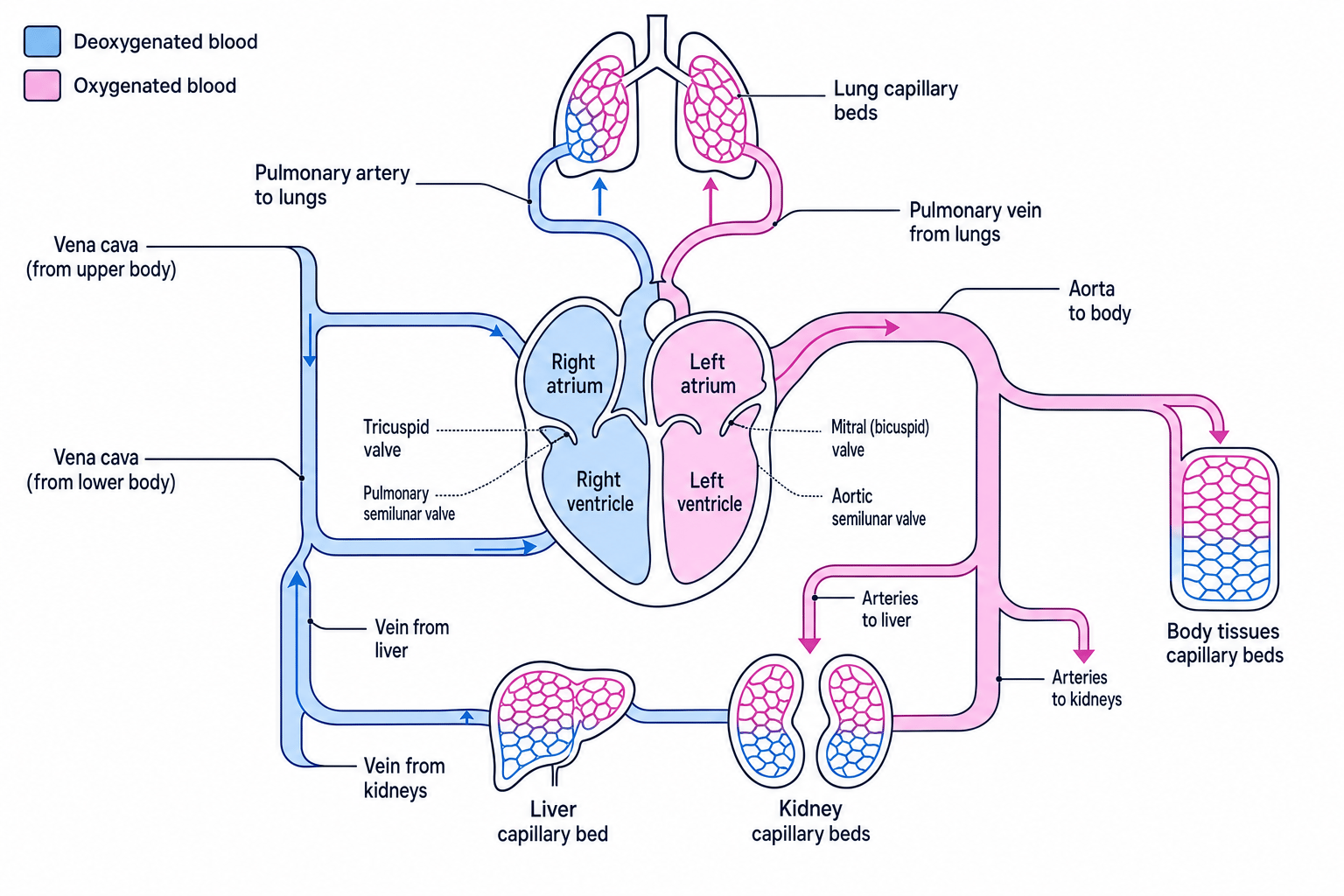
The pulmonary circulation carries blood between the heart and lungs. The systemic circulation carries blood between the heart and the rest of the body.
The liver receives oxygenated blood through the hepatic artery and returns blood through the hepatic vein. It also receives digested food from the small intestine through the hepatic portal vein. The kidneys receive blood through the renal arteries and return blood through the renal veins.
Heart rate, exercise and adrenaline
During exercise, muscle cells respire faster. They need more oxygen and glucose, and they produce more carbon dioxide and heat. The heart rate increases so blood transports these substances faster.
Adrenaline is a hormone released in stressful or exciting situations. It increases heart rate, helping prepare the body for “fight or flight”.
Coronary heart disease
The coronary arteries supply the heart muscle with oxygen and glucose. Coronary heart disease can happen when fatty deposits build up in these arteries, narrowing the lumen. This reduces blood flow to the heart muscle and can lead to a heart attack.
Risk factors include smoking, high blood pressure, a diet high in saturated fat, high cholesterol, lack of exercise, obesity, stress and genetic factors.
Risk factors are not guarantees
A risk factor increases the chance of disease, but it does not mean the disease will definitely happen.
Arteries, veins and capillaries
| Blood vessel | Structure | Function link |
|---|---|---|
| Arteries | Thick muscular and elastic walls, small lumen, no valves | Carry blood away from the heart at high pressure |
| Veins | Thinner walls, larger lumen, valves | Carry blood back to the heart at lower pressure; valves prevent backflow |
| Capillaries | Walls one cell thick, very narrow lumen | Allow rapid exchange of substances between blood and cells |
Pulmonary exception
Most arteries carry oxygenated blood and most veins carry deoxygenated blood, but the pulmonary artery carries deoxygenated blood to the lungs and the pulmonary vein carries oxygenated blood to the heart.
In the exam
-
For plant transport, always name the tissue, the substance transported and the direction: xylem moves water and mineral ions upwards; phloem moves sucrose and amino acids between sources and sinks.
-
For potometer questions, state the independent variable, dependent variable, control variables, repeats and the rate calculation with units.
-
For heart questions, trace blood in order and remember that valves prevent backflow.
Check yourself
- Why can a unicellular organism rely on diffusion, but a large multicellular organism cannot?
- How would increasing humidity and increasing wind speed affect transpiration rate?
- Can you trace a red blood cell from the vena cava to a kidney capillary bed?
