

What you'll learn
- How diffusion allows oxygen and carbon dioxide to move in plants and humans.
- How leaves, stomata and alveoli are adapted for efficient gas exchange.
- How light intensity changes net gas exchange in leaves.
- How to describe the breathing practicals, including carbon dioxide release and exercise.
The big idea: gases move by diffusion
All living cells need to exchange gases with their surroundings. In animals, oxygen is needed for aerobic respiration, and carbon dioxide is produced as a waste gas. In green plants, photosynthesis also affects the movement of gases.
Diffusion
Diffusion is the net movement of particles from a region of higher concentration to a region of lower concentration, down a concentration gradient.
A concentration gradient means there is a difference in concentration between two places. The steeper the gradient, the faster diffusion can happen.
Gas exchange depends on gradients
Gas exchange is not “pumping” gases across a surface. Oxygen and carbon dioxide diffuse because their concentrations are different on each side of the exchange surface.
Gas exchange in flowering plants (Paper 2 only)
The plant gas exchange points in this section are Paper 2 only, but they are still part of the course and can be examined fully on that paper.
Photosynthesis and respiration use different gases
Plants do photosynthesis in chloroplasts when light is available. Photosynthesis uses carbon dioxide and produces oxygen.
Plants also do respiration all the time, in both light and darkness. Respiration uses oxygen and produces carbon dioxide.
So a leaf has two processes affecting gases:
- Photosynthesis: carbon dioxide in, oxygen out
- Respiration: oxygen in, carbon dioxide out
Plants respire all the time
Do not write that plants “only respire at night”. They respire during the day and night. The difference is that photosynthesis only happens when there is enough light.
How a leaf is adapted for gas exchange
A leaf is well adapted for diffusion because gases need short, easy pathways into and out of the cells.
Important adaptations include:
- Thin shape: gives a short diffusion distance.
- Broad surface: provides a large surface area for exchange.
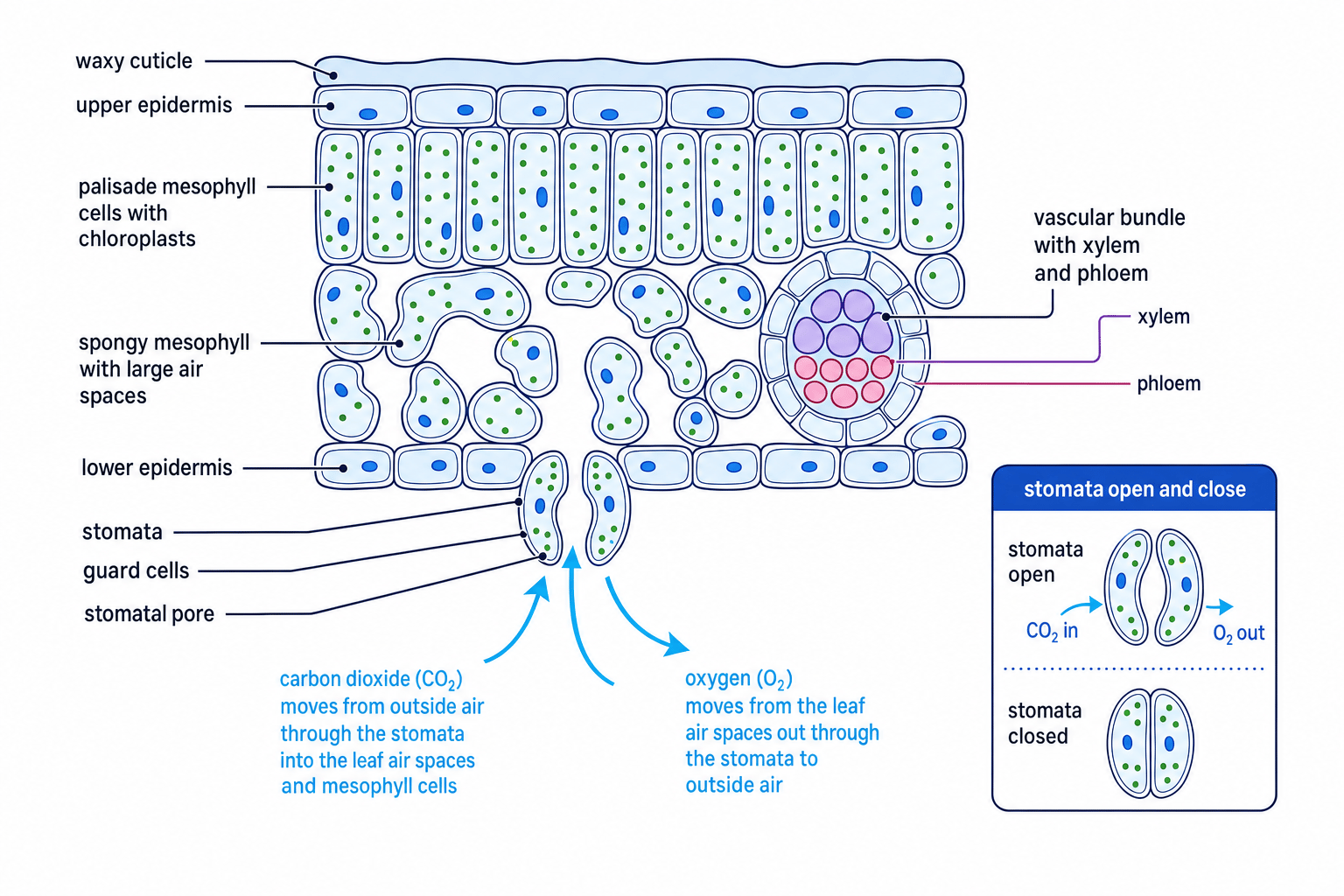
- Spongy mesophyll: has large air spaces so gases can diffuse through the leaf.
- Moist cell surfaces: gases dissolve before diffusing into cells.
- Stomata: tiny pores that allow gases to enter and leave.
- Many chloroplasts in palisade mesophyll cells: photosynthesis uses carbon dioxide, helping maintain a carbon dioxide gradient into the leaf in light.
Stomata
Stomata are tiny pores, usually found mostly on the lower surface of a leaf, that allow gases to diffuse in and out.
Each stoma is surrounded by two guard cells. Guard cells can change shape to open or close the pore. When stomata are open, carbon dioxide can diffuse in for photosynthesis, while oxygen and water vapour can diffuse out.
Stomata balance two needs
Open stomata allow gas exchange, but they also increase water loss. Closing stomata reduces water loss but also reduces carbon dioxide entry.
Net gas exchange and light intensity
Because respiration and photosynthesis happen at the same time in the light, we often talk about net gas exchange.
Net gas exchange
Net gas exchange means the overall movement of gases after considering both photosynthesis and respiration together.
The net exchange depends on light intensity:
- Bright light: photosynthesis is faster than respiration, so there is net carbon dioxide uptake and net oxygen release.
- Low light: photosynthesis may equal respiration, so there is no net gas exchange.
- Darkness: photosynthesis stops, but respiration continues, so there is net oxygen uptake and net carbon dioxide release.
Interpreting net gas exchange
A leaf is placed in hydrogen-carbonate indicator. After some time, the indicator is purple in bright light, red-orange in dim light and yellow in darkness.
- Link the colours to carbon dioxide concentration: purple means low carbon dioxide, red-orange means about atmospheric carbon dioxide, and yellow means high carbon dioxide.
- In bright light, carbon dioxide has fallen, so photosynthesis has used more carbon dioxide than respiration has produced. The leaf has net carbon dioxide uptake.
- In darkness, carbon dioxide has risen, so respiration is producing carbon dioxide with no photosynthesis to remove it. The leaf has net carbon dioxide release.
Practical: effect of light on net gas exchange from a leaf
In this named practical, you investigate how light affects net gas exchange using hydrogen-carbonate indicator.
Hydrogen-carbonate indicator
Hydrogen-carbonate indicator changes colour depending on carbon dioxide concentration: yellow in high carbon dioxide, red-orange in normal air, and purple in low carbon dioxide.
Method
- Put equal-sized leaves into separate boiling tubes with the same volume of hydrogen-carbonate indicator.
- Seal the tubes with bungs to stop outside air entering.
- Place the tubes in different light conditions, for example bright light, dim light and darkness.
- Use a control tube with indicator but no leaf.
- Leave the tubes for the same length of time, then record the final colour.
Variables
- Independent variable: light intensity.
- Dependent variable: indicator colour, showing net carbon dioxide change.
- Control variables: leaf size, plant species, volume of indicator, time left, temperature, starting indicator colour and distance from the lamp.
Expected results
In bright light, the indicator should turn purple because photosynthesis removes carbon dioxide. In darkness, it should turn yellow because respiration releases carbon dioxide. In dim light, it may stay red-orange if photosynthesis and respiration are roughly balanced.
Breathing near the tubes
Your exhaled air contains extra carbon dioxide. If you breathe into or near an open tube, the indicator may turn yellow for the wrong reason.
Gas exchange in humans
Humans exchange gases in the lungs. The lungs are inside the thorax, which is the chest cavity.
Structure of the thorax
The air pathway is:
trachea → bronchi → bronchioles → alveoli
Key structures:
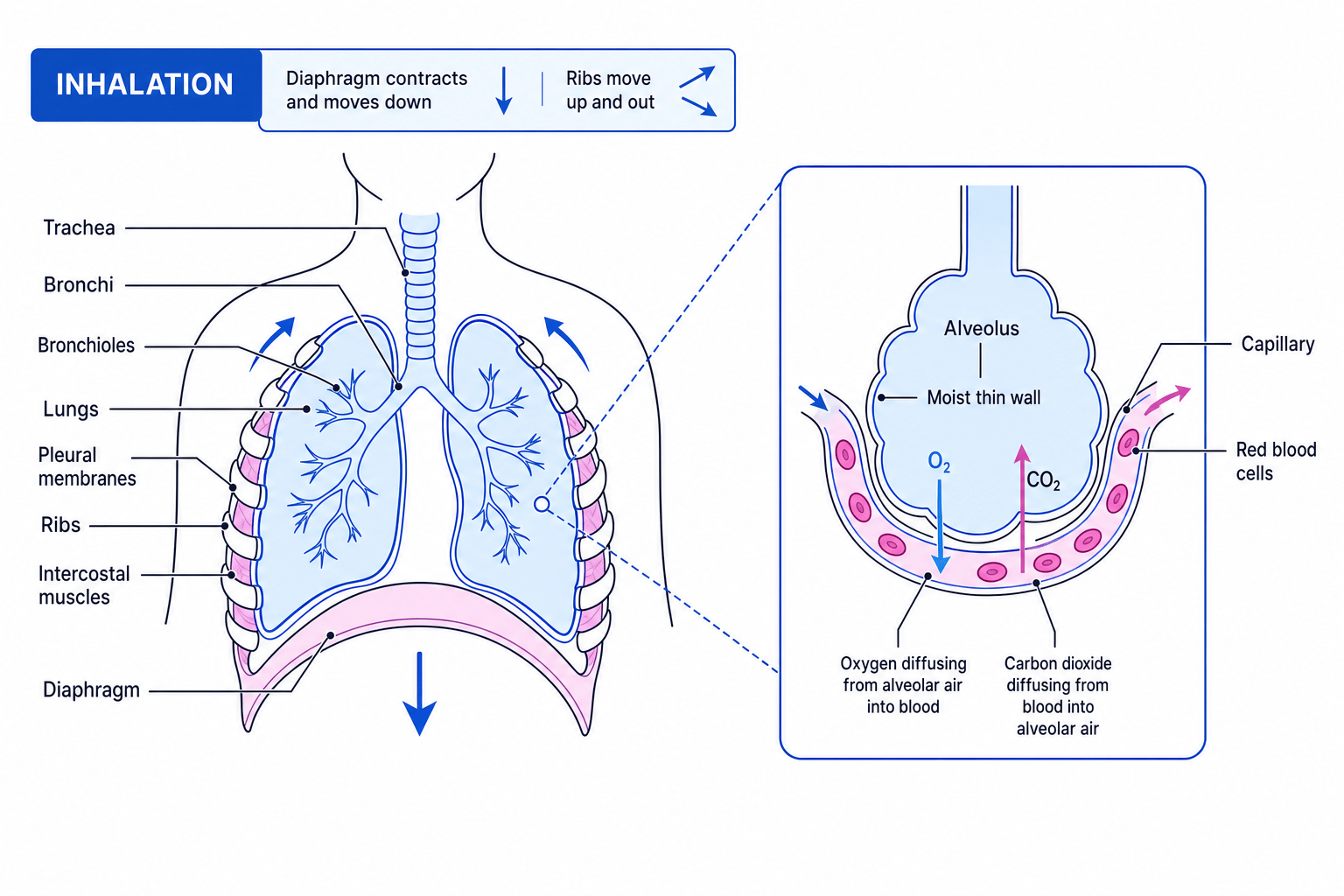
- Ribs: protect the lungs and help change thorax volume.
- Intercostal muscles: muscles between the ribs.
- Diaphragm: a sheet of muscle below the lungs.
- Trachea: the windpipe.
- Bronchi: two main branches from the trachea, one to each lung.
- Bronchioles: smaller branches inside the lungs.
- Alveoli: tiny air sacs where gas exchange happens.
- Pleural membranes: membranes around the lungs and inner chest wall that reduce friction and help the lungs move with the thorax.
Ventilation: moving air in and out
Ventilation
Ventilation is the movement of air into and out of the lungs.
Ventilation maintains steep concentration gradients for diffusion at the alveoli.
Inhalation
During inhalation:
- The intercostal muscles contract, moving the ribs up and out.
- The diaphragm contracts and flattens.
- The volume of the thorax increases.
- The pressure inside the lungs decreases.
- Air moves into the lungs.
Exhalation
During resting exhalation:
- The intercostal muscles relax, so the ribs move down and in.
- The diaphragm relaxes and becomes dome-shaped.
- The volume of the thorax decreases.
- The pressure inside the lungs increases.
- Air moves out of the lungs.
Volume and pressure link
For breathing questions, use the chain: muscle action → thorax volume changes → pressure changes → air moves.
Alveoli are adapted for diffusion
Alveoli are specialised gas exchange surfaces.
They are adapted because they have:
- A very large surface area from many tiny air sacs.
- Thin walls, only one cell thick, giving a short diffusion distance.
- Moist lining, so gases can dissolve.
- A rich blood supply from capillaries.
- Constant ventilation, maintaining concentration gradients.
Oxygen diffuses from the air in the alveoli into the blood. Carbon dioxide diffuses from the blood into the air in the alveoli.
Alveoli and concentration gradients
Blood arriving at the lungs has a low oxygen concentration and a high carbon dioxide concentration. Air in the alveoli has more oxygen and less carbon dioxide, so both gases diffuse down their gradients.
Smoking and its consequences
Smoking affects both the lungs and the circulatory system.
In the lungs:
- Tar damages cilia, which normally move mucus and trapped dirt away from the lungs.
- More mucus builds up, increasing the risk of infections and bronchitis.
- Alveoli can be damaged, reducing surface area for gas exchange and causing emphysema.
- Carcinogens in smoke increase the risk of lung cancer.
In the circulatory system:
- Carbon monoxide reduces the blood’s ability to carry oxygen because it binds to haemoglobin.
- Nicotine is addictive and can increase heart rate and blood pressure.
- Smoking increases the risk of coronary heart disease, where coronary arteries become narrowed or blocked, reducing oxygen supply to heart muscle.
Coronary heart disease
Coronary heart disease is a condition where the coronary arteries are narrowed or blocked, reducing blood flow to the heart muscle.
Practical: investigating breathing in humans
This named practical has two common parts: showing that exhaled air contains carbon dioxide, and investigating how exercise affects breathing.
Showing carbon dioxide is released
A simple method uses limewater.
- Put limewater into a test tube.
- Breathe out gently through a clean straw into the limewater.
- Observe the colour change.
Limewater turns cloudy or milky when carbon dioxide is present. A control can be limewater exposed to normal air for the same time.
Safety with breathing practicals
Use clean mouthpieces or straws, do not share them, and never suck liquid back up the tube.
Investigating the effect of exercise
A simple method:
- Sit still and count breaths for one minute to find resting breathing rate.
- Exercise for a set time, such as two minutes of step-ups.
- Count breaths for one minute immediately after exercise.
- Repeat at intervals to see recovery, or repeat the whole investigation and calculate a mean.
Control variables include the same person, same exercise, same duration, same counting time and similar room temperature.
Expected result: breathing rate and depth increase after exercise because muscle cells respire faster, using more oxygen and producing more carbon dioxide.
Calculating breathing rate
A student counts 18 breaths in 30 seconds at rest and 32 breaths in 30 seconds immediately after exercise.
- Convert 30 seconds into minutes: 30 seconds is 0.5 minutes.
- Calculate resting breathing rate: 18÷0.5=3618 \div 0.5 = 3618÷0.5=36, so the resting rate is 36 breaths per minute.
- Calculate post-exercise breathing rate: 32÷0.5=6432 \div 0.5 = 6432÷0.5=64, so the rate after exercise is 64 breaths per minute.
- Calculate the percentage increase: 64−3636×100=77.8%\frac{64 - 36}{36} \times 100 = 77.8\%3664−36×100=77.8%, so the breathing rate increased by about 78%.
Confusing breathing with respiration
Breathing is ventilation: moving air in and out. Respiration is the chemical process in cells that releases energy from glucose.
In the exam
- For diffusion explanations, mention the concentration gradient, the exchange surface and the direction of movement.
- For ventilation questions, write the full chain: muscle contraction or relaxation → volume change → pressure change → air movement.
- For practical questions, include the independent variable, dependent variable, control variables, expected result and one source of error.
Check yourself
- Why can a leaf release oxygen overall in bright light but take in oxygen in darkness?
- How do stomata help gas exchange, and what is the disadvantage of leaving them open?
- Why does exercise increase breathing rate?
