What you'll learn
- What excretion means, and how it is different from removing undigested food.
- How flowering plants lose waste carbon dioxide and oxygen through stomata.
- The excretory products of the lungs, kidneys and skin.
- How the kidney filters blood, reabsorbs useful substances, and controls water content using ADH (Paper 2 only).
What is excretion?
Your cells are constantly carrying out metabolism: all the chemical reactions that happen inside living organisms. Some of these reactions produce waste substances. If these wastes build up, they can become harmful, so the body must remove them.
Excretion
Excretion is the removal from the body of waste products of metabolism, toxic substances, and substances in excess of requirements.
Excretion is not the same as egestion, which is the removal of undigested food from the digestive system as faeces. Faeces are not mainly metabolic waste, so egestion is not excretion.
Excretion vs egestion
Do not write that faeces are an excretory product. Excretion removes metabolic wastes, such as carbon dioxide and urea; egestion removes undigested material from the gut.
Excretion in flowering plants
Waste gases from metabolism
Flowering plants carry out both respiration and photosynthesis.
- Respiration releases energy in cells and produces carbon dioxide as a waste product.
- Photosynthesis uses light energy to make glucose and produces oxygen as a waste product.
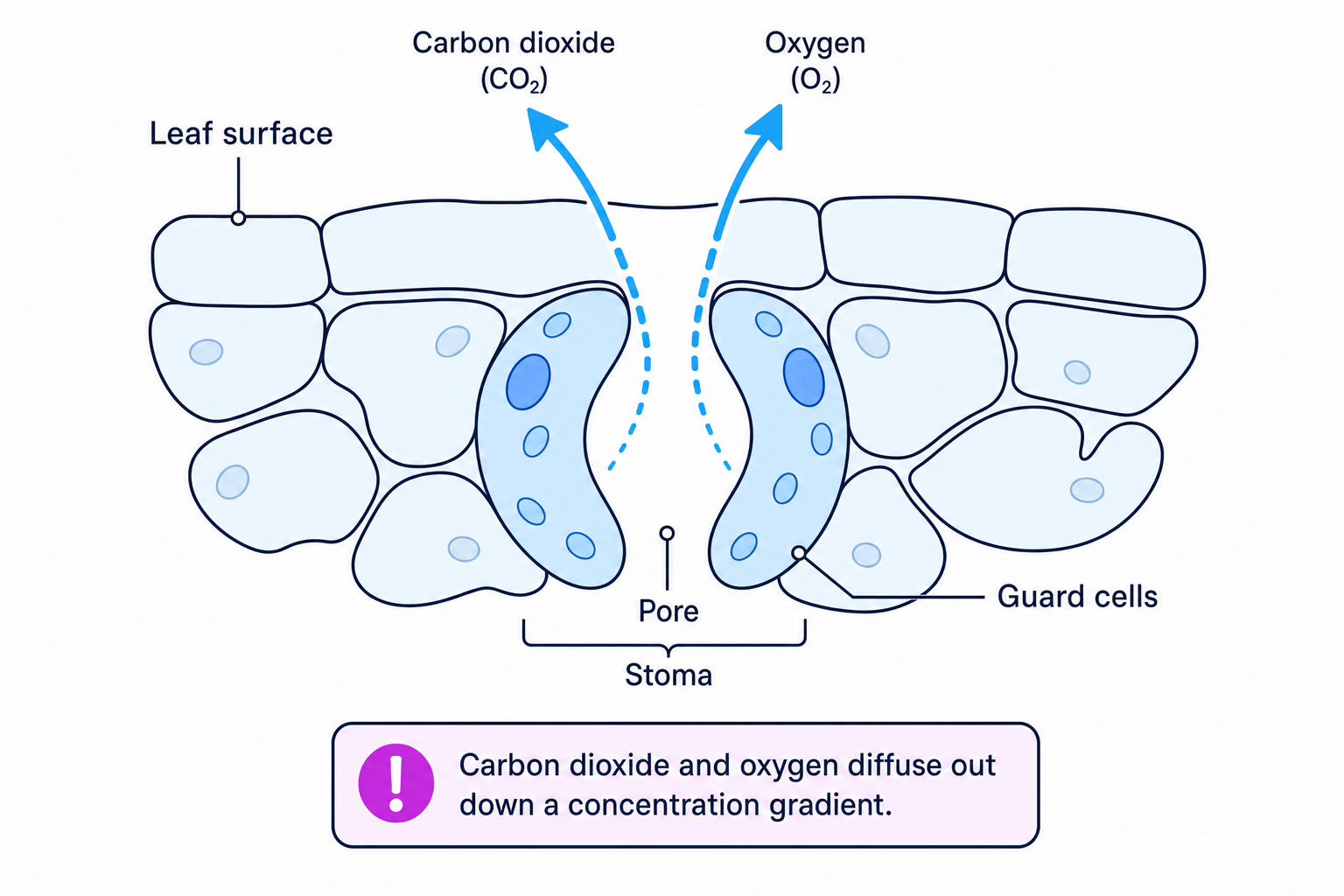
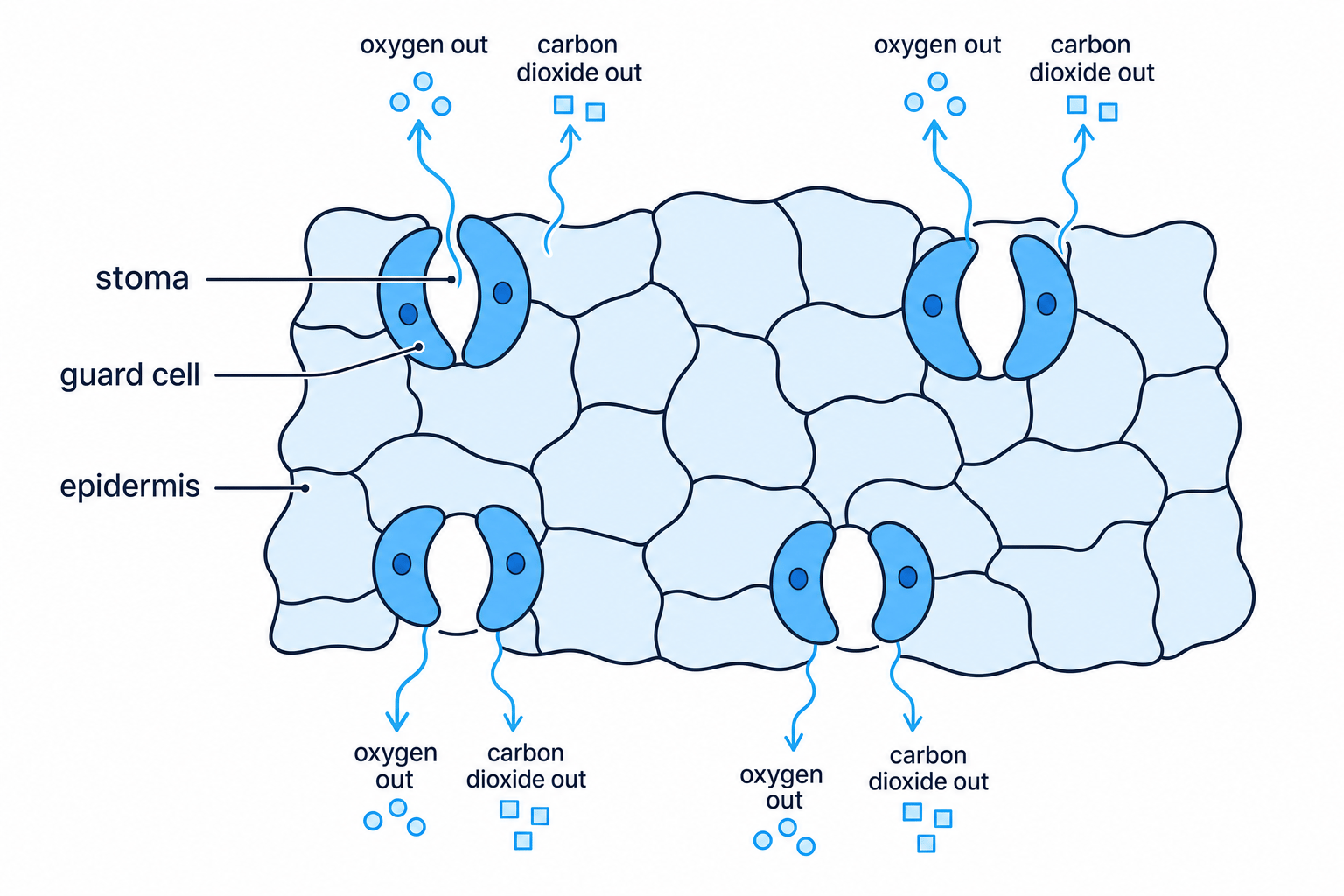
These gases leave the leaf mainly through stomata. A stoma is a tiny pore in the leaf surface. Each stoma is controlled by two guard cells, which can open or close the pore.
Waste gases diffuse out through stomata when their concentration is higher inside the leaf than outside.
Plant waste gases
In plants, carbon dioxide is a waste product of respiration, and oxygen is a waste product of photosynthesis. Both can be lost from leaves through the stomata.
Predicting gas exchange in a leaf
A leaf is placed in bright light. Predict which waste gas is most likely to leave the leaf in large amounts.
- In bright light, the leaf carries out photosynthesis rapidly, as well as respiration.
- Photosynthesis produces oxygen, so oxygen builds up inside the leaf if it is not all used in respiration.
- Oxygen diffuses out through the stomata down its concentration gradient, so the main waste gas leaving in bright light is oxygen.
Human organs of excretion
An organ of excretion is an organ that removes metabolic waste or excess substances from the body.
Lungs
The lungs excrete:
- carbon dioxide, produced by respiration
- water vapour, also produced during respiration
Carbon dioxide is removed when you breathe out.
Kidneys
The kidneys excrete waste in the form of urine. Urine contains:
- water
- urea
- ions, such as excess mineral ions
Urea
Urea is a waste substance made in the liver from excess amino acids. It is carried in the blood to the kidneys and excreted in urine.
Skin
The skin excretes sweat, which contains:
- water
- ions, especially salts
- small amounts of urea
Sweating is also important in temperature control, but sweat still contains excretory products.
The urinary system (Paper 2 only)
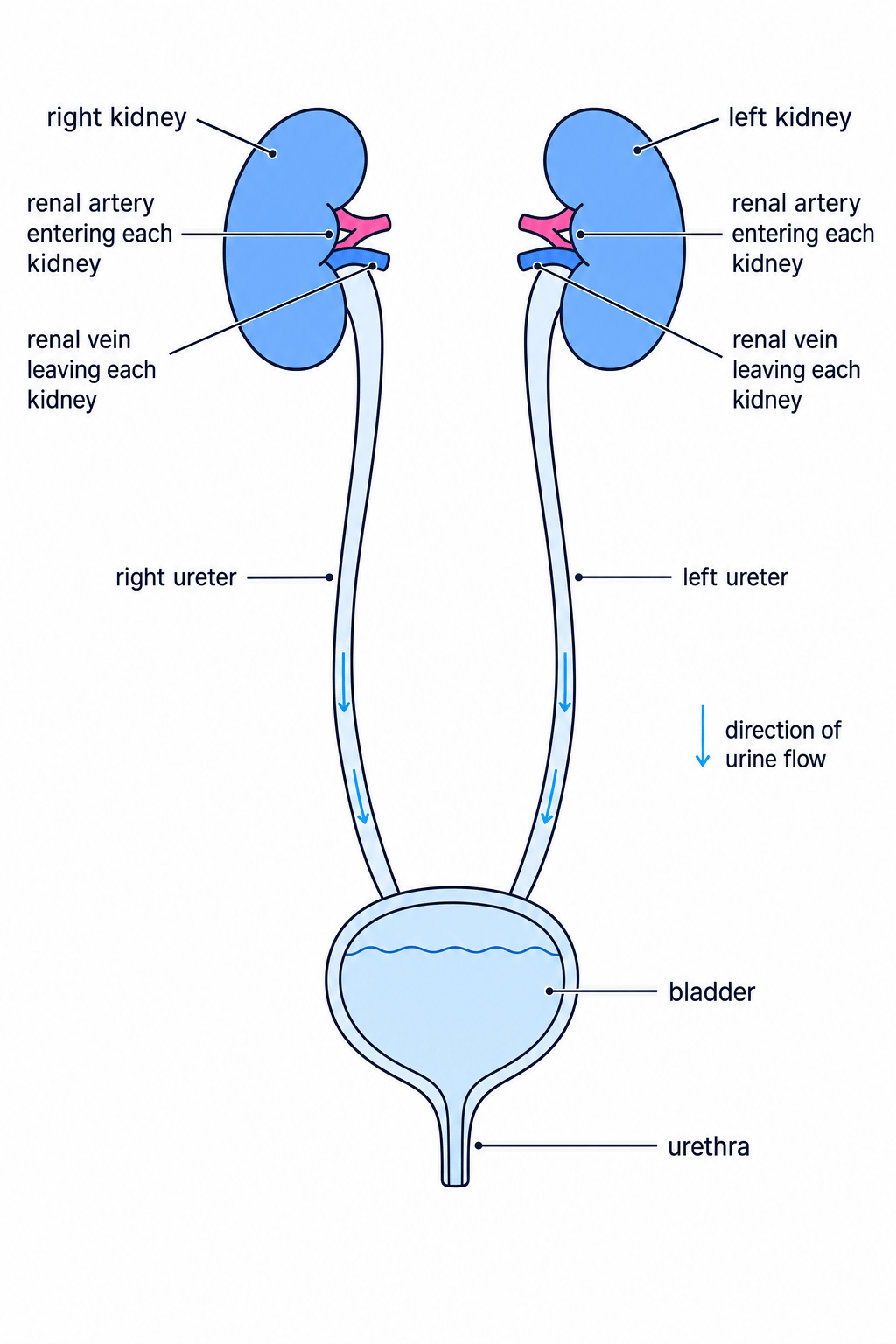
The urinary system makes, stores and removes urine from the body.
- The kidneys filter the blood and produce urine.
- The ureters are tubes that carry urine from the kidneys to the bladder.
- The bladder stores urine.
- The urethra carries urine from the bladder to outside the body.
Blood enters each kidney through a renal artery and leaves through a renal vein.
Kidney roles
The kidneys carry out excretion by removing urea and excess ions, and they carry out osmoregulation by controlling the water content of the blood.
Osmoregulation
Osmoregulation is the control of the water content and ion concentration of body fluids, especially the blood.
The nephron (Paper 2 only)
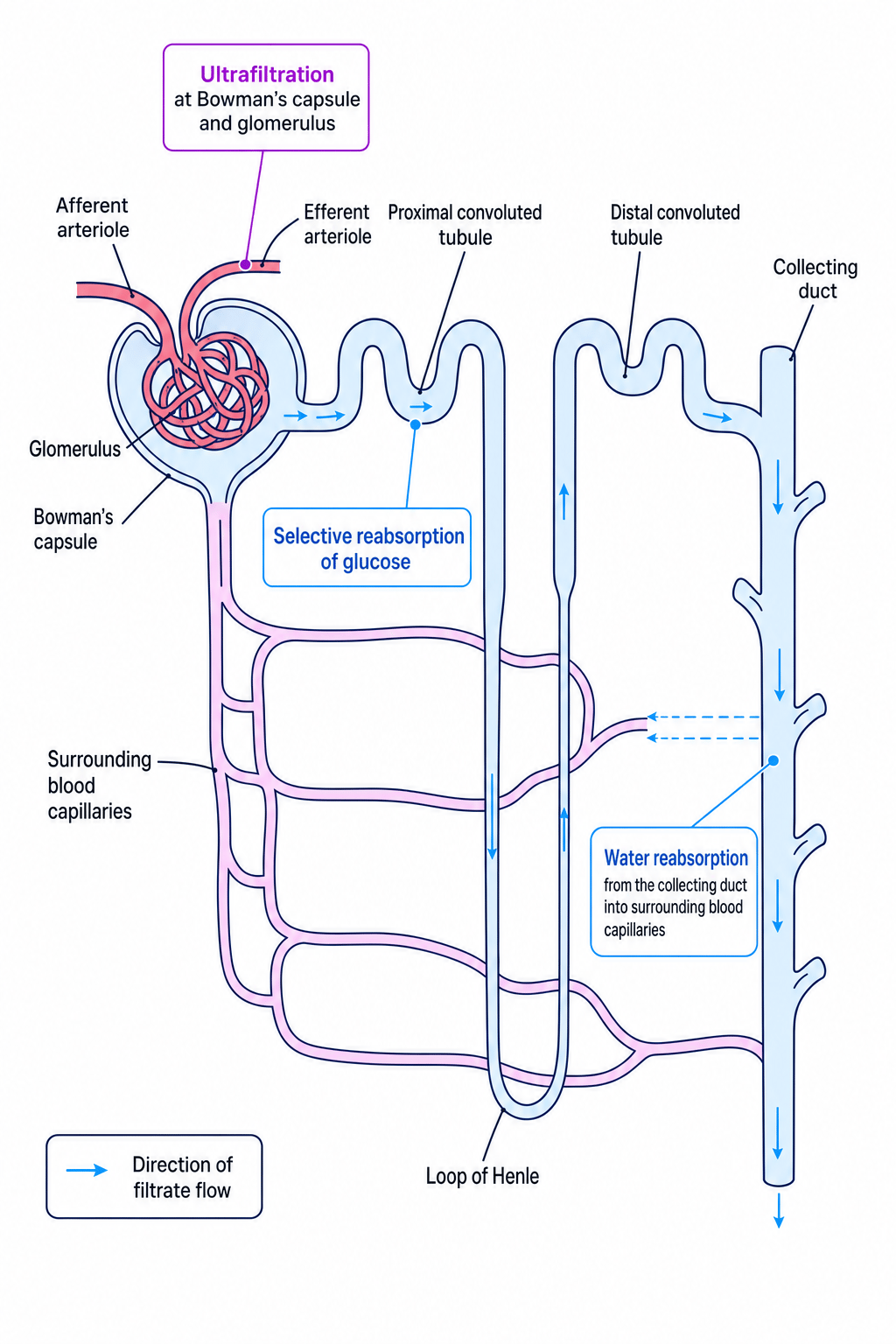
Each kidney contains many tiny filtering units called nephrons. A nephron filters the blood and adjusts the filtrate to form urine.
The main parts are:
- Bowman’s capsule: a cup-shaped structure at the start of the nephron
- glomerulus: a knot of blood capillaries inside Bowman’s capsule
- proximal convoluted tubule: the first coiled tubule after Bowman’s capsule
- loop of Henle: a looped section of the tubule
- distal convoluted tubule: a later coiled tubule
- collecting duct: the tube where final water reabsorption is adjusted before urine leaves the nephron
Ultrafiltration in Bowman’s capsule (Paper 2 only)
Blood enters the glomerulus under high pressure. This pressure forces small molecules out of the blood and into Bowman’s capsule. This process is called ultrafiltration.
Ultrafiltration
Ultrafiltration is filtration under high pressure, where small molecules are forced out of the blood into Bowman’s capsule.
The liquid formed in Bowman’s capsule is called the glomerular filtrate. It contains small molecules, including:
- water
- glucose
- urea
- ions
It does not normally contain:
- blood cells
- large plasma proteins
These are too large to pass through the filter.
Working out filtrate composition
A student says: “The filtrate in Bowman’s capsule contains red blood cells, proteins, glucose and urea.” Decide which parts are correct.
- Ultrafiltration allows small molecules through, so glucose and urea can enter Bowman’s capsule.
- Red blood cells are cells, and plasma proteins are large molecules, so they are too large to pass through the filter.
- The correct composition includes glucose and urea, but not red blood cells or large proteins.
Selective reabsorption of glucose (Paper 2 only)
The body needs glucose for respiration, so it should not be lost in urine. In the proximal convoluted tubule, glucose is selectively reabsorbed from the filtrate back into the blood.
Selective reabsorption
Selective reabsorption is the process where useful substances are taken back from the filtrate into the blood.
This is “selective” because the kidney does not simply take everything back. Useful substances, such as glucose, are reabsorbed, while waste substances, such as urea, remain in the filtrate.
Filtered does not mean excreted
Glucose is filtered into Bowman’s capsule, but it is normally reabsorbed in the proximal convoluted tubule. So healthy urine should not contain glucose.
Water reabsorption and urine formation (Paper 2 only)
As filtrate passes through the nephron, water is reabsorbed into the blood. The final adjustment happens in the collecting duct.
Water moves from the collecting duct into the surrounding blood capillaries by osmosis. Osmosis is the movement of water molecules from a dilute solution to a more concentrated solution through a partially permeable membrane.
If more water is reabsorbed, the urine becomes more concentrated and has a smaller volume. If less water is reabsorbed, the urine becomes more dilute and has a larger volume.
ADH and control of blood water content (Paper 2 only)
ADH stands for antidiuretic hormone. A hormone is a chemical messenger carried in the blood.
ADH helps regulate the water content of the blood by changing how much water is reabsorbed from the collecting ducts.
- If the blood has too little water, more ADH is released.
- More ADH makes the collecting ducts more permeable to water.
- More water is reabsorbed into the blood.
- A small volume of concentrated urine is produced.
If the blood has too much water, less ADH is released. The collecting ducts become less permeable to water, less water is reabsorbed, and a large volume of dilute urine is produced.
Remember ADH
ADH is anti-diuretic: it acts against producing lots of urine. More ADH means less urine, but the urine is more concentrated.
Predicting urine after sweating
A runner sweats heavily during a race. Predict how ADH secretion and urine concentration will change.
- Sweating removes water from the body, so the blood becomes more concentrated and has a lower water content.
- More ADH is released, making the collecting ducts more permeable to water.
- More water is reabsorbed into the blood, so the runner produces a smaller volume of more concentrated urine.
What urine contains (Paper 2 only)
Urine is the final liquid excreted by the kidneys. It contains:
- water, in variable amounts
- urea, from the breakdown of excess amino acids
- ions, especially if they are in excess
The exact concentration of urine changes depending on water intake, sweating, temperature and ADH levels.
In the exam
- Use the word excretion only for metabolic wastes or excess substances, not undigested food.
- For nephron questions, keep the order clear: ultrafiltration in Bowman’s capsule, glucose reabsorption in the proximal convoluted tubule, then water adjustment in the collecting duct.
- In ADH questions, link cause and effect: blood water content changes → ADH changes → collecting duct permeability changes → urine volume and concentration change.
Check yourself
- What waste gas is produced by respiration in plants, and how does it leave the leaf?
- Which substances are found in glomerular filtrate but not normally in final urine?
- What happens to ADH release and urine concentration when the body is dehydrated?