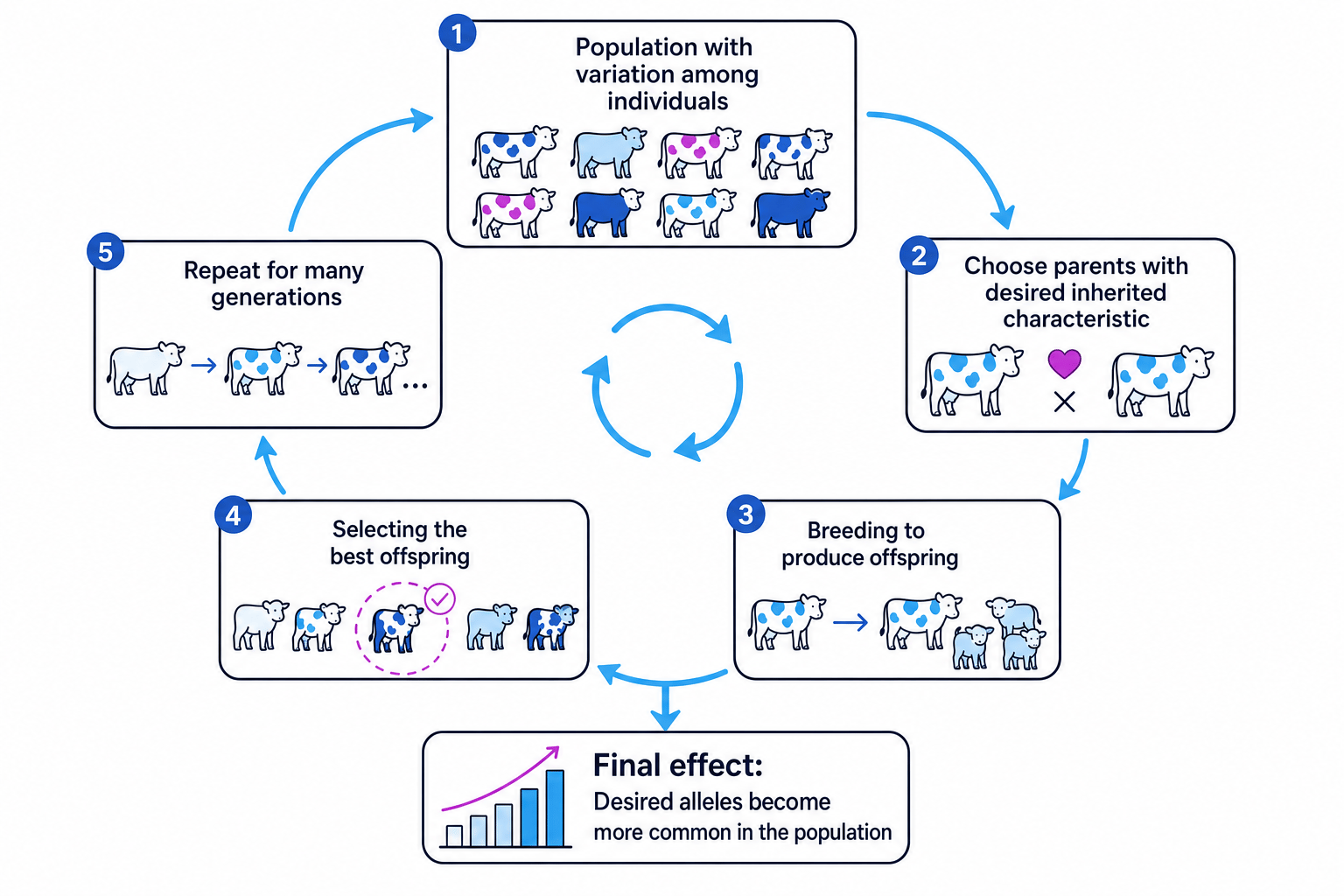
What you'll learn
- Why living things differ, and which differences can be passed from parents to young.
- The step-by-step method of selective breeding.
- How selective breeding can develop crop plants and farm animals with useful features.
- The benefits, risks, and exam points you need to explain clearly.
1. The biology you need first
Characteristics, variation, and inheritance
A characteristic is a feature of an organism, such as height in a plant, milk yield in a cow, or disease resistance in a crop.
Variation means differences between individuals. For example, some tomato plants may produce larger fruits than others, and some sheep may produce thicker wool than others.
A population is a group of organisms of the same kind living or being bred together.
Inside cells, DNA is the chemical that carries genetic information. A gene is a section of DNA that influences a characteristic. An allele is a different version of a gene. Parents pass alleles to their offspring, which means their young.
Inherited characteristic
An inherited characteristic is a feature passed from parents to offspring through genes. This is different from an acquired feature, which is caused by life experiences or the environment, such as a scar or extra muscle from training.
Selective breeding only works well when the useful feature has an inherited basis. If a feature is caused only by the environment, selecting that individual as a parent will not reliably produce offspring with the same feature.
What breeders can select
Breeders choose organisms with useful inherited characteristics, because those organisms are more likely to pass relevant alleles to their offspring.
Deciding what can be selected
- A crop field contains some plants that stay healthy when a disease spreads. If healthy parent plants tend to produce healthy offspring, disease resistance is likely to have a genetic basis.
- A sheep has short wool because it has just been sheared. That difference was caused by cutting the wool, not by alleles for naturally short wool.
- The breeder should select the disease-resistant crop plants for breeding, because their offspring are more likely to inherit alleles linked with resistance.
2. What selective breeding means
In biology, breeding means producing offspring. Selective breeding usually uses sexual reproduction, where two parents contribute genetic information to their offspring.
A desired characteristic is a feature humans want, such as high crop yield, disease resistance, calm behaviour in animals, or high milk production.
Selective breeding
Selective breeding is the process where humans choose parent organisms with desired inherited characteristics and breed them together, then select the best offspring to breed again over many generations.
Selective breeding is also called artificial selection. “Artificial” means humans are doing the selecting, rather than the environment.
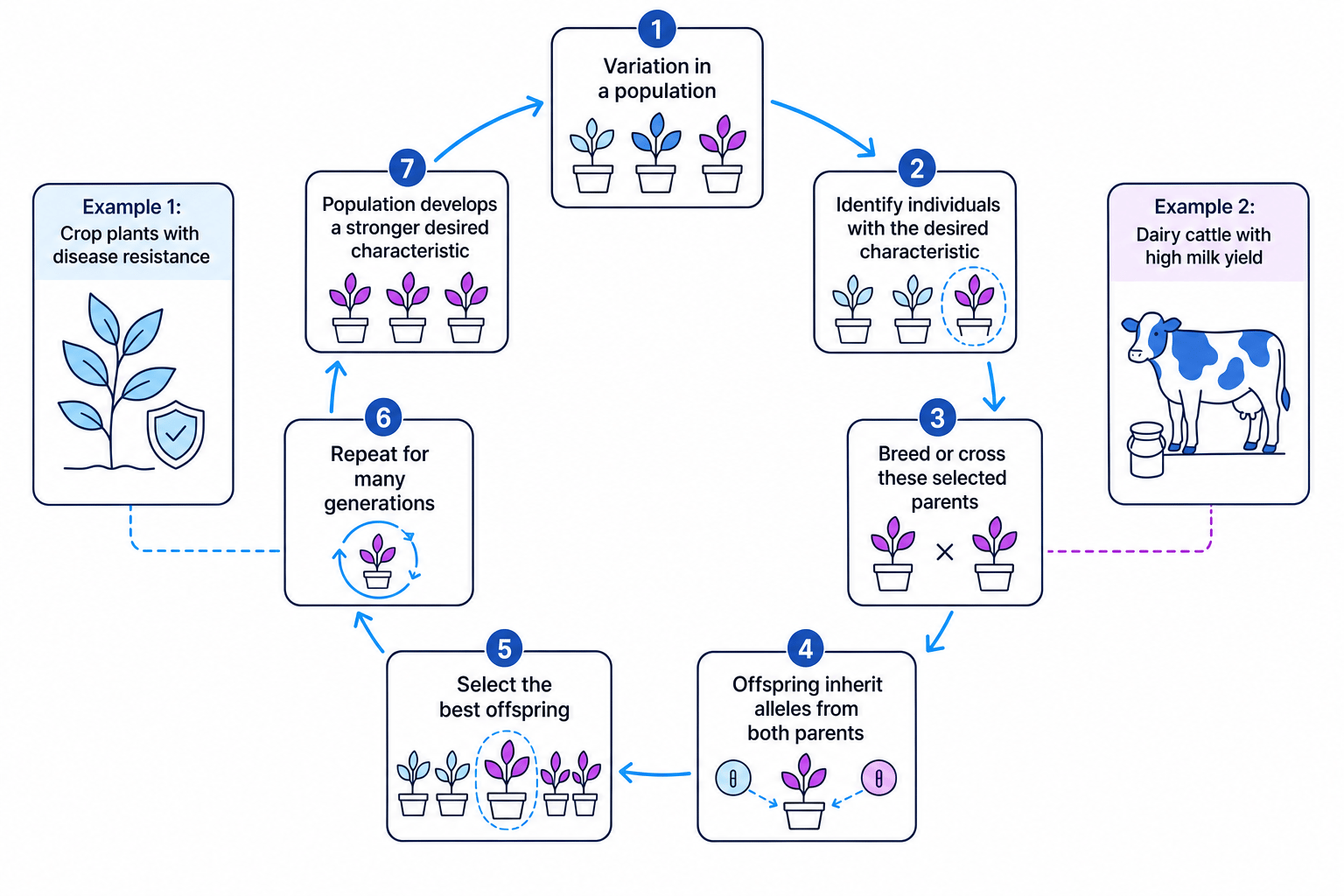
The flow below shows the full cycle. Notice that the process is repeated; one breeding event usually does not produce a completely improved population.
Why repeated selection works
When selected parents reproduce, they pass alleles to their offspring. If the offspring with the strongest desired characteristic are also selected as parents, alleles linked to that characteristic become more common in the population over generations.
The important direction of change
Selective breeding does not change the genes of an individual during its lifetime. It changes the next generations by controlling which organisms reproduce.
The basic method
The general method is the same for plants and animals:
- Choose the desired characteristic.
- Identify individuals that show this characteristic strongly.
- Breed these selected individuals together.
- Select offspring that show the characteristic best.
- Breed those selected offspring.
- Repeat for many generations until the characteristic becomes stronger or more common.
Thinking one organism is transformed
Do not write that selective breeding “turns” an existing cow into a high-milk cow or “makes” one plant disease-resistant. It selects parents so that future offspring are more likely to have the desired inherited characteristic.
3. Developing plants with desired characteristics
Selective breeding can develop plants with features useful to humans, including:
- higher yield, meaning more food produced per plant or per field
- resistance to disease
- larger fruits or seeds
- better flavour or nutritional content
- tolerance to dry conditions
- crops that ripen at the same time, making harvesting easier
Controlled breeding in plants
Many crop plants reproduce using flowers. Pollination is the transfer of pollen from an anther to a stigma. Pollen carries male sex cells, and the stigma is the part of the flower that receives pollen.
In selective breeding, a breeder can carry out controlled pollination, where pollen from a selected plant is deliberately placed onto the stigma of another selected plant. Flowers may be covered with bags to stop unwanted pollen reaching them.
Breeding crop plants for disease resistance
- In a crop population, select plants that remain healthy when exposed to a disease, because these plants are more likely to carry alleles linked with resistance.
- Cross-pollinate selected resistant plants, or cross a resistant plant with another plant that also has a useful characteristic, such as high yield.
- Grow the seeds produced by the cross under similar conditions, so differences between the young plants are less likely to be caused by different amounts of light, water, or minerals.
- Select offspring that show both good disease resistance and strong growth, because these are the individuals most useful for the next generation.
- Repeat the breeding and selection over many generations, increasing the chance that the crop population develops reliable disease resistance.
Why plants are often convenient
Plants often produce many seeds, so breeders can compare lots of offspring and keep only the best few for the next generation.
4. Developing animals with desired characteristics
Selective breeding can also develop animals with desired characteristics, such as:
- cows with higher milk yield
- hens that lay more eggs
- sheep with better wool quality
- pigs or cattle with faster growth or more meat
- animals with disease resistance
- animals with calmer behaviour, making them easier and safer to handle
Controlled breeding in animals
For animals, breeders choose male and female parents with useful inherited characteristics. The animals may mate naturally, or breeders may use artificial insemination, where semen, the fluid containing sperm cells, is placed into the female reproductive system without natural mating.
Animal breeding often takes longer than plant breeding because many animals have fewer offspring and longer generation times.
Choosing cattle for high milk yield
- Compare cows kept in similar conditions, such as similar diet and housing, so differences in milk yield are more likely to be linked to inherited factors rather than the environment.
- Select cows with consistently high milk yield, and select bulls from families where female relatives also produce high milk yields.
- Breed these selected parents and measure the characteristics of their offspring when they mature.
- Keep the offspring with the best inherited performance for future breeding, so alleles linked with high milk yield become more common in the herd over generations.
For some animal characteristics, you cannot measure the feature directly in both sexes. For example, a bull cannot produce milk, so breeders use records from its mother, sisters, or daughters when deciding whether it is a good breeding male.
5. Benefits of selective breeding
Selective breeding is important in food production because it can increase the amount and quality of biological resources humans use.
Benefits include:
- higher food production from crops and farm animals
- reduced crop loss if plants are resistant to disease
- more predictable characteristics, such as uniform fruit size
- economic benefits for farmers and food producers
- improved usefulness, such as animals that are easier to handle
These benefits explain why selective breeding has been used for thousands of years in farming.
6. Risks and limitations
Selective breeding can cause problems, especially if only a small number of parents are used repeatedly.
Gene pool and inbreeding
The gene pool is all the alleles present in a population. Inbreeding is breeding between closely related individuals, which can happen when breeders repeatedly use a small number of selected parents.
If the gene pool becomes smaller, there is less genetic variation. This can make a population more vulnerable to new diseases or environmental changes. Inbreeding can also increase the chance that harmful inherited conditions appear in offspring.
Selective breeding can also raise animal welfare concerns. For example, animals bred for very fast growth or very high production may experience health problems if the selected characteristic puts strain on their bodies.
Explaining vulnerability to a new disease
- A crop variety is bred from a small number of parent plants, so many plants in the population have very similar alleles.
- A new disease arrives that can infect plants with that shared genetic make-up.
- Because there is little variation, there may be few or no resistant individuals, so the disease can spread quickly through the crop.
Selective breeding versus genetic engineering
Selective breeding uses existing variation and normal reproduction. Genetic engineering directly changes an organism’s DNA, for example by inserting a gene; that is a different technique.
7. Artificial selection versus natural selection
Selective breeding is a form of artificial selection because humans choose which organisms reproduce.
In natural selection, the environment “selects” individuals that are better adapted to survive and reproduce. No human breeder is involved.
The key similarity is that both processes depend on inherited variation and take place over generations. The key difference is who or what does the selecting: humans in selective breeding, and environmental pressures in natural selection.
In the exam
- For “describe selective breeding”, give the sequence: choose parents with the desired inherited characteristic, breed them, select the best offspring, then repeat for many generations.
- For “explain how it works”, mention alleles being passed on and becoming more common in the population over generations.
- If asked for disadvantages, focus on reduced genetic variation, inbreeding, increased disease vulnerability, or animal welfare problems.
Check yourself
- Why must the desired characteristic be inherited for selective breeding to work?
- How could a breeder develop crop plants with disease resistance over several generations?
- Give one benefit and one risk of selective breeding in animals.