

What you'll learn
- How enzymes are used to cut and join DNA.
- How plasmids and viruses can carry DNA into cells.
- How genetically modified bacteria can make human insulin in fermenters.
- How genetically modified plants can improve food production.
The starting point: DNA, genes and proteins
Your cells contain DNA, the chemical that stores genetic information. A gene is a section of DNA that contains instructions for making a protein.
Proteins do many jobs in organisms. For example, insulin is a protein hormone that helps control blood glucose concentration. People with some forms of diabetes need insulin as a medicine.
Genetic modification
Genetic modification, also called genetic engineering, is the process of changing the genetic material of an organism, often by inserting a useful gene into its DNA.
The key idea is simple: if an organism receives a new gene, it may start making a new protein or show a new characteristic.
Gene → protein → characteristic
A useful gene can be transferred into an organism so that the organism produces a useful protein or develops a useful feature.
Cutting DNA: restriction enzymes
To move a gene, scientists first need to cut DNA.
Restriction enzyme
A restriction enzyme is an enzyme that cuts DNA at a specific base sequence. This means it cuts at particular sites, not randomly.
Restriction enzymes are useful because they can cut out a wanted gene, such as the human insulin gene. The same restriction enzyme can also be used to cut open another piece of DNA, such as a bacterial plasmid.
Some cuts leave short exposed DNA ends called sticky ends. These can help matching pieces of DNA line up before they are joined.
Joining DNA: ligase enzymes
After DNA has been cut, the pieces need to be joined together.
Ligase enzyme
A ligase enzyme joins pieces of DNA together by forming bonds in the DNA backbone.
So, in genetic engineering:
- restriction enzymes cut DNA at specific sites
- ligase enzymes join DNA pieces together
Swapping the enzymes
Do not say ligase cuts DNA. Restriction enzymes cut; ligase joins.
Choosing enzymes for recombinant DNA
A scientist wants to insert a human gene into a bacterial plasmid. They cut the human DNA with restriction enzyme A, but cut the plasmid with restriction enzyme B. Explain why this may not work well.
- The gene and the plasmid need compatible ends so the gene can fit into the opened plasmid.
- Using the same restriction enzyme usually creates matching cut ends on both the gene and the plasmid.
- If different enzymes are used, the ends may not match, so the gene may not line up properly with the plasmid.
- Ligase can only join DNA successfully if the pieces are correctly positioned, so fewer recombinant plasmids are likely to form.
Vectors: getting DNA into cells
Once a useful gene has been joined into another DNA molecule, it must be delivered into a living cell.
Vector
A vector is something used to carry genetic material into a cell.
In IGCSE Biology, the two important examples are plasmids and viruses.
Plasmids
Plasmid
A plasmid is a small circular piece of DNA found in bacteria.
Plasmids are useful vectors because they can be removed from bacteria, cut open, joined with a useful gene, and then put back into bacteria.
When DNA from different sources has been joined together, it is called recombinant DNA.
Recombinant DNA
Recombinant DNA is DNA made by joining genetic material from different sources.
Viruses
Viruses can also act as vectors because they naturally insert genetic material into host cells. Scientists can modify viruses so that they carry a useful gene rather than causing disease.
Vectors are not the useful gene
The vector is the carrier. The useful gene is the message being carried. For example, a plasmid may carry the human insulin gene into a bacterium.
The full technique: making insulin using bacteria
Bacteria are often used in genetic engineering because they reproduce quickly and can be grown in large numbers.
The diagram shows the main stages for manufacturing human insulin using genetically modified bacteria.
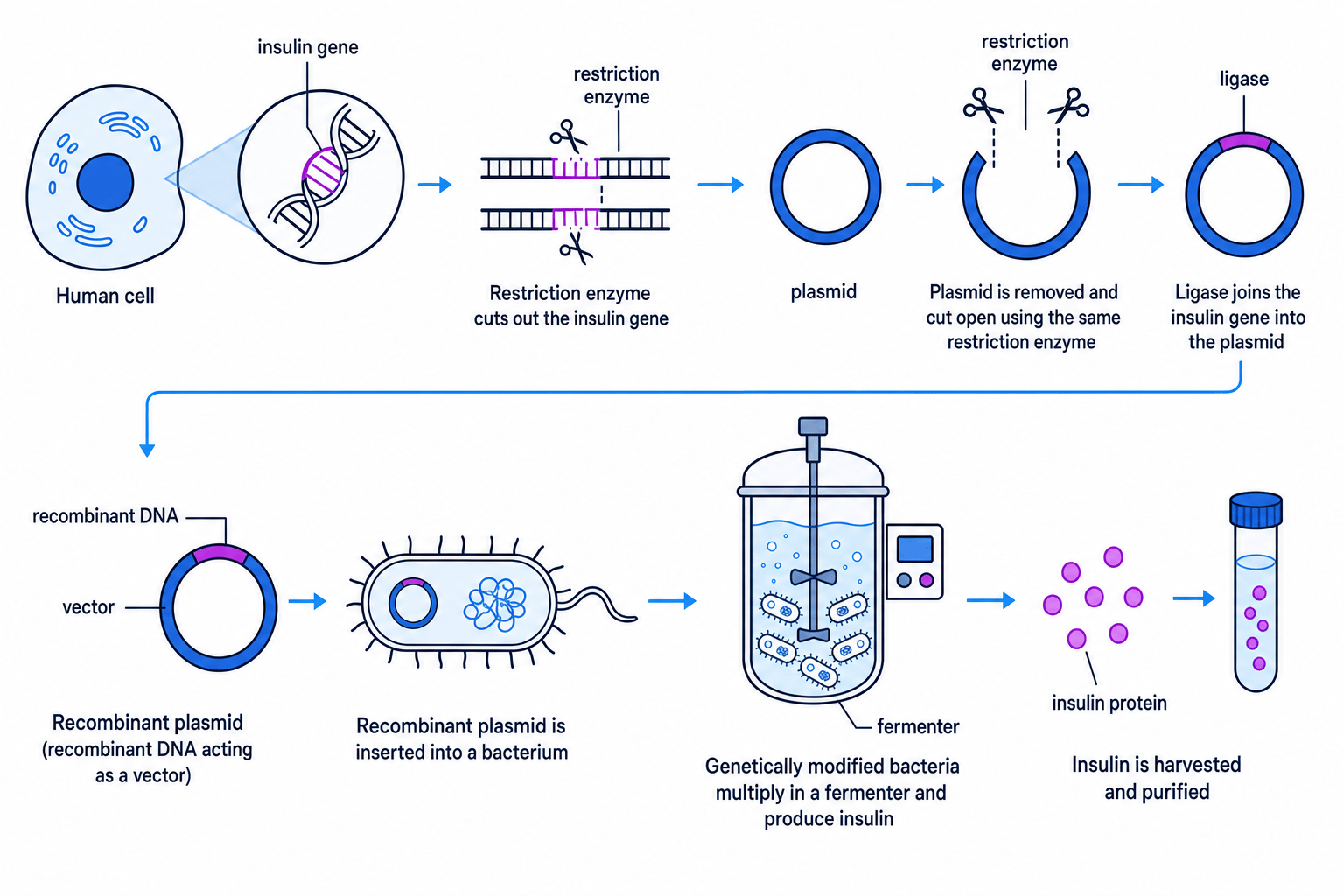
Step-by-step insulin production
- The human insulin gene is identified and cut out of human DNA using a restriction enzyme.
- A bacterial plasmid is removed from a bacterium.
- The plasmid is cut open using the same restriction enzyme.
- The insulin gene is inserted into the plasmid.
- Ligase joins the insulin gene into the plasmid, forming a recombinant plasmid.
- The recombinant plasmid is inserted into a bacterium.
- The bacterium is now genetically modified and contains the human insulin gene.
- The bacteria are grown in a fermenter.
- The bacteria produce human insulin.
- The insulin is harvested and purified for medical use.
Fermenter
A fermenter is a vessel used to grow microorganisms on a large scale under controlled conditions.
A fermenter provides conditions that help bacteria grow rapidly, such as:
- suitable nutrients, including a glucose source
- suitable temperature
- suitable pH
- oxygen, if the bacteria need aerobic respiration
- sterile conditions to prevent contamination
- mixing to spread nutrients and oxygen evenly
Why bacteria can make human insulin
Bacteria can produce human insulin because the inserted human gene contains the instructions for making the insulin protein.
Explaining high insulin production
A question asks why genetically modified bacteria in a fermenter can produce large amounts of insulin. Build the explanation.
- The bacteria contain the recombinant plasmid, so they carry the human insulin gene.
- The insulin gene gives the bacteria the instructions to make the insulin protein.
- Bacteria reproduce quickly by cell division, so the number of insulin-producing cells increases rapidly.
- The fermenter keeps conditions suitable for growth, so many bacteria survive and remain active.
- As a result, a large amount of insulin can be produced and then purified.
Transgenic organisms
Transgenic
Transgenic means that genetic material has been transferred from one species to a different species.
Examples include:
- a bacterium containing the human insulin gene
- a crop plant containing a gene from a bacterium that makes it resistant to insect pests
- a plant containing a gene from another plant species to improve food production
Spotting transgenic examples
Ask: “Has DNA from one species been placed into a different species?” If yes, it is transgenic.
Genetically modified plants and food production
Genetically modified plants can be used to improve food production by giving crops useful characteristics.
Pest resistance
A crop plant may be given a gene that makes it resistant to insect pests. This means fewer leaves, stems or fruits are damaged.
This can increase yield because more of the plant’s energy can be used for growth and food production rather than replacing damaged tissue.
Herbicide tolerance
Some crops are genetically modified to tolerate a particular herbicide. Farmers can spray the field to kill weeds while the crop survives.
This can improve food production because weeds compete with crop plants for:
- light
- water
- mineral ions
- space
Disease resistance
Some GM plants are resistant to diseases caused by viruses, bacteria or fungi. Less disease means more plants survive to harvest.
Drought tolerance
A crop may be modified so it can grow better with less water. This is useful in dry areas or during periods of low rainfall.
Improved nutrition or storage
Some GM crops are designed to contain more of a useful nutrient, or to ripen more slowly so they can be transported and stored for longer.
Explaining increased crop yield
A GM crop is resistant to an insect pest that normally eats its leaves. Explain how this can improve food production.
- If fewer leaves are eaten, the plant keeps more leaf surface area.
- More leaf surface area allows a higher rate of photosynthesis, provided light, carbon dioxide and temperature are suitable.
- More glucose can be made and used to produce biomass, such as roots, stems, seeds or fruits.
- More crop biomass reaches harvest, so the yield of food is increased.
Benefits and concerns
GM organisms can be very useful, but exam questions often expect balanced thinking.
Possible benefits include:
- higher crop yields
- reduced use of chemical pesticides
- crops that grow in difficult conditions
- improved nutritional content
- large-scale production of medicines such as insulin
Possible concerns include:
- genes spreading to wild plants by pollination
- effects on non-target organisms, such as harmless insects
- reduced biodiversity if one crop variety is used too widely
- high cost of seeds for farmers
- public concern about long-term effects
Writing only opinions
In biology answers, support your point with a biological reason. For example, do not just write “GM crops are good”. Explain that pest resistance can reduce crop damage and increase yield.
Quick summary
Genetic engineering uses enzymes and vectors to move useful genes between organisms. Restriction enzymes cut DNA at specific sites. Ligase joins DNA pieces together. Plasmids and viruses can act as vectors. If genetic material is transferred from one species to another, the organism is transgenic. Genetically modified bacteria can make human insulin, and genetically modified plants can improve food production.
In the exam
- Use the correct enzyme words: restriction enzyme cuts, ligase joins.
- When describing insulin production, include the sequence: gene cut out → plasmid cut → gene inserted → ligase joins → bacterium modified → fermenter → insulin purified.
- For GM crop questions, link the modification to food production: for example, pest resistance reduces damage, so photosynthesis and yield can increase.
Check yourself
- What is the difference between a plasmid and a vector?
- Why must the human insulin gene be inserted into the bacterium before the bacterium can make insulin?
- How could a GM plant with pest resistance improve crop yield?
