

What you'll learn
- What respiration is and how it produces ATP, the energy supply used by cells.
- The differences between aerobic and anaerobic respiration.
- The word and balanced symbol equations you need to know.
- How to investigate carbon dioxide and heat released by respiring seeds.
Why cells need respiration
Every living cell needs energy to stay alive. Cells use energy for processes such as:
- muscle contraction
- active transport across cell membranes
- building larger molecules from smaller ones
- cell division
- maintaining body temperature in mammals and birds
Cells cannot usually use the energy stored in glucose directly. Instead, they transfer energy from glucose into a molecule called ATP.
Respiration
Respiration is the chemical process in living cells that releases energy from glucose and transfers it to ATP.
ATP
ATP stands for adenosine triphosphate. It is a small molecule that stores and supplies energy for cell processes.
Respiration is not breathing
Breathing moves air in and out of the lungs. Respiration is a chemical reaction inside cells. Breathing helps supply oxygen for aerobic respiration, but the two words do not mean the same thing.
ATP: the cell’s immediate energy supply
ATP is useful because it can release small, manageable amounts of energy exactly where the cell needs it. For example, a muscle cell uses ATP when protein fibres slide past each other during contraction.
Respiration does not “make energy” from nothing. Instead, it transfers energy from glucose into ATP. Some energy is also transferred to the surroundings as heat.
ATP as a rechargeable battery
Glucose is like a large fuel store. ATP is like a small rechargeable battery that the cell can use quickly for individual jobs.
Aerobic respiration
Aerobic respiration
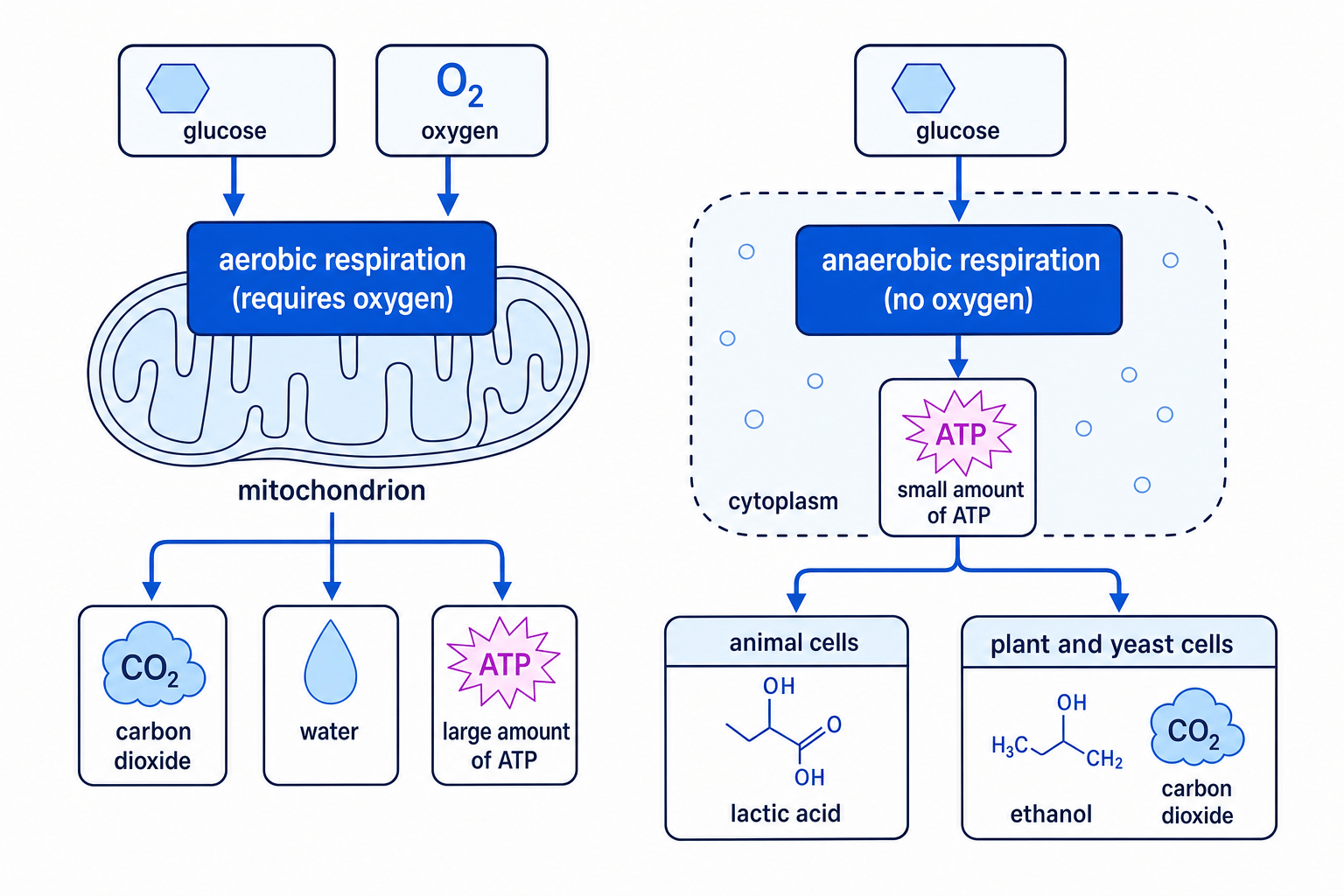
Aerobic respiration is respiration that uses oxygen to release energy from glucose.
Aerobic respiration happens in living organisms, including animals, plants, fungi, protoctists and bacteria. In plant and animal cells, most aerobic respiration happens in the mitochondria, which are cell structures where aerobic respiration occurs.
The word equation is:
glucose + oxygen → carbon dioxide + water (+ ATP energy)
The balanced chemical symbol equation is:
C6H12O6+6O2→6CO2+6H2O\mathrm{C_6H_{12}O_6} + 6\mathrm{O_2} \to 6\mathrm{CO_2} + 6\mathrm{H_2O}C6H12O6+6O2→6CO2+6H2OThis equation means that one glucose molecule reacts with six oxygen molecules to produce six carbon dioxide molecules and six water molecules.
Why aerobic respiration is efficient
Aerobic respiration releases a large amount of ATP because glucose is completely broken down using oxygen.
Balancing aerobic respiration
- Start with glucose: C6H12O6\mathrm{C_6H_{12}O_6}C6H12O6 contains 6 carbon atoms, 12 hydrogen atoms and 6 oxygen atoms.
- Match the carbon atoms by making 6 carbon dioxide molecules: 6CO26\mathrm{CO_2}6CO2 gives 6 carbon atoms.
- Match the hydrogen atoms by making 6 water molecules: 6H2O6\mathrm{H_2O}6H2O gives 12 hydrogen atoms.
- Count oxygen on the products side: 6CO26\mathrm{CO_2}6CO2 has 12 oxygen atoms and 6H2O6\mathrm{H_2O}6H2O has 6 oxygen atoms, giving 18 oxygen atoms in total.
- Glucose already supplies 6 oxygen atoms, so oxygen gas must supply the remaining 12 oxygen atoms. That needs 6O26\mathrm{O_2}6O2.
Anaerobic respiration
Anaerobic respiration
Anaerobic respiration is respiration that releases energy from glucose without oxygen.
Anaerobic respiration releases much less ATP than aerobic respiration because glucose is only partly broken down.
Anaerobic respiration in animals
In animal cells, anaerobic respiration produces lactic acid.
The word equation is:
glucose → lactic acid (+ ATP energy)
This can happen during vigorous exercise, when muscles need ATP faster than oxygen can be supplied by the blood. The lactic acid can cause muscle fatigue and must later be broken down when oxygen is available again.
Anaerobic respiration in plants and yeast
In plant cells and yeast cells, anaerobic respiration produces ethanol and carbon dioxide. This is also called fermentation.
The word equation is:
glucose → ethanol + carbon dioxide (+ ATP energy)
Yeast fermentation is useful in bread-making because the carbon dioxide makes dough rise. It is also useful in brewing because ethanol is produced.
Plants respire too
Plants photosynthesise in the light, but they also respire all the time. Plant cells need ATP just like animal cells do.
Comparing aerobic and anaerobic respiration
Aerobic and anaerobic respiration both:
- happen in living cells
- use glucose as a fuel
- transfer energy to ATP
They differ in oxygen use, products and ATP yield.
Aerobic respiration
- Uses oxygen.
- Produces carbon dioxide and water.
- Releases a large amount of ATP.
- In plant and animal cells, mainly occurs in mitochondria.
Anaerobic respiration
- Does not use oxygen.
- Releases a small amount of ATP.
- In animals, produces lactic acid.
- In plants and yeast, produces ethanol and carbon dioxide.
Choosing the respiration pathway
A sprinter’s leg muscles are contracting very rapidly. The blood cannot deliver enough oxygen to the muscle cells for the ATP demand.
- Compare oxygen supply with ATP demand: oxygen supply is too low for the rate of energy use.
- Choose the pathway that does not require oxygen: the muscle cells use anaerobic respiration.
- Use the animal-cell word equation: glucose is converted to lactic acid, releasing a small amount of ATP.
Quick equation memory
For anaerobic respiration, remember: animals make lactic acid; plants and yeast make ethanol and carbon dioxide.
Practical: investigating carbon dioxide and heat from respiring seeds
The word evolution in this practical means production and release. So “evolution of carbon dioxide” means carbon dioxide is being produced and given off.
Germinating seeds are useful because they are beginning to grow, so their cells are respiring rapidly to make ATP.
Investigating carbon dioxide production
A typical method is:
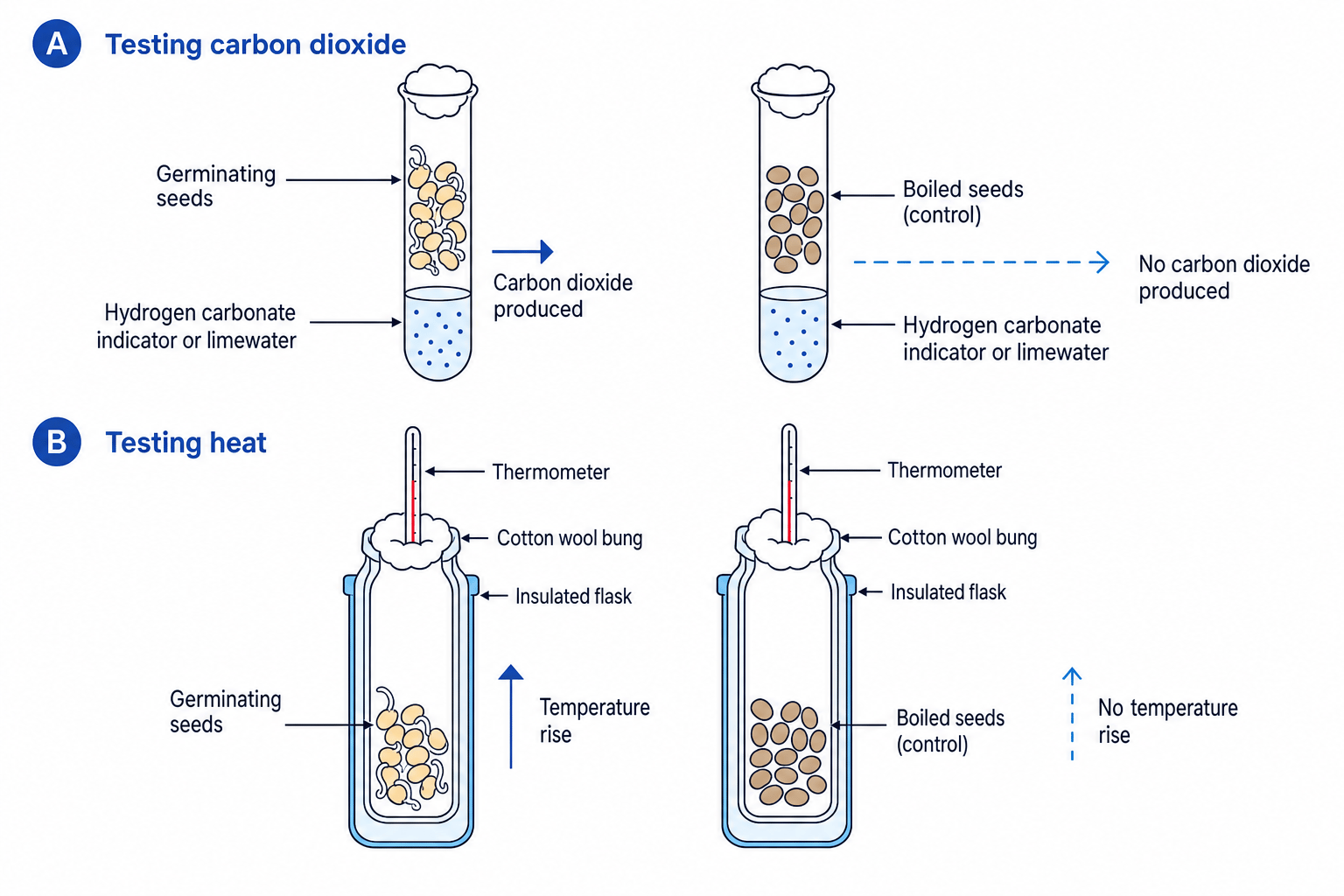
- Place some germinating seeds in a boiling tube, supported above a small volume of hydrogen carbonate indicator or limewater.
- Set up a control tube with the same mass of boiled seeds, or glass beads, instead of germinating seeds.
- Seal the tubes and leave them for the same length of time at the same temperature.
- Observe the indicator.
Expected results:
- With germinating seeds, carbon dioxide is produced by respiration.
- Hydrogen carbonate indicator changes from red/orange towards yellow when carbon dioxide increases.
- Limewater turns cloudy or milky when carbon dioxide is present.
- The control should show little or no change.
Investigating heat production
A typical method is:
- Put the same mass of germinating seeds into an insulated flask.
- Put the same mass of boiled seeds, or glass beads, into a second insulated flask as a control.
- Place a thermometer into each flask and use cotton wool bungs to reduce heat loss while still allowing some gas exchange.
- Record the starting temperature and then the temperature after a set time, such as 20 or 30 minutes.
Expected results:
- The flask with germinating seeds should show a temperature rise.
- The control should show little or no temperature rise.
- This shows that respiration transfers some energy to the surroundings as heat.
Variables in the seed practical
The independent variable is whether the seeds are living and germinating or dead/control material.
The dependent variable is what you measure: either indicator colour change, cloudiness of limewater, or temperature change.
Important control variables include:
- mass or number of seeds
- starting temperature
- time left before observing results
- volume and type of indicator
- size and insulation of flask
- whether the seeds are at the same stage of germination
Calculating rate of temperature increase
A flask of germinating seeds increases from 19 °C to 25 °C in 30 minutes.
- Calculate the temperature change: ΔT=25−19=6\Delta T = 25 - 19 = 6ΔT=25−19=6 °C.
- Use the rate equation: rate=temperature changetime\text{rate} = \frac{\text{temperature change}}{\text{time}}rate=timetemperature change.
- Substitute the values: rate=630=0.2\text{rate} = \frac{6}{30} = 0.2rate=306=0.2 °C per minute.
Forgetting the control
A control with boiled seeds or glass beads is needed to show that any carbon dioxide or heat comes from living respiration, not from the apparatus or the seeds simply being present.
Common sources of error
Microorganisms on seeds may also respire, poor insulation allows heat to escape, and dry ungerminated seeds may respire too slowly to give a clear result.
Bringing it together
Respiration is one of the most important processes in biology because it links food molecules to usable energy in cells. Aerobic respiration is more efficient because oxygen allows glucose to be fully broken down. Anaerobic respiration is useful when oxygen is unavailable, but it releases much less ATP and produces different waste products.
In the exam
- If asked for the aerobic symbol equation, write it balanced: C6H12O6+6O2→6CO2+6H2O\mathrm{C_6H_{12}O_6} + 6\mathrm{O_2} \to 6\mathrm{CO_2} + 6\mathrm{H_2O}C6H12O6+6O2→6CO2+6H2O.
- If asked to compare aerobic and anaerobic respiration, mention oxygen use, products and amount of ATP released.
- In practical questions, always describe the control and explain what result you expect from the germinating seeds.
Check yourself
- Why does aerobic respiration release more ATP than anaerobic respiration?
- What are the word equations for anaerobic respiration in animals and in yeast?
- How would you show that germinating seeds release heat during respiration?
