

What you'll learn
- How photosynthesis converts light energy into chemical energy in glucose.
- How leaf structure, mineral ions and limiting factors affect plant growth.
- What makes a balanced human diet, and how food is digested and absorbed.
- How to handle the named practicals on photosynthesis and food energy.
Plant nutrition: photosynthesis
Plants do not “eat” food like animals do. Instead, most flowering plants make glucose using light, carbon dioxide and water.
Photosynthesis
Photosynthesis is the process in which green plants use light energy to convert carbon dioxide and water into glucose and oxygen.
The important energy idea is that light energy is converted into chemical energy stored in glucose. Glucose can then be used in respiration, converted into starch for storage, used to make cellulose for cell walls, or combined with nitrate ions to make amino acids.
The word equation is:
carbon dioxide + water → glucose + oxygen
The balanced chemical symbol equation is:
6CO2 + 6H2O → C6H12O6 + 6O2
Energy conversion
Photosynthesis does not “make energy”. It transfers energy from light into chemical stores in glucose.
Factors affecting the rate of photosynthesis
Rate of photosynthesis
The rate of photosynthesis means how quickly photosynthesis is happening, often estimated by measuring oxygen produced per minute.
Three main factors affect the rate:
- Light intensity: more light usually increases the rate, until another factor becomes limiting.
- Carbon dioxide concentration: more carbon dioxide usually increases the rate, until another factor becomes limiting.
- Temperature: increasing temperature increases the rate at first, but very high temperatures reduce the rate because enzymes become denatured.
Limiting factor
A limiting factor is the factor in shortest supply, which prevents the rate of a process from increasing further.
Identifying the limiting factor
A pondweed produces 24 cm³ of oxygen in 6 minutes at low light intensity, then 60 cm³ in 6 minutes when the lamp is moved closer.
- Calculate the first rate: 24÷6=424 \div 6 = 424÷6=4 cm³ per minute.
- Calculate the second rate: 60÷6=1060 \div 6 = 1060÷6=10 cm³ per minute.
- Compare the rates: the rate increased when light intensity increased, so light intensity was limiting at first.
- If moving the lamp even closer no longer increased the rate, a different factor, such as carbon dioxide concentration or temperature, would now be limiting.
Plateaus on graphs
A flat part of a photosynthesis graph does not mean photosynthesis has stopped. It means the rate is no longer increasing because another factor is limiting.
Leaf structure and adaptations
A leaf is adapted to absorb light, take in carbon dioxide, receive water and transport sugars away. The diagram shows the main tissues you need to recognise.
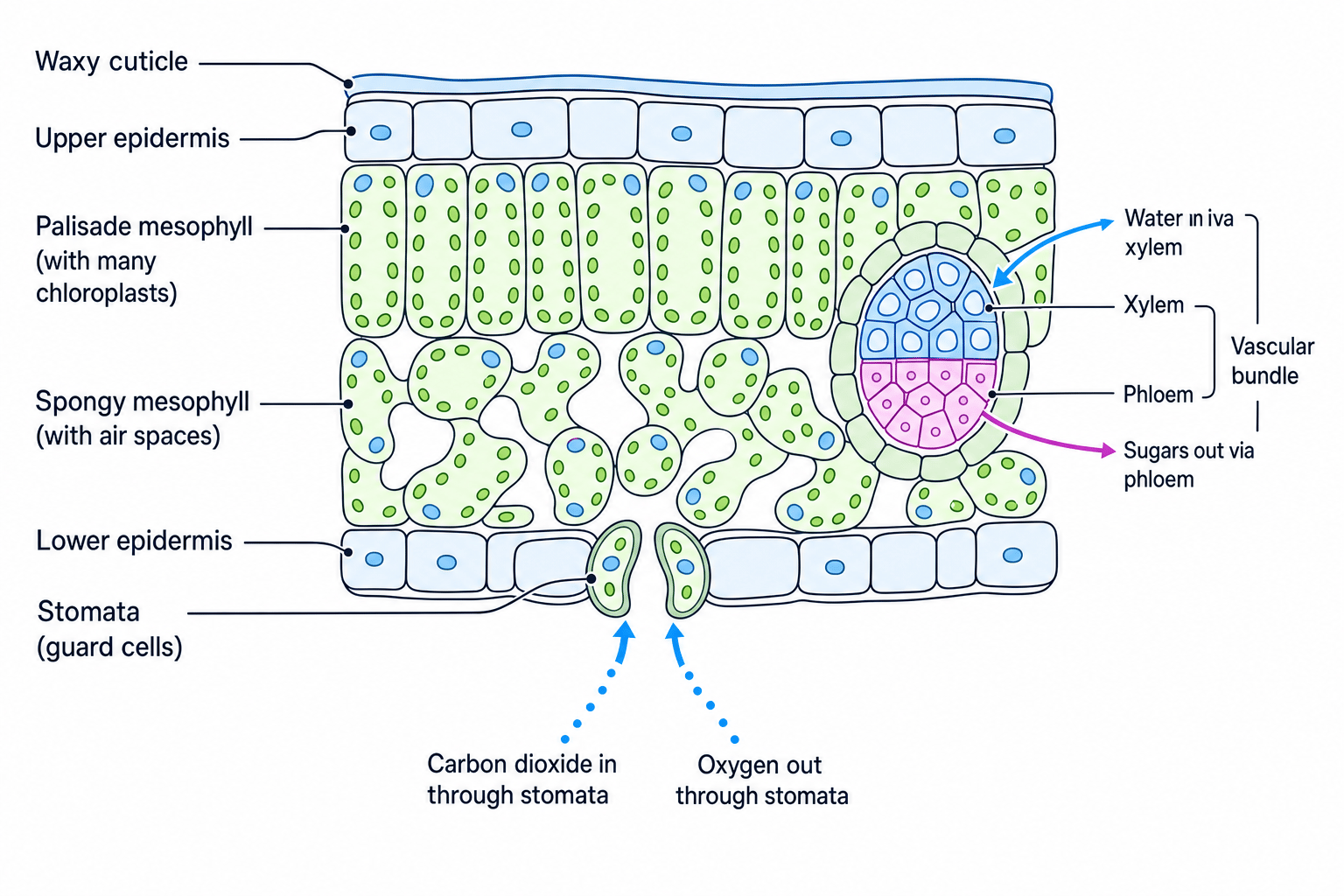
Main leaf adaptations
- The waxy cuticle reduces water loss.
- The upper epidermis is thin and transparent, allowing light through.
- The palisade mesophyll contains many chloroplasts for absorbing light.
- Chloroplasts contain chlorophyll, the green pigment that absorbs light energy.
- The spongy mesophyll has air spaces so gases can diffuse quickly.
- Stomata are pores that allow carbon dioxide in and oxygen out.
- Guard cells open and close stomata.
- Xylem brings water and mineral ions to the leaf.
- Phloem carries sugars away from the leaf.
Leaf design
A leaf is thin for short diffusion distances, broad for light absorption, and full of chloroplasts in the palisade layer for photosynthesis.
Mineral ions for plant growth
Mineral ions
Mineral ions are dissolved nutrients absorbed from the soil by plant roots.
Plants need mineral ions for healthy growth:
- Magnesium ions are needed to make chlorophyll. Without enough magnesium, leaves may turn yellow.
- Nitrate ions are needed to make amino acids, which are then used to make proteins. Without enough nitrate, growth is poor.
Practical: investigating photosynthesis
The spec expects you to understand practical evidence for oxygen production, starch production, and the requirements for light, carbon dioxide and chlorophyll.
Showing oxygen is produced
A water plant, such as pondweed, is placed in water with sodium hydrogencarbonate solution to provide carbon dioxide. A lamp provides light. Oxygen bubbles can be counted, or oxygen gas can be collected in a gas syringe.
- Independent variable: light intensity, carbon dioxide concentration or temperature.
- Dependent variable: rate of oxygen production.
- Control variables: plant species, length of plant, temperature, time measured and carbon dioxide concentration if not being tested.
- Expected result: more oxygen is produced when photosynthesis is faster.
Showing starch is produced
First, destarch the plant by keeping it in the dark for 24–48 hours so stored starch is used up. Then expose it to the condition being tested.
To test a leaf for starch:
- Boil the leaf in water to kill cells.
- Heat it in ethanol in a water bath to remove chlorophyll.
- Rinse it in water to soften it.
- Add iodine solution.
Iodine solution turns blue-black if starch is present and stays orange-brown if starch is absent.
Testing requirements
- Light: cover part of a leaf with foil. Only the exposed area should turn blue-black.
- Carbon dioxide: place a plant in a sealed container with soda lime to absorb carbon dioxide. It should not make starch.
- Chlorophyll: use a variegated leaf. Only the green areas should turn blue-black.
Ethanol safety
Ethanol is flammable, so it must be heated in a hot water bath, not directly with a Bunsen burner.
Human nutrition: a balanced diet
Balanced diet
A balanced diet contains appropriate proportions of carbohydrate, protein, lipid, vitamins, minerals, water and dietary fibre for a person’s needs.
“Balanced” does not mean equal amounts of everything. Your needs depend on your body and lifestyle.
| Component | Good sources | Main functions |
|---|---|---|
| Carbohydrate | Bread, rice, pasta, potatoes, fruit | Energy source for respiration |
| Protein | Meat, fish, eggs, beans, lentils, nuts | Growth and repair; making enzymes |
| Lipid, including fats and oils | Butter, oils, nuts, cheese, oily fish | Energy store, insulation, cell membranes |
| Vitamin A | Carrots, liver, dairy foods | Healthy vision and skin |
| Vitamin C | Citrus fruits, peppers, leafy vegetables | Healthy skin and gums; wound healing |
| Vitamin D | Oily fish, eggs, sunlight exposure | Helps calcium absorption for bones and teeth |
| Calcium ions | Milk, cheese, yoghurt, leafy greens | Strong bones and teeth; blood clotting |
| Iron ions | Red meat, beans, spinach | Making haemoglobin in red blood cells |
| Water | Drinks, fruit, vegetables | Solvent, transport, temperature control |
| Dietary fibre | Whole grains, vegetables, fruit | Adds bulk to food; helps prevent constipation |
Energy requirements increase with activity level because muscles respire more. Children and teenagers need energy and nutrients for growth. Pregnant people need extra energy and nutrients to support the developing fetus and changes in their own body.
Balanced diet
Do not write that a balanced diet contains “all food types in equal amounts”. It means suitable amounts for that person.
The alimentary canal
Alimentary canal
The alimentary canal is the long tube through which food passes during digestion, absorption and egestion.
Food is broken down in the gut so small soluble molecules can be absorbed into the blood. This diagram links the main organs with the villus, the key absorption structure.
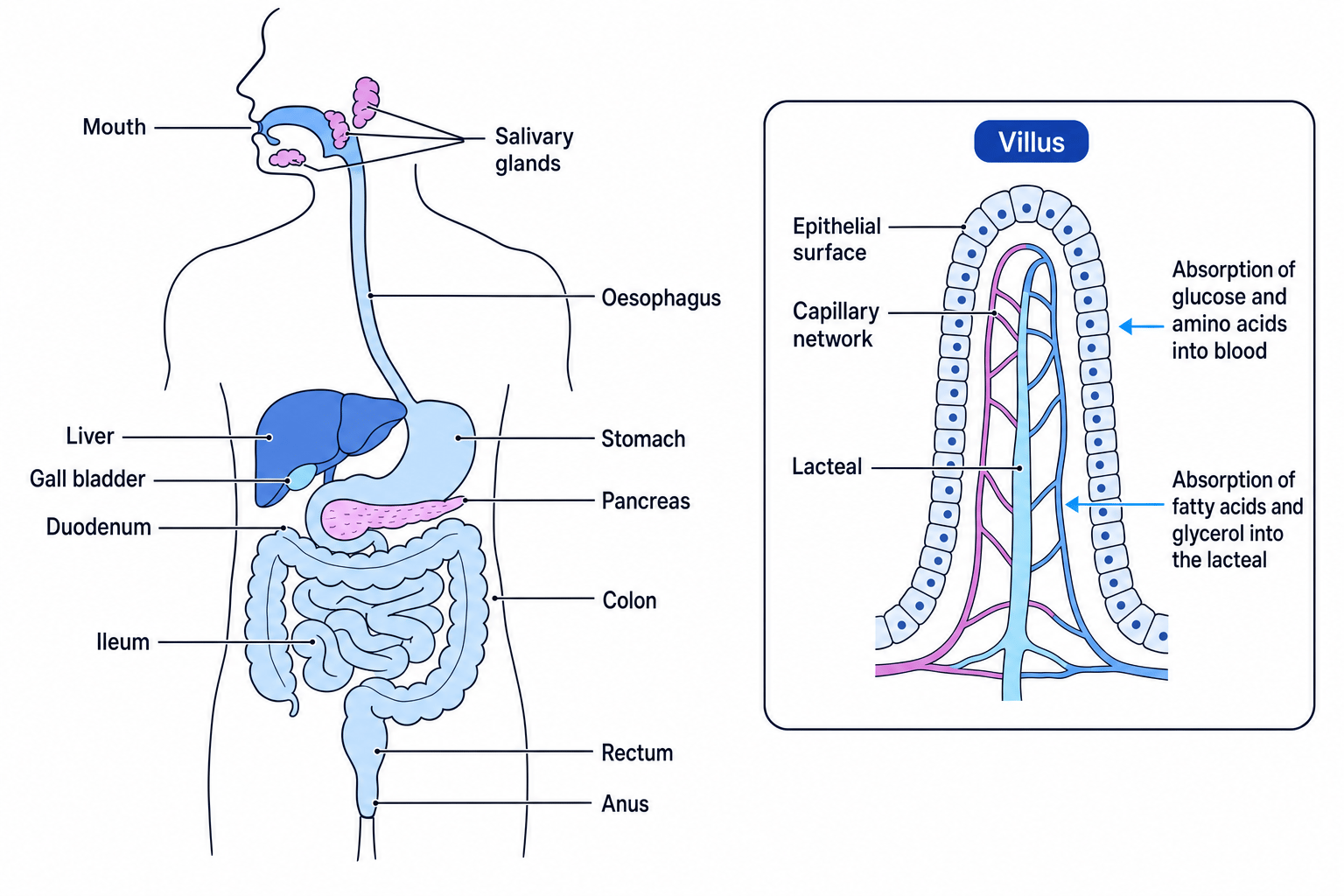
Functions of the main organs
- Mouth: teeth mechanically digest food; saliva contains amylase.
- Oesophagus: carries food from mouth to stomach.
- Stomach: churns food; acid provides suitable conditions for stomach protease and kills many microbes.
- Small intestine: the duodenum receives bile and pancreatic enzymes; the ileum completes digestion and absorbs nutrients.
- Pancreas: produces digestive enzymes released into the small intestine.
- Large intestine: the colon absorbs water; the rectum stores faeces before egestion through the anus.
Peristalsis
Peristalsis is the movement of food through the gut by rhythmic contractions of circular and longitudinal muscles in the gut wall.
Peristalsis pushes food along even if you are lying down. It is not simply gravity.
Digestive enzymes and bile
Digestive enzyme
A digestive enzyme is a biological catalyst that speeds up the breakdown of large insoluble food molecules into small soluble molecules.
You need to know these enzyme actions:
- Amylase breaks starch into maltose.
- Maltase breaks maltose into glucose.
- Proteases break proteins into amino acids.
- Lipases break lipids into fatty acids and glycerol.
Bile is produced by the liver and stored in the gall bladder. It has two main roles:
- It neutralises stomach acid entering the small intestine, giving a more suitable pH for enzymes.
- It emulsifies lipids, breaking large fat droplets into smaller droplets with a larger surface area for lipase.
Bile is not an enzyme
Bile helps lipid digestion, but it does not chemically digest lipids. Lipase is the enzyme that breaks lipids down.
Absorption in the small intestine
Absorption
Absorption is the movement of small soluble molecules from the gut into the blood or lymph.
The small intestine is adapted for absorption by having many villi.
Villus
A villus is a tiny finger-like projection in the small intestine that increases surface area for absorption.
Each villus has:
- A large surface area.
- A thin epithelial surface, giving a short diffusion distance.
- A good blood supply in capillaries, maintaining concentration gradients.
- A lacteal, which absorbs fatty acids and glycerol.
Glucose and amino acids enter the blood capillaries. Fatty acids and glycerol enter the lacteal.
Practical: energy content in food
The food energy practical is Paper 2 only, but learn it fully.
A food sample is burned to heat a known volume of water. The temperature rise is used to estimate the energy released.
Method:
- Measure a known volume of water into a boiling tube or calorimeter.
- Record the starting temperature of the water.
- Measure the mass of the food sample.
- Set fire to the food and hold it beneath the water.
- Stir the water and record the highest temperature reached.
- Reweigh the remaining food, then calculate the mass burned.
The energy transferred to the water is calculated using:
E=m×c×ΔTE = m \times c \times \Delta TE=m×c×ΔTwhere EEE is energy in joules, mmm is the mass of water in grams, ccc is 4.2 joules per gram per degree Celsius, and ΔT\Delta TΔT is the temperature change.
Calculating energy content of food
A food sample heats 25 cm³ of water from 20 °C to 45 °C. Its mass decreases from 1.20 g to 0.75 g.
- Convert the water volume to mass: 25 cm³ of water has a mass of 25 g.
- Find the temperature change: 45−20=2545 - 20 = 2545−20=25 °C.
- Calculate energy transferred to the water: E=25×4.2×25=2625E = 25 \times 4.2 \times 25 = 2625E=25×4.2×25=2625 J.
- Find the mass of food burned: 1.20−0.75=0.451.20 - 0.75 = 0.451.20−0.75=0.45 g.
- Calculate energy per gram: 2625÷0.45=58332625 \div 0.45 = 58332625÷0.45=5833 J per g, which is about 5.8 kJ per g.
Sources of error include heat loss to the air, incomplete combustion, soot forming, the flame being too far from the tube, and not stirring the water. Using a draught shield and a metal calorimeter improves the estimate.
In the exam
- For photosynthesis questions, always link the factor to the rate: more light or carbon dioxide increases rate only until another factor becomes limiting.
- For digestion questions, name both the enzyme and the products: for example, lipase breaks lipids into fatty acids and glycerol.
- For practical questions, include variables, repeats, expected results and errors, not just the method.
Check yourself
- Why does a variegated leaf help show that chlorophyll is needed for photosynthesis?
- How does bile help lipase digest lipids faster?
- In the food energy practical, why is the calculated energy content usually an underestimate?
