What you'll learn
- How substances move across cell membranes by diffusion, osmosis and active transport.
- Why surface area, volume, distance, temperature and concentration gradient affect movement rate.
- How to investigate diffusion and osmosis using living and non-living systems.
- How to calculate percentage change in mass in an osmosis practical.
Why substances need to move
Cells need useful substances to enter, such as oxygen, glucose, water and mineral ions. They also need waste substances, such as carbon dioxide, to leave.
A cell membrane is the thin boundary around a cell. It controls what enters and leaves. Some membranes are partially permeable, meaning they allow some particles through but not others.
A particle is a tiny unit of a substance. A solute is a substance dissolved in a liquid, and a solution is the mixture formed. For example, sucrose dissolved in water forms a sucrose solution.
Concentration and concentration gradient
Concentration means how much of a substance there is in a given volume. A concentration gradient is the difference in concentration between two areas.
Particles are always moving randomly. This random movement is the basic reason diffusion and osmosis happen.
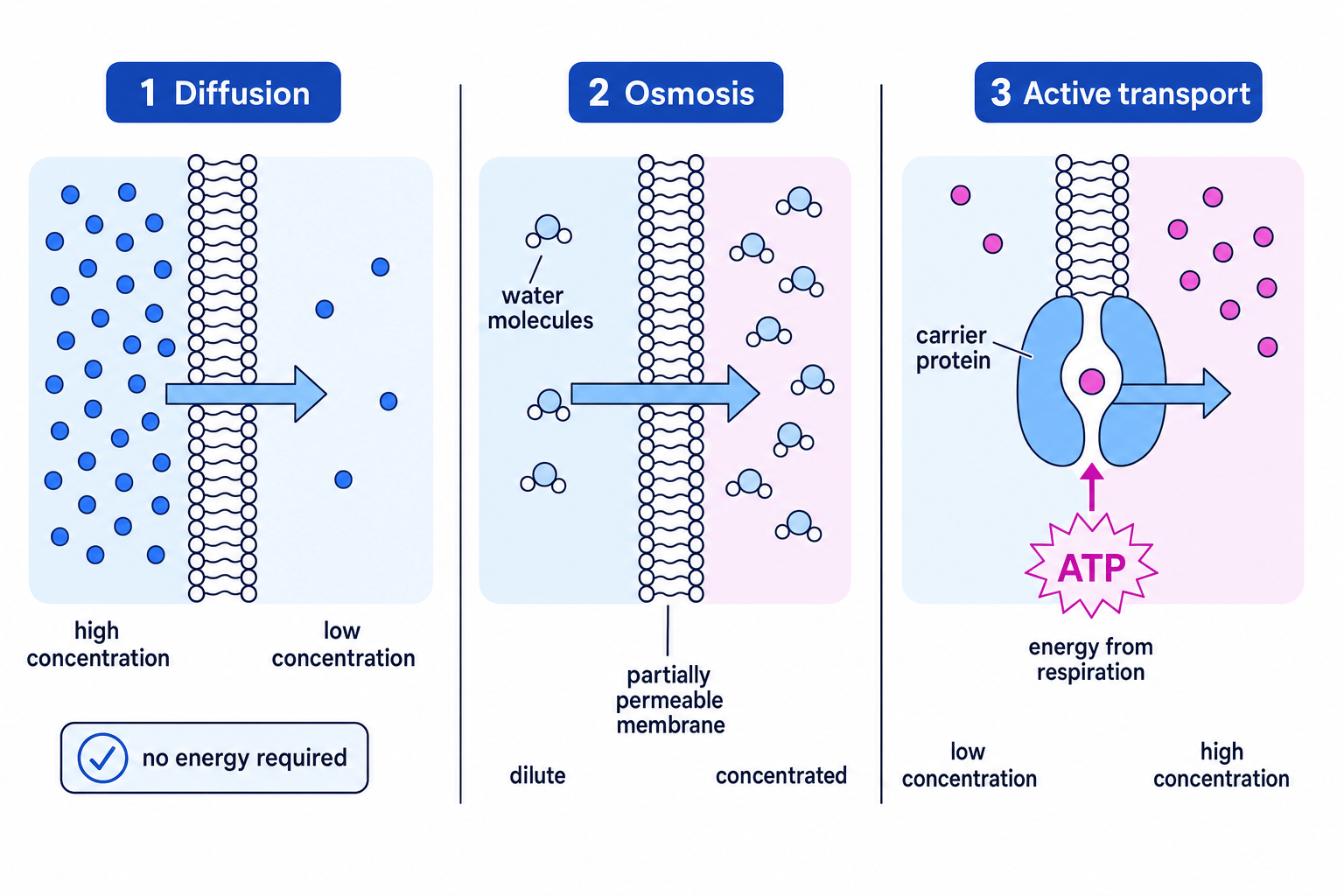
Diffusion, osmosis and active transport
Diffusion
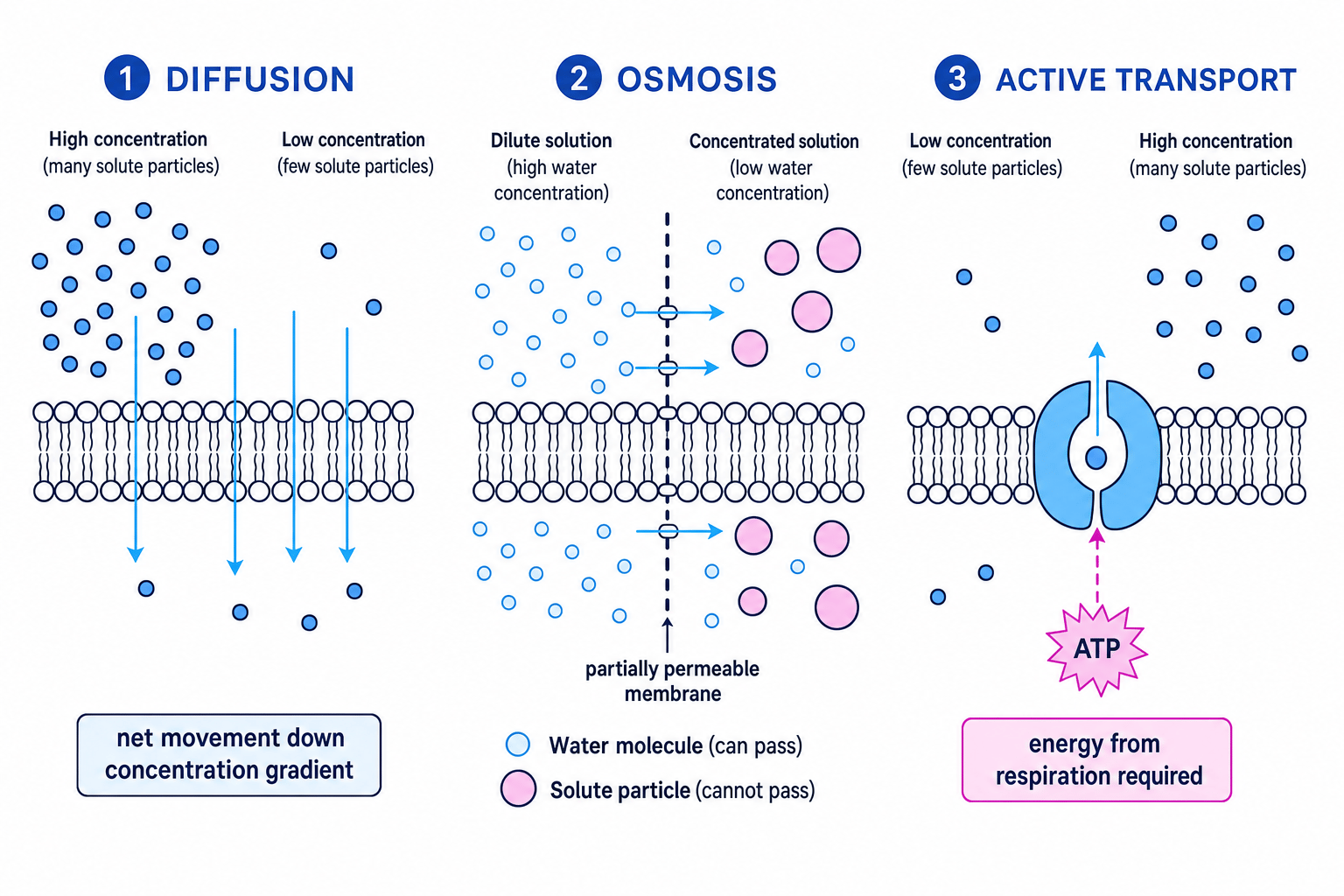
Diffusion is the net movement of particles from an area of higher concentration to an area of lower concentration.
“Net movement” means particles move both ways, but overall more move from high concentration to low concentration.
Diffusion does not require energy from respiration. It happens because particles move randomly.
Examples in biology include:
- oxygen diffusing from the air spaces in the lungs into the blood
- carbon dioxide diffusing from cells into the blood
- dissolved substances diffusing into and out of cells
Diffusion goes down the gradient
In diffusion, particles move down their concentration gradient: from higher concentration to lower concentration.
Osmosis
Osmosis is the net movement of water molecules from a dilute solution to a more concentrated solution through a partially permeable membrane.
A dilute solution has a relatively high water concentration and fewer dissolved solute particles. A concentrated solution has a relatively low water concentration and more dissolved solute particles.
So in osmosis, water moves from:
- higher water concentration to lower water concentration
- dilute solution to concentrated solution
In plant cells, water enters the vacuole and cytoplasm by osmosis. A plant cell that gains water becomes turgid, meaning swollen and firm. This helps support the plant.
If plant cells lose water, they become flaccid, meaning soft and less firm. If they lose a lot of water, the cell membrane can pull away from the cell wall; this is called plasmolysis.
Animal cells do not have a cell wall, so if too much water enters by osmosis, they may burst.
Osmosis is only water
Do not say “osmosis is the movement of particles”. Osmosis is specifically the movement of water molecules through a partially permeable membrane.
Active transport
Active transport is the movement of particles from an area of lower concentration to an area of higher concentration, using energy from respiration.
This means active transport moves substances against the concentration gradient.
It usually involves carrier proteins in the cell membrane. You do not need detailed A-Level biochemistry here: for IGCSE, say that active transport requires energy from respiration.
Examples include:
- mineral ions being taken up by root hair cells from soil
- glucose being absorbed in the small intestine when its concentration is lower in the gut than in the blood
Active transport needs energy
Diffusion and osmosis are passive processes. Active transport is different because it uses energy from respiration to move substances against a concentration gradient.
Factors affecting the rate of movement
The rate of movement means how quickly substances move into or out of cells.
1. Surface area to volume ratio
Surface area is the area of the outside surface. Volume is the amount of space inside. The surface area to volume ratio compares how much exchange surface there is compared with the amount of cell or organism needing exchange.
Small cells have a large surface area to volume ratio, so substances can enter and leave quickly enough.
As an organism or cube gets larger, its volume increases faster than its surface area. This makes exchange less efficient unless the organism has specialised exchange surfaces.
Comparing surface area to volume ratio
A cube-shaped cell has sides of 2 cm. Calculate its surface area to volume ratio.
- Use the formula for the surface area of a cube:
where aaa is the length of one side.
- Substitute a=2 cma = 2 \text{ cm}a=2 cm:
- Calculate the volume using:
so:
23=8 cm3 2^3 = 8 \text{ cm}^3 23=8 cm3- Compare surface area with volume:
The surface area to volume ratio is 3:1.
2. Diffusion distance
Diffusion distance is the distance particles must travel. The shorter the distance, the faster diffusion happens.
This is why exchange surfaces are often very thin. For example, alveoli in the lungs have walls that are only one cell thick, so oxygen has a short distance to diffuse into the blood.
3. Temperature
At higher temperatures, particles have more kinetic energy, meaning energy of movement. They move faster, so diffusion and osmosis usually happen faster.
In living cells, very high temperatures can damage membranes or enzymes, so the rate may not keep increasing forever.
4. Concentration gradient
A steeper concentration gradient means a bigger difference in concentration between two areas. This increases the rate of diffusion or osmosis.
For example, oxygen diffuses into blood faster if the oxygen concentration in the air sacs is high and the oxygen concentration in the blood is low.
How to explain faster diffusion
Use the phrase: “There is a steeper concentration gradient, so there is more net movement per second.”
Practical: investigating diffusion and osmosis
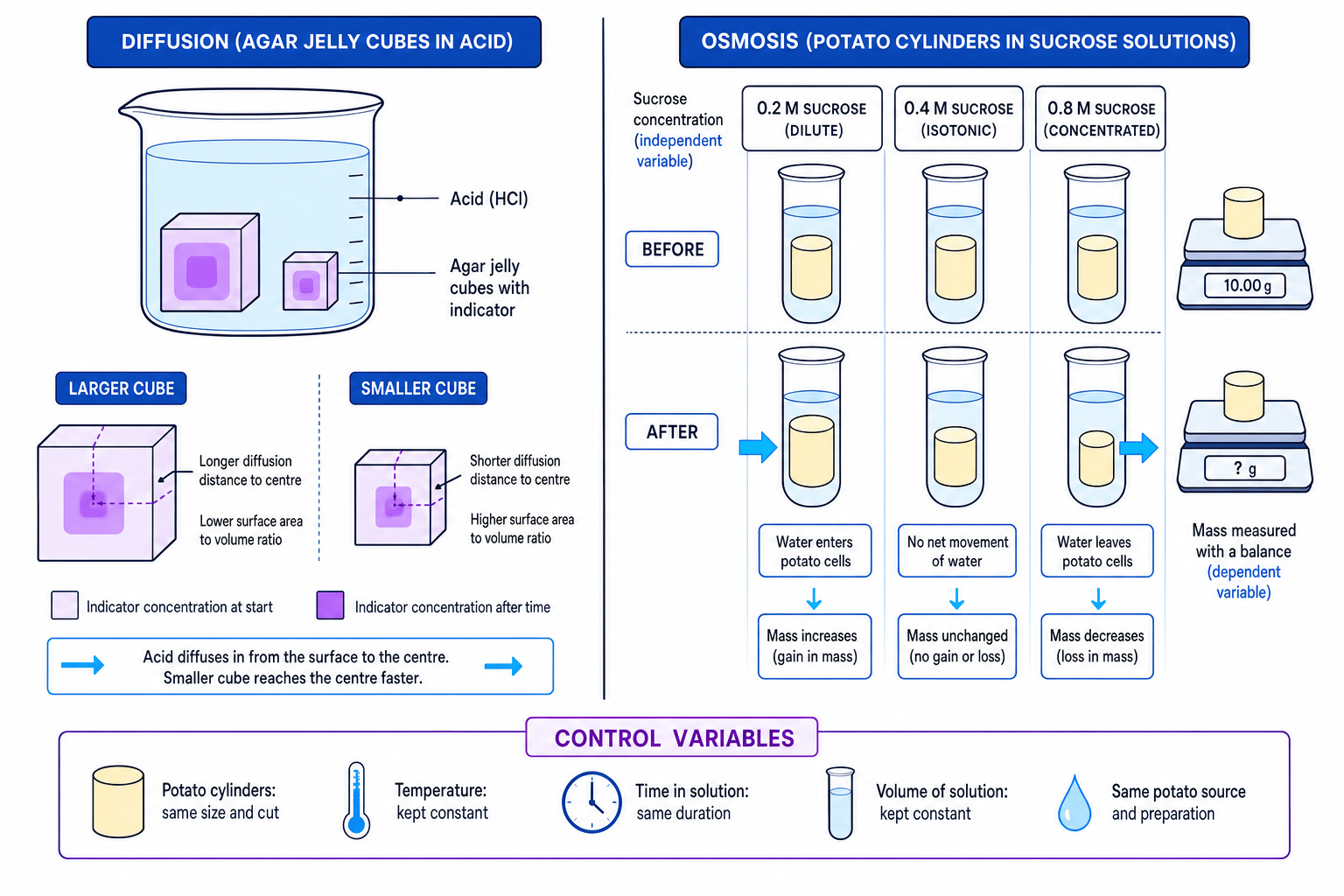
The Edexcel specification expects you to understand practical investigations using both living systems and non-living systems.
An independent variable is the factor you change. A dependent variable is the factor you measure. Control variables are factors you keep the same to make the test fair.
Non-living diffusion: agar jelly cubes
Agar jelly can be used as a non-living model of diffusion. The agar may contain an indicator, and acid diffuses in from the outside.
Method:
- Cut agar jelly into cubes of different sizes.
- Place the cubes into the same concentration of acid.
- Start timing.
- Record how long it takes for the colour change to reach the centre.
- Compare different cube sizes.
Key variables:
- Independent variable: cube size, which changes surface area to volume ratio and diffusion distance.
- Dependent variable: time taken for acid to diffuse to the centre.
- Control variables: acid concentration, temperature, volume of acid and type of agar.
Expected result:
- Smaller cubes change colour throughout faster.
- They have a shorter diffusion distance and a larger surface area to volume ratio.
Living osmosis: potato cylinders
Potato tissue is used as a living plant system because potato cells have partially permeable cell membranes.
Method:
- Cut potato cylinders to the same length and diameter.
- Measure the initial mass of each cylinder.
- Place each cylinder in a different concentration of sucrose solution.
- Leave them for the same amount of time.
- Remove, gently blot dry and measure the final mass.
- Calculate percentage change in mass.
Expected results:
- In dilute solution, water enters potato cells by osmosis, so mass increases.
- In concentrated solution, water leaves potato cells by osmosis, so mass decreases.
- In an isotonic solution, there is no net movement of water, so mass stays about the same.
Isotonic means the water concentration inside and outside the cells is equal, so there is no overall gain or loss of water.
Calculating percentage change in mass
A potato cylinder has an initial mass of 2.40 g and a final mass of 2.16 g after 30 minutes in sucrose solution.
- Calculate the change in mass:
The negative sign shows a loss of mass.
- Substitute into the percentage change formula:
- Calculate:
The potato cylinder lost 10% of its mass.
- If asked for mean rate of mass change over 30 minutes:
Non-living osmosis: Visking tubing
Visking tubing is a non-living partially permeable membrane. It can model osmosis.
For example, you can fill Visking tubing with concentrated sucrose solution and place it in water. Water moves into the tubing by osmosis, so the mass of the tubing increases.
Key variables:
- Independent variable: concentration of solution outside the tubing.
- Dependent variable: change in mass.
- Control variables: time, temperature, volume of solution and starting size of tubing.
Forgetting to blot potato
If you do not blot the potato before measuring its final mass, extra solution on the surface will make the mass too high.
Agar cubes are only a model
Agar jelly is useful for studying diffusion, but it is not alive and does not have a cell membrane. Do not describe agar cubes as “cells” in your final answer.
Bringing the ideas together
Cells exchange substances effectively when they have:
- a large surface area
- a short diffusion distance
- a steep concentration gradient
- a suitable temperature
- enough energy from respiration for active transport
These ideas appear again in gas exchange, absorption in the small intestine, root hair cells and transport in plants.
In the exam
- For diffusion, always say particles move from higher concentration to lower concentration.
- For osmosis, always mention water molecules and a partially permeable membrane.
- For practical questions, name the independent variable, dependent variable and at least two control variables.
- For percentage change, divide by the initial mass, then multiply by 100.
Check yourself
- Why does a smaller agar cube change colour throughout faster than a larger cube?
- What happens to potato cells placed in a concentrated sucrose solution?
- How is active transport different from diffusion?