What you'll learn
- The chemical elements found in carbohydrates, proteins and lipids.
- How large biological molecules are made from smaller basic units.
- How to test foods for glucose, starch, protein and fat.
- How temperature and pH affect enzymes and their active sites.
Biological molecules: the basics
Living organisms are made of chemicals. Many important chemicals in cells are biological molecules, such as carbohydrates, proteins and lipids.
Chemical element
A chemical element is a pure substance made of only one type of atom, for example carbon, hydrogen, oxygen or nitrogen.
Biological molecules are important because they form cell structures, store energy, and help chemical reactions happen inside cells.
Carbohydrates, proteins and lipids
Carbohydrates
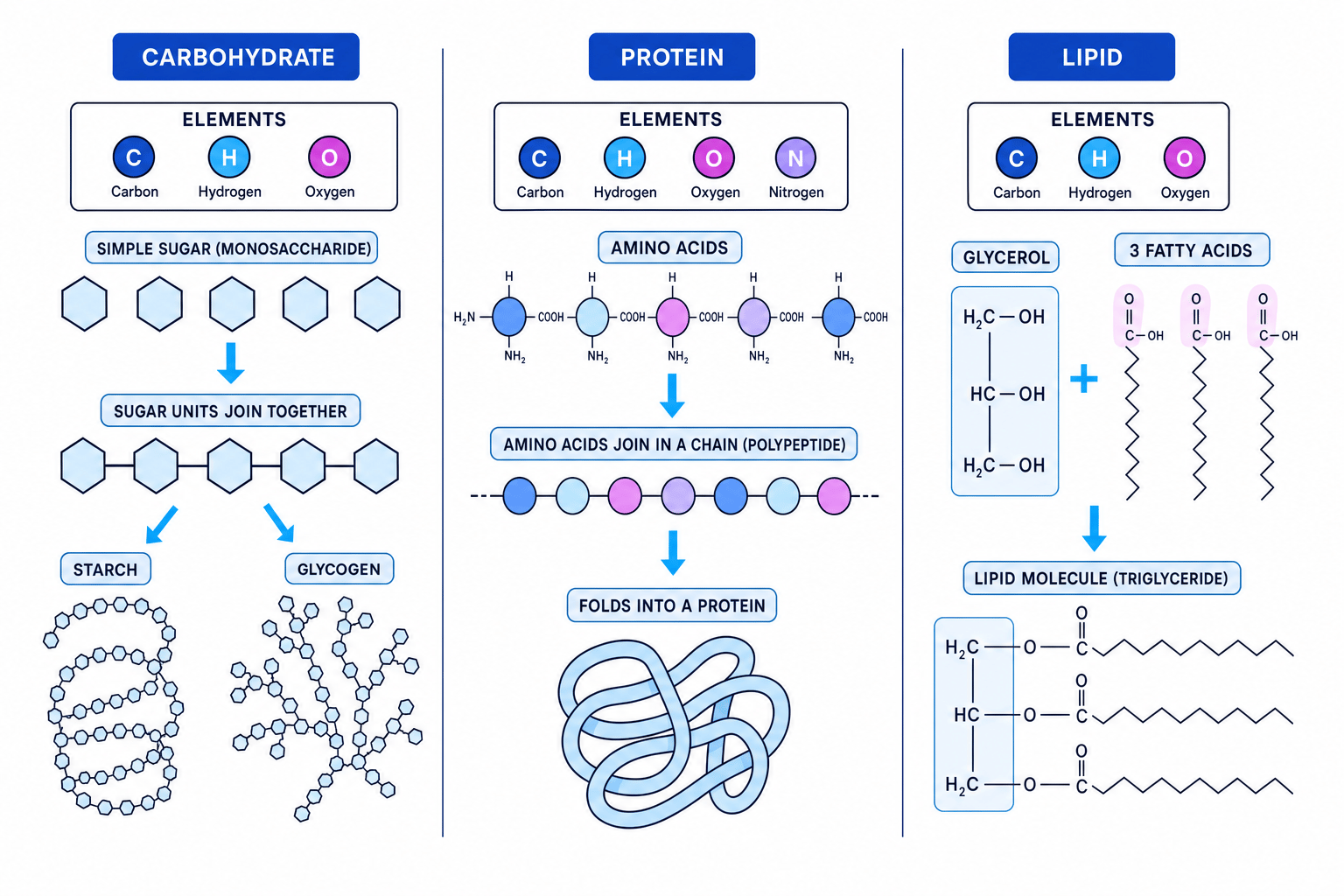
Carbohydrates contain the elements carbon, hydrogen and oxygen.
Small carbohydrates are called simple sugars. Glucose is an important simple sugar used in respiration.
Large carbohydrates are made by joining many simple sugar units together:
- Starch is a storage carbohydrate in plants.
- Glycogen is a storage carbohydrate in animals.
Proteins
Proteins contain carbon, hydrogen, oxygen and nitrogen.
Proteins are large molecules made from smaller units called amino acids. Different proteins have different sequences of amino acids, which gives them different shapes and jobs.
Examples of protein roles include enzymes, some hormones, antibodies and structural materials in cells.
Lipids
Lipids are fats and oils. They contain carbon, hydrogen and oxygen.
A lipid molecule is made from fatty acids and glycerol. Lipids are useful for energy storage, insulation and making cell membranes.
Elements and building blocks
Carbohydrates and lipids contain carbon, hydrogen and oxygen. Proteins contain carbon, hydrogen, oxygen and nitrogen. Starch and glycogen are made from simple sugars, proteins are made from amino acids, and lipids are made from fatty acids and glycerol.
Mixing up the smaller units
Do not say proteins are made from glucose. Proteins are made from amino acids. Glucose is a simple sugar used to make carbohydrates such as starch and glycogen.
Food tests practical
In this named practical, you investigate food samples for glucose, starch, protein and fat.
A food sample is usually prepared by crushing the food with distilled water and filtering it, so you can test the liquid extract. For the fat test, ethanol is used because lipids dissolve better in ethanol than in water.
The tests you need to know
| Food molecule tested | Reagent or method | Positive result |
|---|---|---|
| Glucose | Add Benedict’s solution and heat in a hot water bath | Blue changes to green, yellow, orange or brick-red |
| Starch | Add iodine solution | Brown/orange changes to blue-black |
| Protein | Add Biuret solution | Blue changes to lilac or purple |
| Fat | Shake with ethanol, then add water | White or cloudy emulsion forms |
Key practical details
For a fair comparison between different foods, keep the testing conditions as similar as possible:
- Use the same mass or volume of food sample.
- Use the same volume of reagent.
- Heat Benedict’s tests for the same time and at the same temperature.
- Use clean test tubes or spotting tiles to avoid contamination.
- Include a negative control, such as distilled water, to show what a negative result looks like.
Identifying an unknown food sample
A food sample gives these results: iodine turns blue-black, Benedict’s turns brick-red after heating, Biuret stays blue, and the ethanol emulsion test stays clear.
- The iodine result is positive because blue-black shows starch is present.
- The Benedict’s result is positive because brick-red after heating shows glucose is present.
- The Biuret result is negative because it stayed blue, so protein is not detected.
- The emulsion test is negative because it stayed clear, so fat is not detected.
Forgetting to heat Benedict’s solution
Benedict’s solution only gives its colour change after heating in a hot water bath. If you do not mention heating, you may lose the method mark.
Enzymes as biological catalysts
Enzyme
An enzyme is a protein that acts as a biological catalyst, meaning it speeds up a chemical reaction in living organisms without being used up.
A metabolic reaction is a chemical reaction that happens inside a living organism. Examples include reactions in respiration, digestion and photosynthesis.
Each enzyme has an active site, which is the part of the enzyme where the reacting molecule fits. The reacting molecule is called the substrate. The enzyme and substrate form an enzyme-substrate complex, then products are released. The enzyme is unchanged and can be used again.
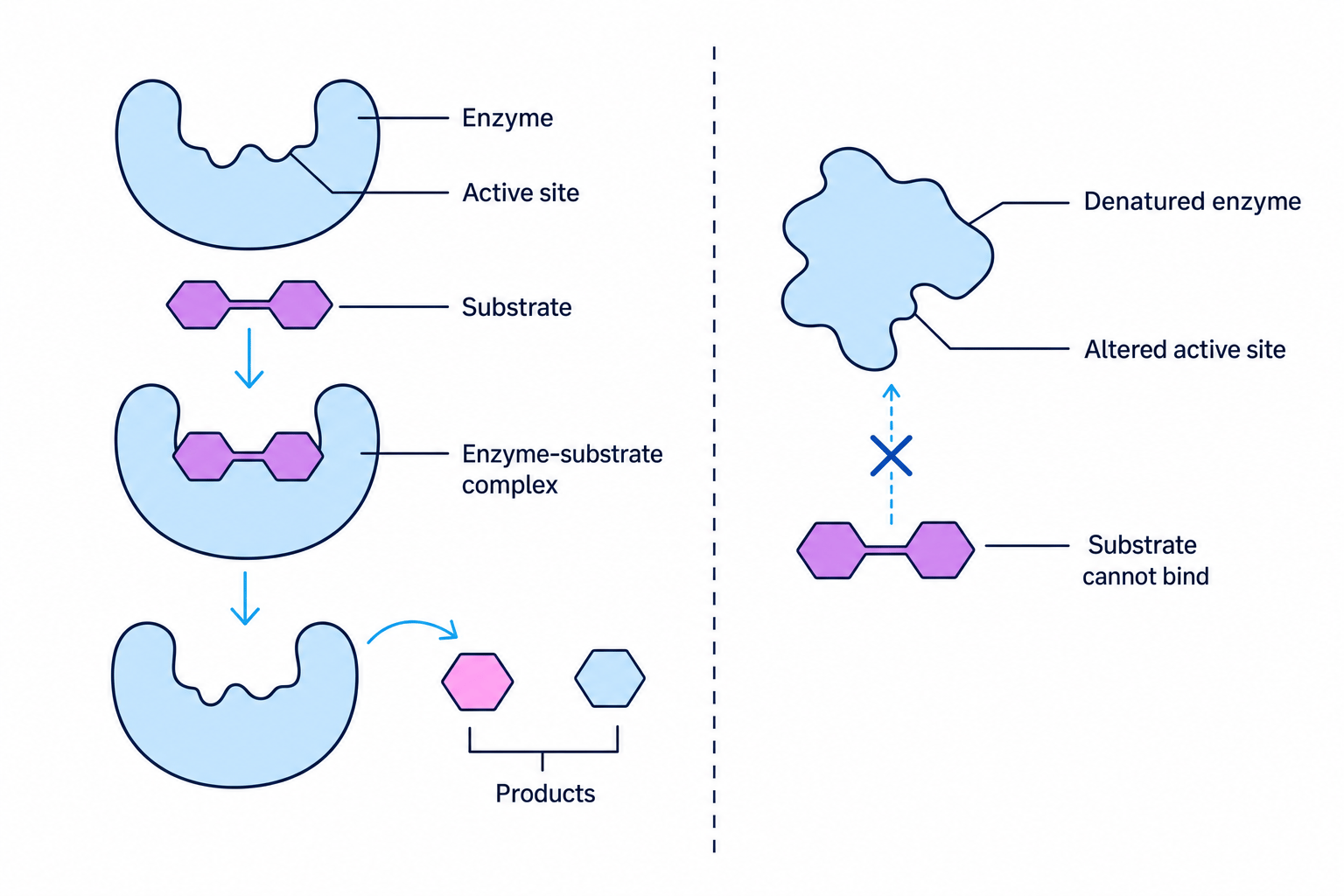
Enzymes are specific because the shape of the active site is complementary to the shape of the substrate. If the active site shape changes, the substrate may no longer fit.
Specific active sites
Enzyme function depends on shape. A substrate must fit into the enzyme’s active site for the reaction to be catalysed.
Temperature and enzyme activity
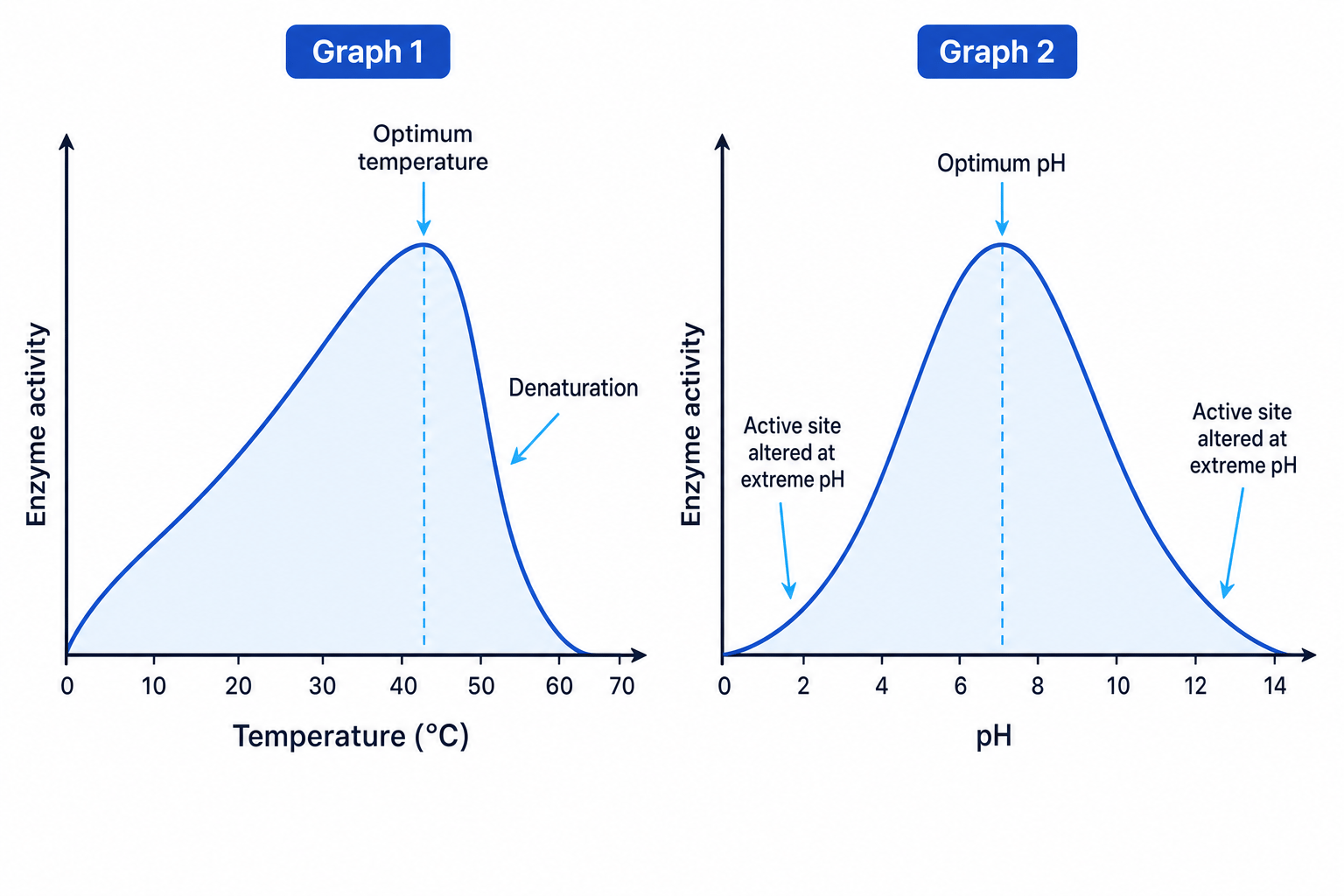
At low temperatures, enzyme activity is low because enzyme and substrate particles have less kinetic energy, so there are fewer successful collisions.
As temperature increases, particles move faster. This increases the frequency of successful collisions, so enzyme activity increases.
At the optimum temperature, the enzyme works at its fastest rate. Above the optimum, the enzyme may become denatured.
Denaturation
Denaturation is a change in the shape of an enzyme’s active site, so the substrate no longer fits properly and the reaction rate decreases.
The graphs below show the typical effect of temperature and pH on enzyme activity.
Saying enzymes are killed
Enzymes are not alive, so they are not “killed”. Say the enzyme is denatured because the active site changes shape.
Practical: effect of temperature on enzyme activity
A common method uses amylase, an enzyme that breaks down starch into sugars.
Method
- Add starch solution to one test tube.
- Add amylase solution and buffer solution to another test tube.
- Place both tubes in a water bath at the chosen temperature for a few minutes.
- Mix the starch and amylase, then start a timer.
- Every 10 seconds, place a drop of the mixture onto iodine solution on a spotting tile.
- Record the time when iodine no longer turns blue-black. This means starch has been broken down.
- Repeat at different temperatures and calculate the rate.
The independent variable is temperature. The dependent variable is the time taken for starch to disappear, or the calculated rate. Control variables include amylase concentration, starch concentration, volumes, pH, and the time allowed for solutions to reach the water bath temperature.
The expected result is that rate increases up to an optimum temperature, then decreases sharply as the enzyme denatures.
Calculating enzyme rate
In an amylase experiment, starch disappeared after 160 s at 20 °C and after 40 s at 40 °C.
- Use the fact that a shorter time means a faster reaction, so calculate rate using:
-
Substitute each time into the formula:
rate20=1160=0.00625 s−1rate40=140=0.025 s−1\begin{aligned} \text{rate}_{20} &= \frac{1}{160} = 0.00625\ \text{s}^{-1}\\ \text{rate}_{40} &= \frac{1}{40} = 0.025\ \text{s}^{-1} \end{aligned}rate20rate40=1601=0.00625 s−1=401=0.025 s−1 -
Compare the two rates: 0.025 is four times larger than 0.00625, so the reaction at 40 °C was four times faster than at 20 °C.
Improving temperature practicals
Let the enzyme and substrate reach the chosen temperature before mixing them. If you mix immediately, the reaction may start at the wrong temperature.
pH and enzyme activity
pH is a measure of how acidic or alkaline a solution is. Low pH is acidic, pH 7 is neutral, and high pH is alkaline.
Changing pH can affect enzyme function because it can alter the shape of the active site. At extreme pH values, the active site may change enough that the substrate no longer fits well.
Each enzyme has an optimum pH where it works fastest. Not all enzymes have the same optimum pH.
Practical: effect of pH on enzyme activity
This named practical is Paper 2 only, but the idea is very similar to the temperature investigation.
You can use amylase and starch again, but change the pH using buffer solutions.
Method
- Prepare test tubes containing starch solution, amylase solution and buffer solution at a chosen pH.
- Keep the temperature constant using a water bath.
- Mix the amylase and starch, then start timing.
- Test samples with iodine every 10 seconds.
- Record the time taken until iodine remains brown/orange.
- Repeat using different buffer pH values.
- Calculate rate using the time taken.
The independent variable is pH. The dependent variable is time taken for starch to disappear or enzyme activity. Control variables include temperature, enzyme concentration, starch concentration, volumes and total reaction time.
The expected pattern is a peak at the optimum pH, with lower activity at pH values below and above the optimum.
Finding the optimum pH
A student tests amylase at pH 5, pH 7 and pH 9. Starch disappears after 120 s at pH 5, 35 s at pH 7, and 90 s at pH 9.
- Compare the times: the fastest reaction has the shortest time, which is 35 s at pH 7.
- Therefore, the highest enzyme activity among the tested values is at pH 7.
- The conclusion should say the optimum pH is around pH 7, because the true optimum might lie between the pH values tested.
In the exam
- For molecule questions, give both the elements and the smaller units using the exact terms: simple sugars, amino acids, fatty acids and glycerol.
- For food tests, name the reagent, the positive colour change, and any key condition such as heating Benedict’s solution.
- For enzyme questions, link changes in temperature or pH to the shape of the active site and whether the substrate can fit.
Check yourself
- Which element is found in proteins but not normally listed for carbohydrates or lipids?
- What positive result would you expect for starch, glucose, protein and fat?
- Why does enzyme activity decrease at very high temperatures or extreme pH values?