Agar blocks are prepared to model how different body shapes of desert organisms affect water loss via evaporation. To survive in arid conditions, a small mammal needs to minimise water loss from its surface.
The diagram below shows three differently shaped blocks of agar prepared from the same mixture. Each block has a volume of 216.0 cm3216.0\text{ cm}^3216.0 cm3.
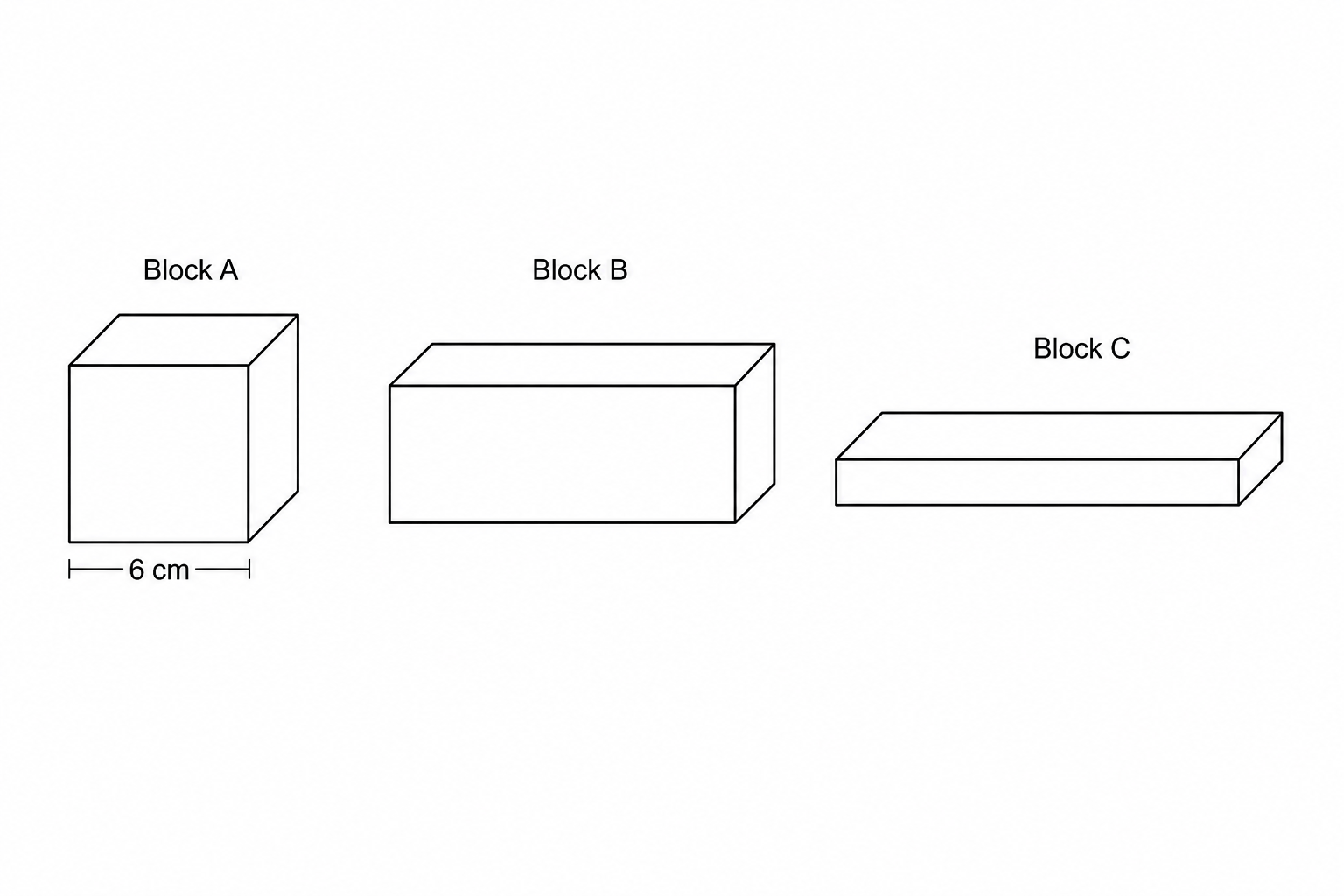
The table below shows the surface area, volume, and surface area to volume ratio for Block B and Block C. Complete the table by calculating and filling in the values for Block A, which is a cube with a side length of 6.0 cm6.0\text{ cm}6.0 cm.
| Block | Surface area (cm2\text{cm}^2cm2) | Volume (cm3\text{cm}^3cm3) | Surface area to volume ratio |
|---|---|---|---|
| A | (i) | (ii) | (iii) |
| B | 252.0252.0252.0 | 216.0216.0216.0 | 1.17:11.17 : 11.17:1 |
| C | 312.0312.0312.0 | 216.0216.0216.0 | 1.44:11.44 : 11.44:1 |
To survive in extremely arid conditions, small desert mammals must minimise their rate of dehydration. Explain which body shape, modelled by A, B, or C, represents the most advantageous adaptation for these mammals to survive in a hot, dry environment.

