

What you'll learn
- Cloning means making genetically identical copies — copies with the same genes.
- Micropropagation, also called plant tissue culture, can produce many identical plants from tiny pieces of plant tissue.
- Mammals such as sheep can be cloned by transferring a nucleus from a mature body cell into an egg cell with its nucleus removed.
- Transgenic animals carry a gene from another species and can be cloned to produce useful human proteins.
Paper 2 link
These cloning details are labelled B in the Edexcel 4BI1 specification, so they are assessed on Paper 2 only — but they connect strongly to genes, mitosis and biotechnology.
The big idea: what is a clone?
Clone
A clone is a cell or organism that is genetically identical to another cell or organism. This means it has the same genes.
Cloning is a form of copying. In biology, copying can happen naturally, for example when bacteria divide or when some plants reproduce asexually. In this topic, you focus on artificial cloning: cloning carried out using laboratory techniques.
A gene is a section of DNA that controls an inherited characteristic, often by coding for a protein. DNA is the chemical that carries genetic information. In plant and animal cells, most DNA is found in the nucleus.
Cloning is useful when an organism has desirable characteristics — features people want, such as high yield, disease resistance, fast growth, or the ability to make a useful substance.
Cloning copies genes
Cloning does not “improve” an organism by itself. It copies an organism or cell that already has useful genes.
Why mitosis matters
Mitosis is cell division that produces genetically identical cells. This is why it is important in cloning: if cells divide by mitosis, each new cell receives copies of the same DNA.
In plant micropropagation, mitosis produces many identical plant cells. In mammal cloning, mitosis allows an embryo to grow after it has received the copied nucleus.
Identical genes are not identical lives
Clones have the same genes, but they may not look exactly the same in every detail if they grow in different environments. Genes and environment both affect characteristics.
Micropropagation: cloning plants
Micropropagation is a plant cloning technique where small pieces of plant tissue are grown in controlled laboratory conditions to make many new plants.
It is also called tissue culture, because plant tissue is grown on a nutrient medium. The tissue is grown in vitro, which means outside a living organism, in laboratory containers such as culture vessels.
Micropropagation terms
- An explant is a small piece of plant tissue taken from a parent plant, often from a shoot tip.
- Sterile means free from living microorganisms.
- A nutrient medium is a jelly-like or liquid material containing minerals, sugars and other substances needed for growth.
- Plant hormones are chemicals that control plant growth and development.
- A callus is a mass of unspecialised plant cells that can later develop into shoots and roots.
The sequence is easier to follow as a flow diagram:
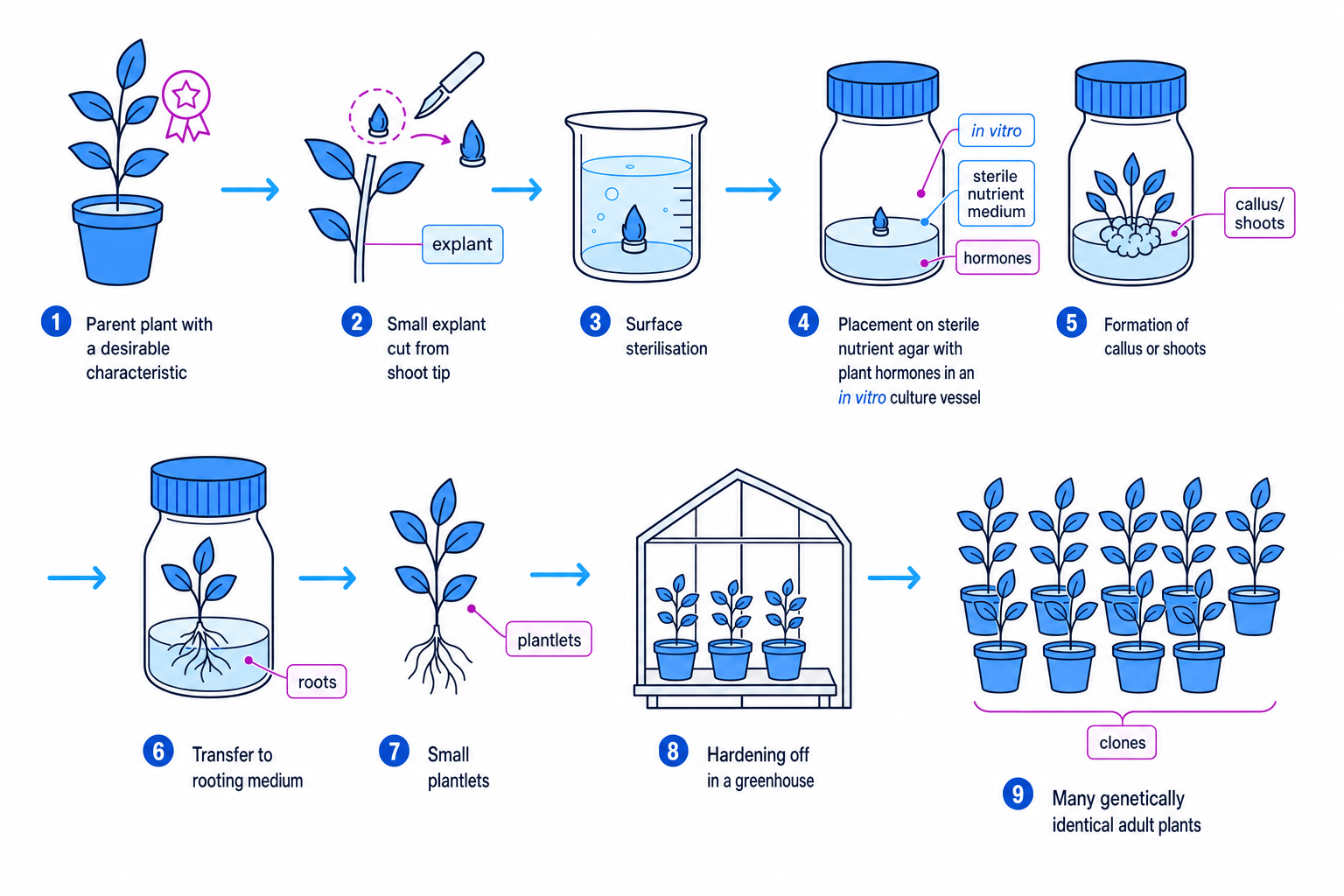
Stages of micropropagation
- A parent plant with desirable characteristics is selected.
- A small explant is cut from the plant, often from a growing shoot tip.
- The explant is surface sterilised to kill microorganisms and reduce contamination, meaning unwanted microorganisms growing in the culture.
- The explant is placed on a sterile nutrient medium containing plant hormones.
- Cells divide by mitosis to form a callus or small shoots.
- The growing tissue is transferred to media with different hormone balances to stimulate shoots and roots.
- Small plantlets are moved to soil or compost and hardened off in a greenhouse.
- The mature plants are clones of the original parent plant.
Micropropagation
Micropropagation can produce commercial quantities of genetically identical plants with desirable characteristics.
Commercial quantities means large numbers produced for sale or large-scale use. This is useful for crops, ornamental plants and rare plants.
Why micropropagation is useful
Micropropagation is useful because it can:
- produce many plants quickly from one parent plant
- make plants with the same desirable characteristics
- produce uniform crops that grow and ripen at similar times
- clone plants that are difficult to grow from seeds
- help produce disease-free plants if healthy tissue is chosen
However, there is a risk. Because the plants are genetically identical, they may all be vulnerable to the same disease or environmental change.
Sterile does not mean nutrient-free
A sterile culture still contains nutrients and plant hormones. “Sterile” only means microorganisms have been removed or killed.
Choosing a method for a uniform crop
A grower has one strawberry plant that produces large fruit and resists a fungal disease. They want thousands of plants with the same characteristics.
- The grower needs many plants with the same useful genes, so the method must copy the selected plant rather than mix its genes with another plant.
- Growing from seeds would involve sexual reproduction, so offspring would show genetic variation and may not all inherit both useful characteristics.
- Micropropagation uses explants from the selected plant and repeated mitosis, so the new plantlets are genetically identical clones.
- The grower should still consider disease risk, because a disease that affects one clone may affect many of them.
Cloning mammals: Dolly the sheep
Cloning a mammal is more difficult than cloning a plant. A mammal is an animal group whose females produce milk, such as sheep, cows and humans.
The method used to produce Dolly the sheep is often called somatic cell nuclear transfer. A somatic cell is a body cell, not a sperm or egg cell. Nuclear transfer means moving a nucleus from one cell into another.
Mammal cloning terms
- A diploid nucleus contains two sets of chromosomes, as found in most body cells.
- A mature cell is a specialised body cell from an adult organism.
- An egg cell is a female gamete, or sex cell.
- An enucleated egg cell is an egg cell whose nucleus has been removed.
- An embryo is an early stage of development formed when cells divide.
- A surrogate mother is a female that carries an embryo during pregnancy but is not the source of its nucleus.
The stages of mammal cloning and its link to transgenic animals are summarised here:
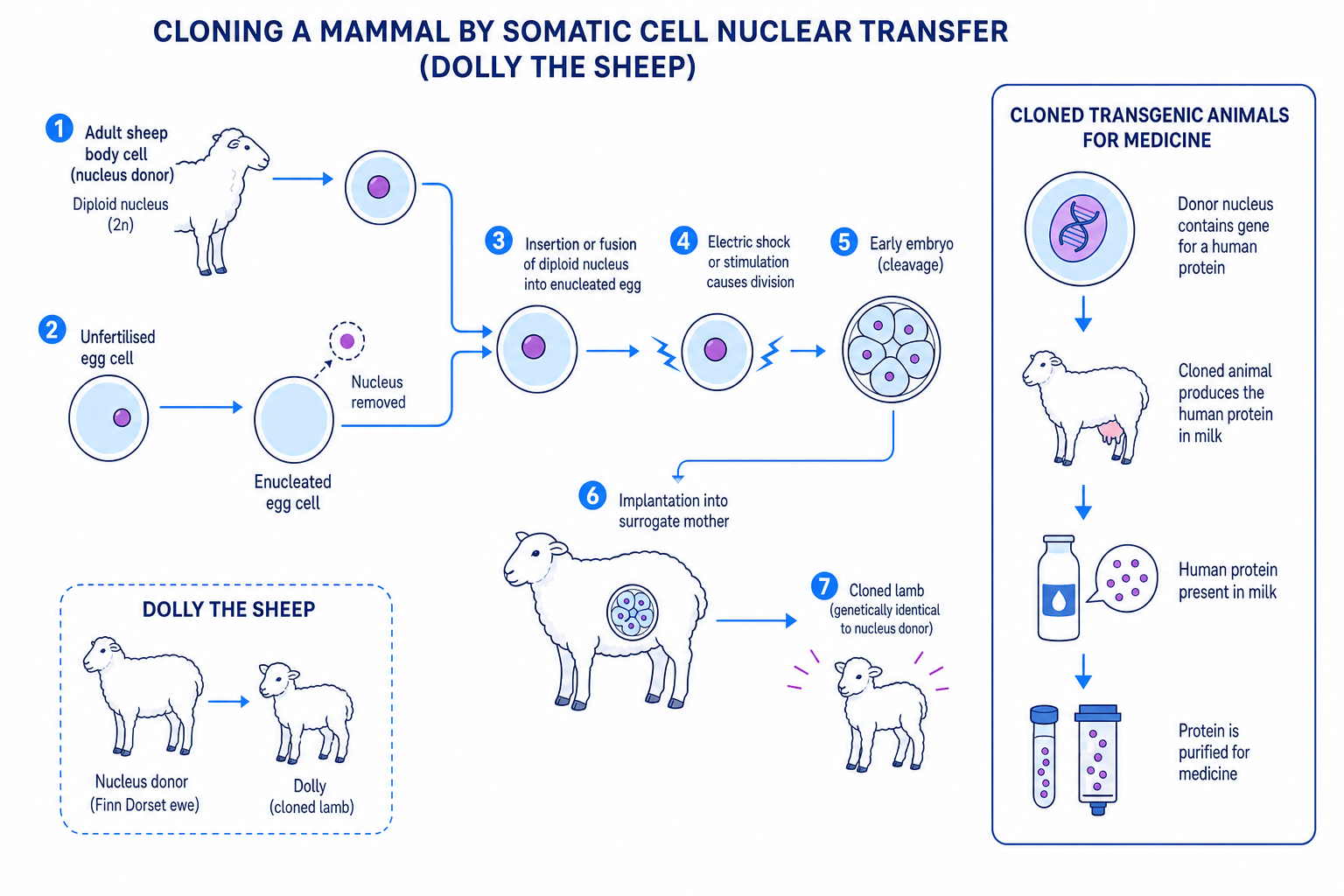
Stages in producing a cloned mammal
- A mature body cell is taken from the animal being cloned.
- The diploid nucleus is removed from this body cell.
- An unfertilised egg cell is taken from another animal.
- The nucleus is removed from the egg cell, making an enucleated egg cell.
- The diploid nucleus from the mature body cell is inserted into the enucleated egg cell.
- The egg cell is stimulated, often using an electric shock, so it begins to divide by mitosis.
- The developing embryo is implanted into the uterus of a surrogate mother.
- The offspring is born as a clone of the animal that donated the diploid nucleus.
Dolly the sheep was cloned using a nucleus from an adult sheep’s body cell. Dolly was genetically identical to the sheep that donated the nucleus, not to the egg donor or the surrogate mother.
Dolly's genetic identity
In mammal cloning, the clone’s nuclear DNA comes from the animal that donated the diploid nucleus.
Identifying the genetic match in Dolly
Three sheep are involved: a nucleus donor, an egg cell donor and a surrogate mother. Which one is the cloned lamb genetically identical to?
- The egg cell donor’s nucleus is removed, so its nuclear DNA is not used to control the embryo’s inherited characteristics.
- The surrogate mother carries the embryo during pregnancy, but she does not provide the embryo’s nucleus.
- The diploid nucleus from the mature body cell is the nucleus that divides by mitosis in the embryo, so the cloned lamb is genetically identical to the nucleus donor.
The surrogate is not the genetic source
Do not say the clone is genetically identical to the surrogate mother. The surrogate provides the uterus for development, not the diploid nucleus.
Cloned transgenic animals and human proteins
Transgenic animal
A transgenic animal is an animal that contains a gene from another species.
A human gene can be inserted into an animal cell so that the animal can make a useful human protein, such as a blood-clotting protein or another medical protein. A protein is a molecule made by cells using instructions from genes.
Cloning is useful here because scientists may successfully produce one animal cell with the human gene in the correct place. If that cell is cloned, many animals can be produced with the same inserted gene.
How cloned transgenic animals can be used
- A useful human gene is inserted into an animal cell.
- The nucleus from this transgenic cell is used in nuclear transfer.
- Cloned embryos are produced and implanted into surrogate mothers.
- The cloned animals grow and all contain the human gene.
- The animals produce the human protein, often in their milk.
- The protein is collected, purified and used as a medicine.
Genetic engineering plus cloning
Genetic engineering adds the useful human gene; cloning copies the successful transgenic animal or cell so many animals can produce the protein.
Why clone a transgenic animal
A scientist has produced one sheep cell containing a human gene for a medical protein. Why use cloning?
- The successful cell contains the human gene, so its diploid nucleus carries the genetic instruction needed to make the protein.
- If this nucleus is transferred into enucleated egg cells, the resulting embryos copy that nucleus by mitosis.
- The cloned animals should all contain the same human gene, so they can form a group of animals producing the human protein.
- Relying only on sexual reproduction would be less predictable, because not every offspring would necessarily inherit or express the gene in the desired way.
Human protein, not human animal
A transgenic sheep producing a human protein is still a sheep. It has one or more human genes, not a whole human genome.
Quick comparison
| Feature | Micropropagation | Mammal nuclear transfer |
|---|---|---|
| Organism cloned | Plant | Mammal |
| Starting material | Explant from parent plant | Diploid nucleus from mature body cell |
| Main cell division involved | Mitosis | Mitosis after the egg is stimulated |
| Genetically identical to | Parent plant | Nucleus donor |
| Main use | Many identical plants with desirable characteristics | Cloned animals, including transgenic animals for protein production |
In the exam
- For micropropagation, give the sequence clearly: explant, sterilise, sterile nutrient medium with hormones, shoots or callus, roots, plantlets, clones.
- For Dolly, state that the diploid nucleus comes from a mature body cell and is inserted into an enucleated egg cell.
- For transgenic animal questions, link both ideas: the human gene allows protein production, and cloning produces many animals with that gene.
Check yourself
- Why must explants be grown on a sterile nutrient medium?
- In mammal cloning, which animal is the clone genetically identical to?
- Why is cloning useful after producing a successful transgenic animal?
