Arteries
Artery
A blood vessel with thick, muscular, elastic walls that carries blood at high pressure away from the heart.
- Arteries carry blood away from the heart at high pressure.
- Their walls are thick, with layers of muscle and elastic tissue.
- The thick, elastic wall withstands and smooths out the high pressure.
- They have a narrow lumen, the central channel through which blood flows.
- Most arteries carry oxygenated blood, the pulmonary artery being the exception.
The elastic wall stretches as blood surges through, then recoils to keep the blood moving.
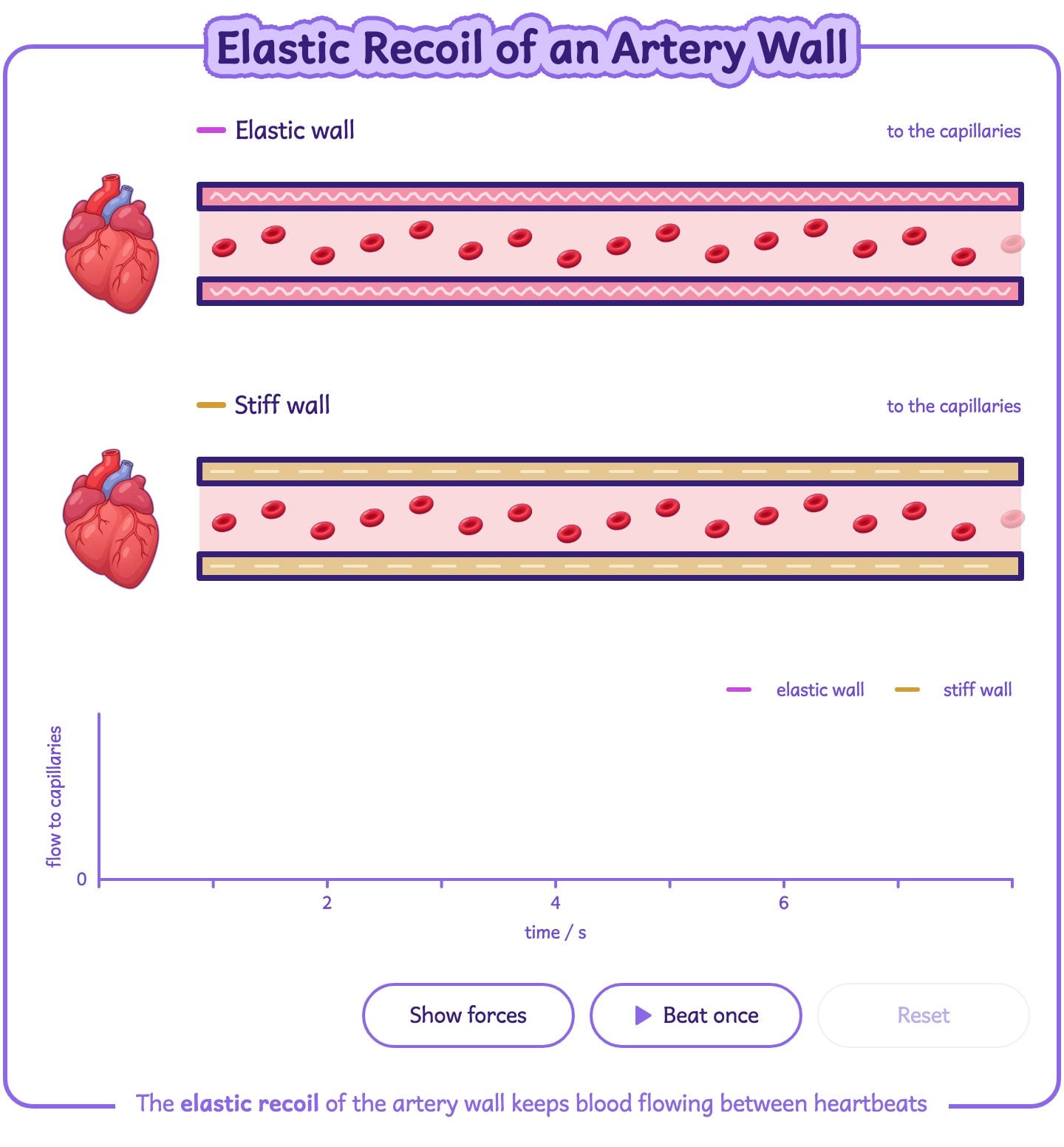
Watch the artery wall stretch and recoil with each heartbeat, keeping blood flowing between beats.
Veins
Vein
A blood vessel with thinner walls and valves that carries blood at low pressure back to the heart.
- Veins carry blood back towards the heart at low pressure.
- Their walls are thinner, with much less muscle and elastic tissue.
- They have a wide lumen, which reduces resistance to the returning blood.
- They contain valves that stop the blood flowing backwards.
- Most veins carry deoxygenated blood, the pulmonary vein being the exception.
Contraction of nearby muscles squeezes the veins and, with the valves, pushes blood back to the heart.
Capillaries
Capillary
A tiny blood vessel with walls one cell thick, where substances are exchanged between the blood and the body's cells.
- Capillaries are the smallest blood vessels and link the arteries to the veins.
- Their walls are only one cell thick.
- This gives a very short distance for substances to diffuse.
- Their function is to allow exchange of substances between the blood and the body's cells.
- Oxygen and nutrients leave the blood here, while carbon dioxide and wastes enter it.
The thin, one-cell-thick wall and narrow size make the capillary an ideal exchange surface.
The Main Blood Vessels
Aorta
The main artery that carries oxygenated blood from the left ventricle to the body.
- The vena cava returns deoxygenated blood from the body to the heart.
- The aorta carries oxygenated blood from the heart to the body.
- The pulmonary artery carries deoxygenated blood from the heart to the lungs.
- The pulmonary vein carries oxygenated blood from the lungs back to the heart.
- The renal artery carries blood to each kidney and the renal vein carries it away.
- Describe the wall of an artery and explain why it suits high pressure.
- Give two features of a vein that suit low-pressure blood flow.
- How thick is the wall of a capillary, and why is this useful?
- State the function of capillaries.
- Name the vessels that carry blood into and out of the kidney.