Artery Structure and High Pressure
Artery
A blood vessel with thick, muscular, elastic walls that carries blood at high pressure away from the heart.
- Arteries carry blood at high pressure, because it has just been pumped from the heart.
- Their walls contain thick layers of muscle and elastic tissue.
- The elastic tissue stretches as high-pressure blood surges in, then recoils to push it on.
- This keeps the blood moving in smooth surges and stops the wall from bursting.
- A narrow lumen helps to maintain the high pressure.
The stretch and recoil of the artery wall is what you feel as a pulse.
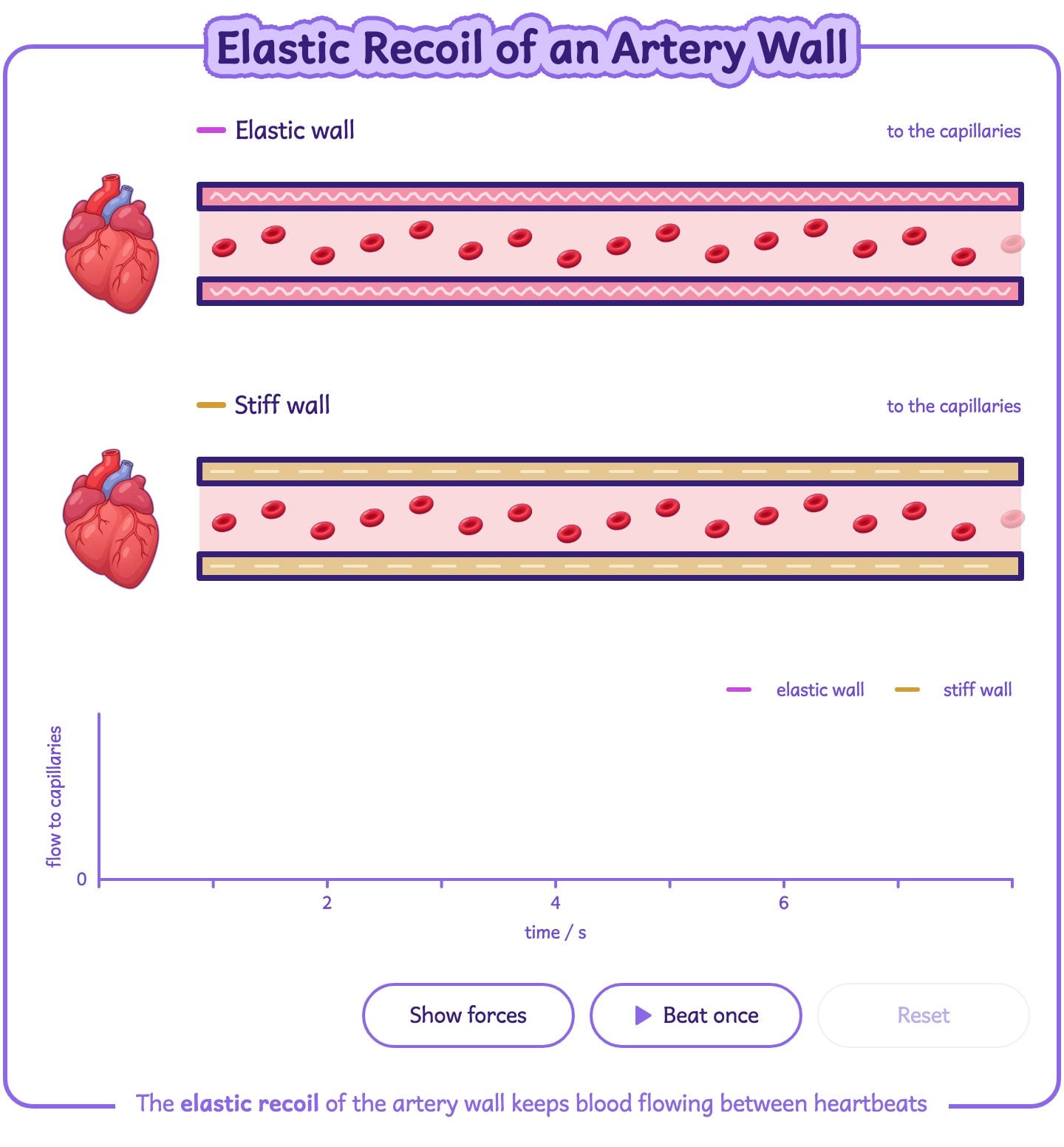
Watch the artery wall stretch and recoil with each heartbeat, keeping blood flowing between beats.
Vein Structure and Low Pressure
Vein
A blood vessel with thinner walls and valves that carries blood at low pressure back to the heart.
- By the time blood reaches the veins, it is at low pressure.
- Veins have thin walls, because they do not need to withstand high pressure.
- They have a wide lumen, which offers little resistance to the slow-moving blood.
- Valves prevent the low-pressure blood from flowing backwards.
- Contraction of nearby skeletal muscles squeezes the veins and helps push blood towards the heart.
Without valves, the low pressure in veins would let blood pool and flow the wrong way.
Capillary Structure and Exchange
Capillary
A tiny blood vessel with walls one cell thick, where substances are exchanged between the blood and the body's cells.
- Capillaries have walls that are only one cell thick.
- This short diffusion distance lets substances pass quickly between the blood and the cells.
- Their walls are permeable, allowing dissolved substances to pass through.
- They form dense networks with a large total surface area for exchange.
- Blood flows slowly through them, giving more time for exchange.
Thin walls, a large surface area and slow flow all speed up exchange at the capillaries.
The Blood Vessels of the Liver
Hepatic portal vein
The blood vessel that carries blood rich in absorbed nutrients from the small intestine to the liver.
- The hepatic artery carries oxygenated blood from the aorta to the liver.
- The hepatic portal vein carries blood rich in absorbed nutrients from the small intestine to the liver.
- The hepatic vein carries blood from the liver back to the vena cava.
- The liver therefore receives blood from two vessels but drains through one.
- Explain how the structure of an artery is related to the high pressure of its blood.
- Explain how the structure of a vein is related to the low pressure of its blood.
- Give three features of a capillary that adapt it for exchange.
- Name the vessel that brings nutrient-rich blood from the intestine to the liver.
- Which vessel drains blood from the liver to the vena cava?