How the Heart Muscle Contracts
Definition
Cardiac muscle
The specialised muscle of the heart wall that contracts and relaxes rhythmically throughout life without becoming fatigued.
- The heart wall is made of cardiac muscle, which contracts and relaxes rhythmically without tiring.
- One heartbeat is a fixed sequence of contraction and relaxation called the cardiac cycle.
- First the two atria contract together, pushing blood down into the ventricles.
- Next the two ventricles contract, pushing blood out into the arteries.
- The heart muscle then relaxes, allowing the chambers to fill with blood again.
Note
The atria and ventricles never contract at the same instant; the atria always contract first.
Pressure Changes Move the Blood
- When a chamber contracts, its volume falls and the pressure of the blood inside rises.
- Blood always flows from a region of higher pressure to one of lower pressure.
- So the high pressure created by contraction pushes blood into the next chamber or artery.
- When a chamber relaxes, its pressure falls and blood flows in to fill it.
Note
The thick-walled left ventricle produces the highest pressure, enough to drive blood around the whole body.
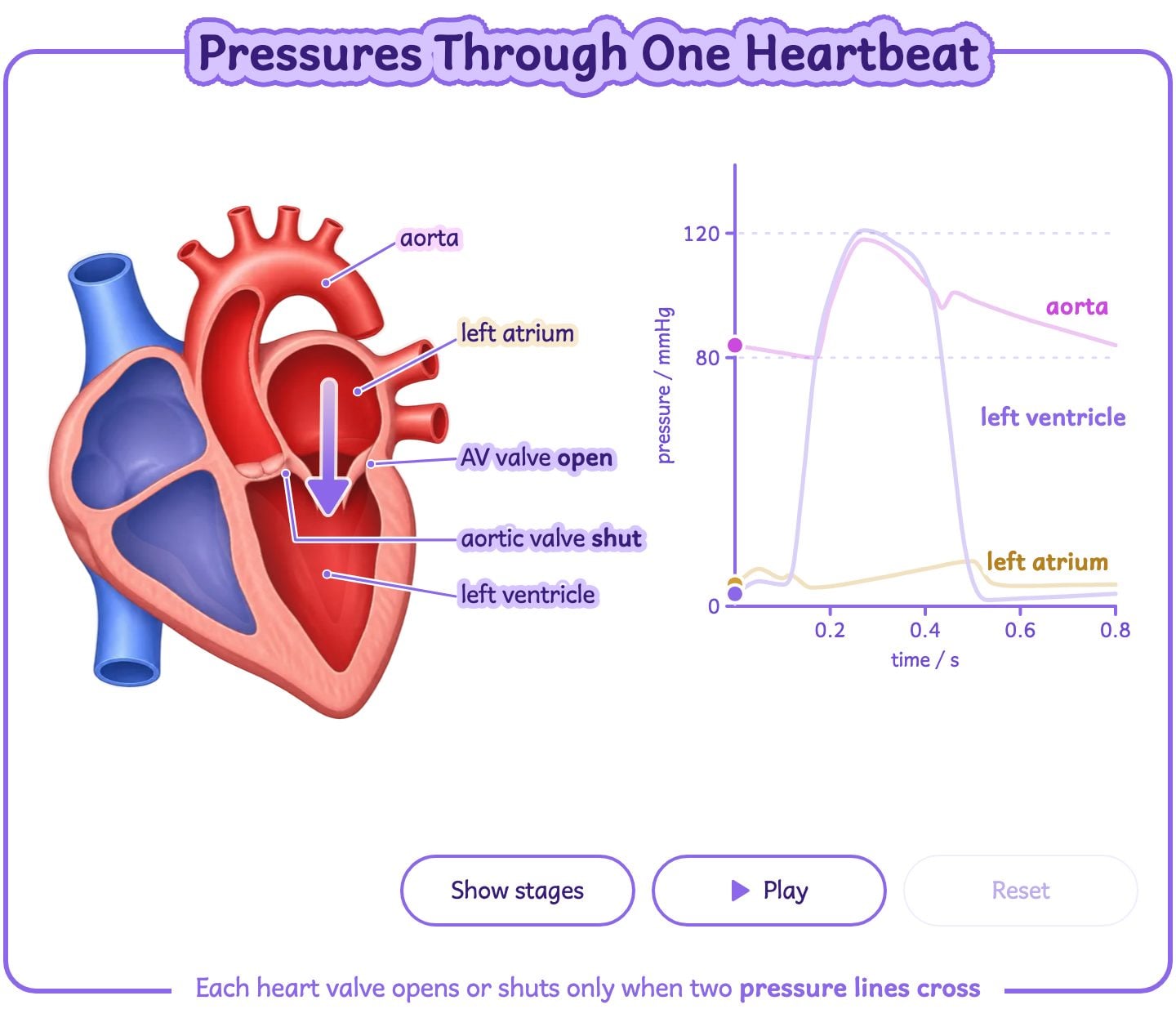
Follow one heartbeat and notice that each valve opens or shuts as the pressures change.
How the Valves Act
Definition
Semilunar valve
A valve at the exit of a ventricle, in the artery, that prevents blood flowing back into the ventricle after it contracts.
- The valves open and close because of these pressure differences, not because any muscle pulls them.
- When the ventricles contract, the rising pressure snaps the atrioventricular valves shut, stopping backflow into the atria.
- The same high pressure forces the semilunar valves open, so blood leaves through the pulmonary artery and aorta.
- When the ventricles relax, the higher pressure in the arteries closes the semilunar valves, preventing backflow into the ventricles.
Common Mistake
It is wrong to say the valves are opened by muscles; they open and close only in response to pressure changes.
The Effect of Physical Activity
Definition
Heart rate
The number of times the heart beats each minute.
- During physical activity the muscles respire faster and need more oxygen and glucose.
- They also produce more carbon dioxide, which must be removed quickly.
- The heart rate increases, so blood is pumped around the body faster.
- This delivers oxygen and glucose to the muscles faster and carries carbon dioxide away faster.
- The hormone adrenaline also raises the heart rate when the body is active or under stress.
Self review
- Which chambers contract first in the cardiac cycle, the atria or the ventricles?
- What happens to the pressure inside a chamber when it contracts?
- What makes the heart valves open and close?
- Explain why the heart rate increases during physical activity.
- Name the hormone that increases the heart rate during activity.