Leaf structure and water loss
Definition
Spongy mesophyll
The spongy mesophyll is the layer of loosely packed cells in the lower part of a leaf, with large air spaces that provide a big moist surface area for evaporation and gas exchange.
- The spongy mesophyll cells are surrounded by interconnecting air spaces.
- These air spaces give a very large internal surface area of moist cell walls for water to evaporate from.
- The larger this moist surface area, the more water can evaporate and the more water vapour is lost.
- The size and number of stomata also affect the loss: more, or larger, open stomata let more water vapour diffuse out.
Note
This objective is Supplement material, examined only on the Extended papers.
Transpiration pull moves water up
Definition
Transpiration pull
Transpiration pull is the suction force that draws a continuous column of water up the xylem as water evaporates from the leaves.
- As water evaporates from the mesophyll and diffuses out of the leaf, water is drawn out of the top of the xylem.
- This creates a transpiration pull, a suction force at the top of the xylem.
- The pull draws a continuous column of water up the xylem, all the way from the roots to the leaves.
Cohesion holds the column together
Definition
Cohesion
Cohesion is the attraction between water molecules that holds them together as a continuous, unbroken column in the xylem.
- Water molecules attract one another; this attraction is called cohesion.
- Cohesion holds the water molecules together as one unbroken column inside the xylem.
- Because the column does not break, the pull at the top is passed all the way down to the roots, so water keeps rising.
Self review
- Explain how the air spaces in the spongy mesophyll increase water loss.
- How does the number of stomata affect the rate of water vapour loss?
- What is transpiration pull and where is it produced?
- Explain why cohesion between water molecules is needed for water to rise up the xylem.
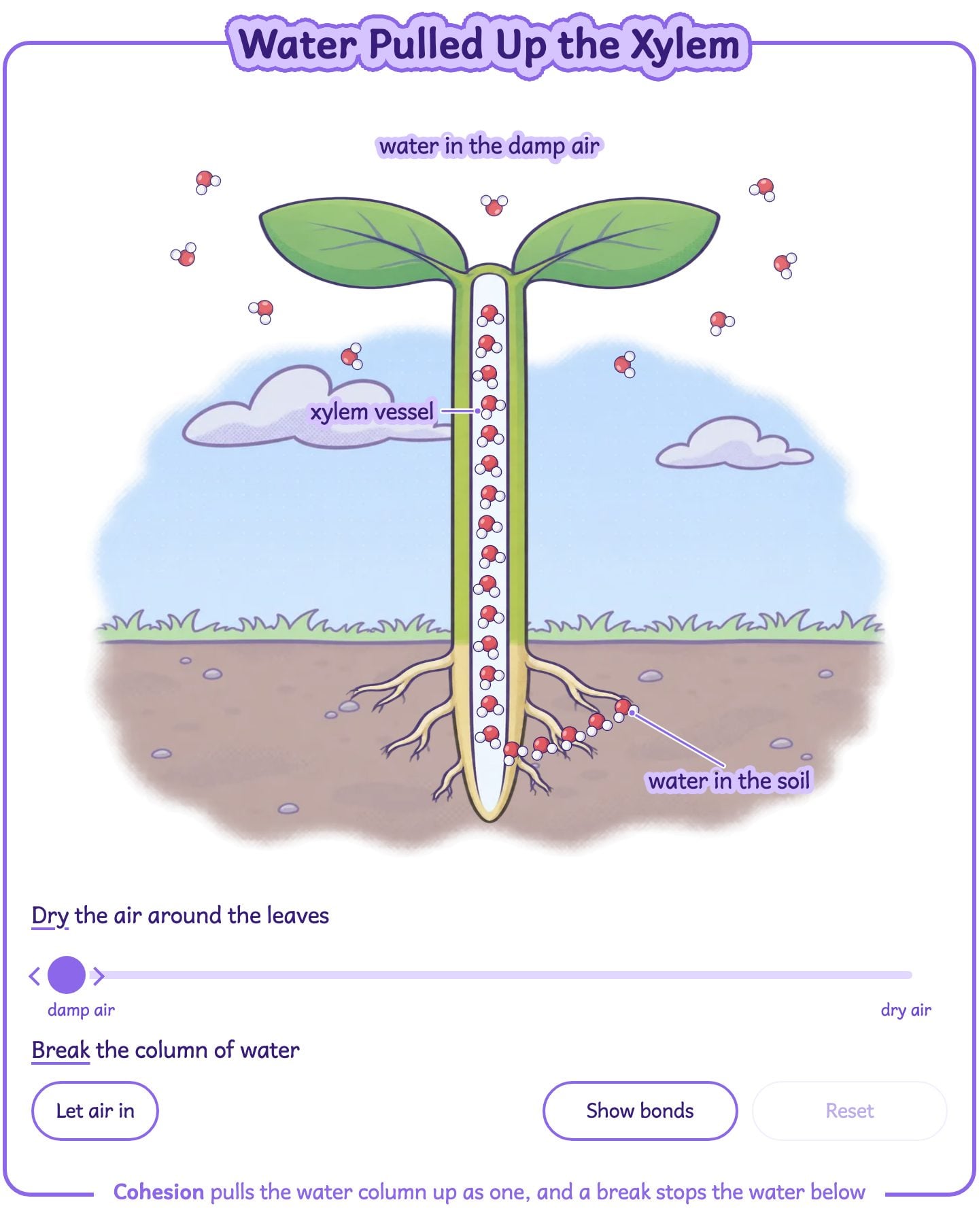
Watch the water molecules pull each other up the xylem, and see what a break does.