How each factor changes the rate
Definition
Transpiration
Transpiration is the loss of water vapour from the leaves of a plant, by evaporation from the mesophyll cell surfaces followed by diffusion out through the stomata.
- Temperature
- A higher temperature gives water molecules more kinetic energy, speeding up evaporation inside the leaf and diffusion out, so the rate rises.
- Wind speed
- Faster air movement removes the humid air next to the stomata, keeping the water vapour gradient steep, so the rate rises.
- Humidity
- More humid air outside the leaf makes the water vapour gradient shallower, so less vapour diffuses out and the rate falls.
Common Mistake
Do not assume every factor speeds transpiration up: increasing humidity is the one that slows it down.
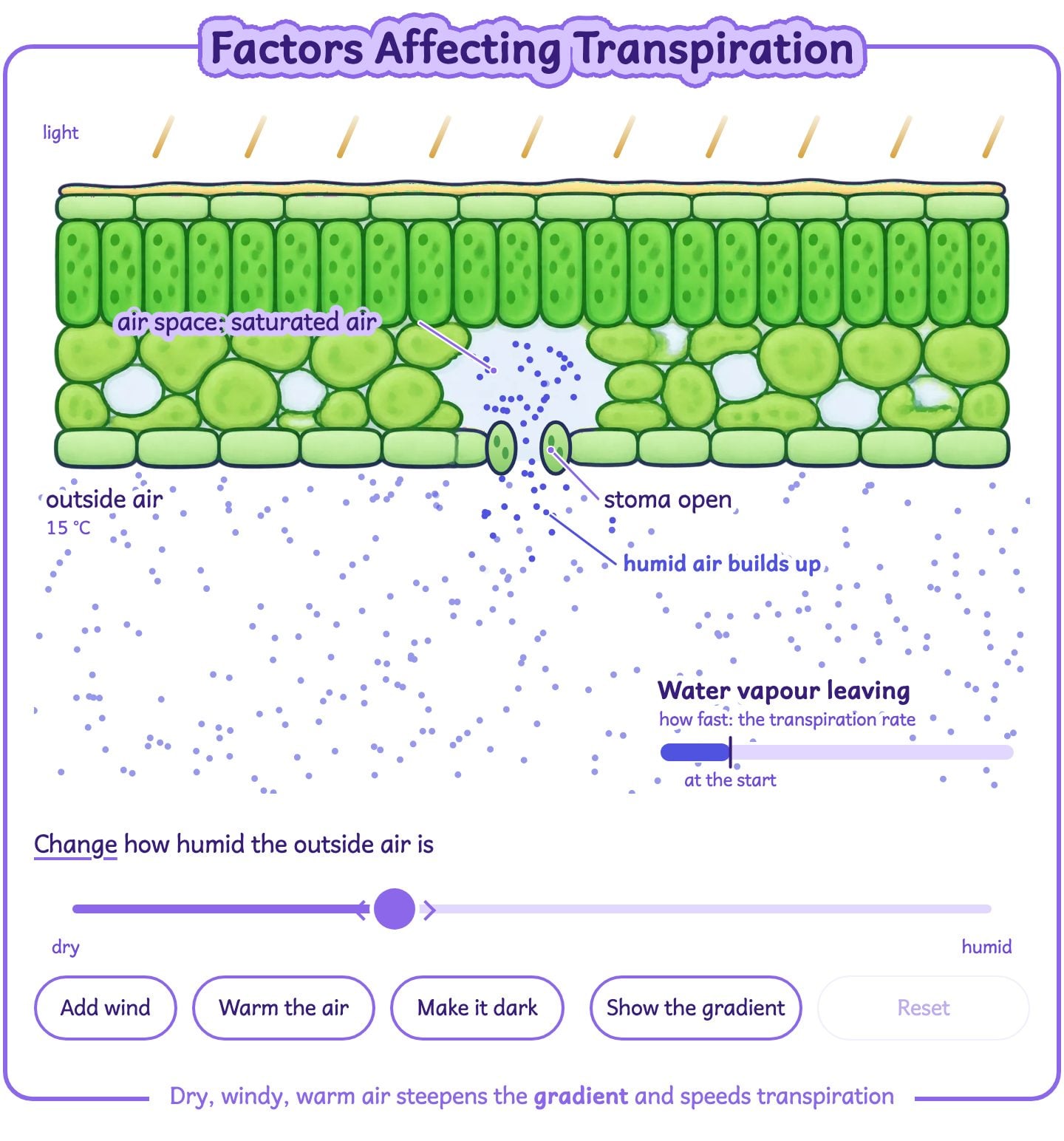
Change the temperature, wind and humidity and watch how fast the plant loses water.
How and why wilting happens
Definition
Wilting
Wilting is the drooping of leaves and stems that happens when a plant loses water by transpiration faster than the roots can absorb it, so the cells lose turgor.
- On a hot, dry or windy day, transpiration can become faster than the roots can absorb water.
- The leaf cells then lose more water than they gain and begin to lose water from their vacuoles.
- The cells lose their turgor and become flaccid, so they no longer press outwards to support the leaf.
- The leaves and stems droop; this drooping is called wilting.
Why wilting can protect the plant
Definition
Turgor
Turgor is the firmness of a plant cell produced when it is full of water and its contents press outwards against the cell wall.
- Normally turgor keeps the cells firm and holds the non-woody parts of the plant upright.
- When leaves wilt, they hang down and may curl, reducing the surface area facing the Sun.
- Wilting can also help the stomata close, which slows further water loss until the plant recovers.
Self review
- Explain why increasing humidity lowers the rate of transpiration.
- Explain the effect of wind speed on transpiration rate.
- Describe how wilting occurs when a plant loses too much water.
- How can wilting reduce further water loss from a plant?