What transpiration is
Definition
Transpiration
Transpiration is the loss of water vapour from the leaves of a plant, by evaporation from the mesophyll cell surfaces followed by diffusion out through the stomata.
- Transpiration is the loss of water vapour from the leaves of a plant.
- Most water is lost through the stomata of the leaves, with a small amount through the stem.
Note
Water leaves as water vapour, a gas, not as liquid water.
How water leaves the leaf
Definition
Stomata
Stomata are small pores in the leaf epidermis, mainly on the lower surface, through which gases and water vapour pass, each opened and closed by a pair of guard cells.
- Water evaporates from the moist surfaces of the mesophyll cells into the air spaces inside the leaf.
- These air spaces become saturated with water vapour.
- The water vapour then diffuses out through the open stomata into the drier air outside.
- The stomata are open mainly to let carbon dioxide in for photosynthesis, so this water loss happens at the same time.
Common Mistake
Do not think the plant transpires on purpose: water loss is an unavoidable side effect of opening the stomata for gas exchange.
Temperature and wind speed change the rate
- Temperature
- A higher temperature gives water molecules more energy, so evaporation and diffusion speed up and the rate rises.
- Wind speed
- Moving air blows away the humid air next to the leaf, keeping the difference in water vapour steep, so the rate rises.
- In still air, water vapour builds up around the leaf and the rate falls.
Practical
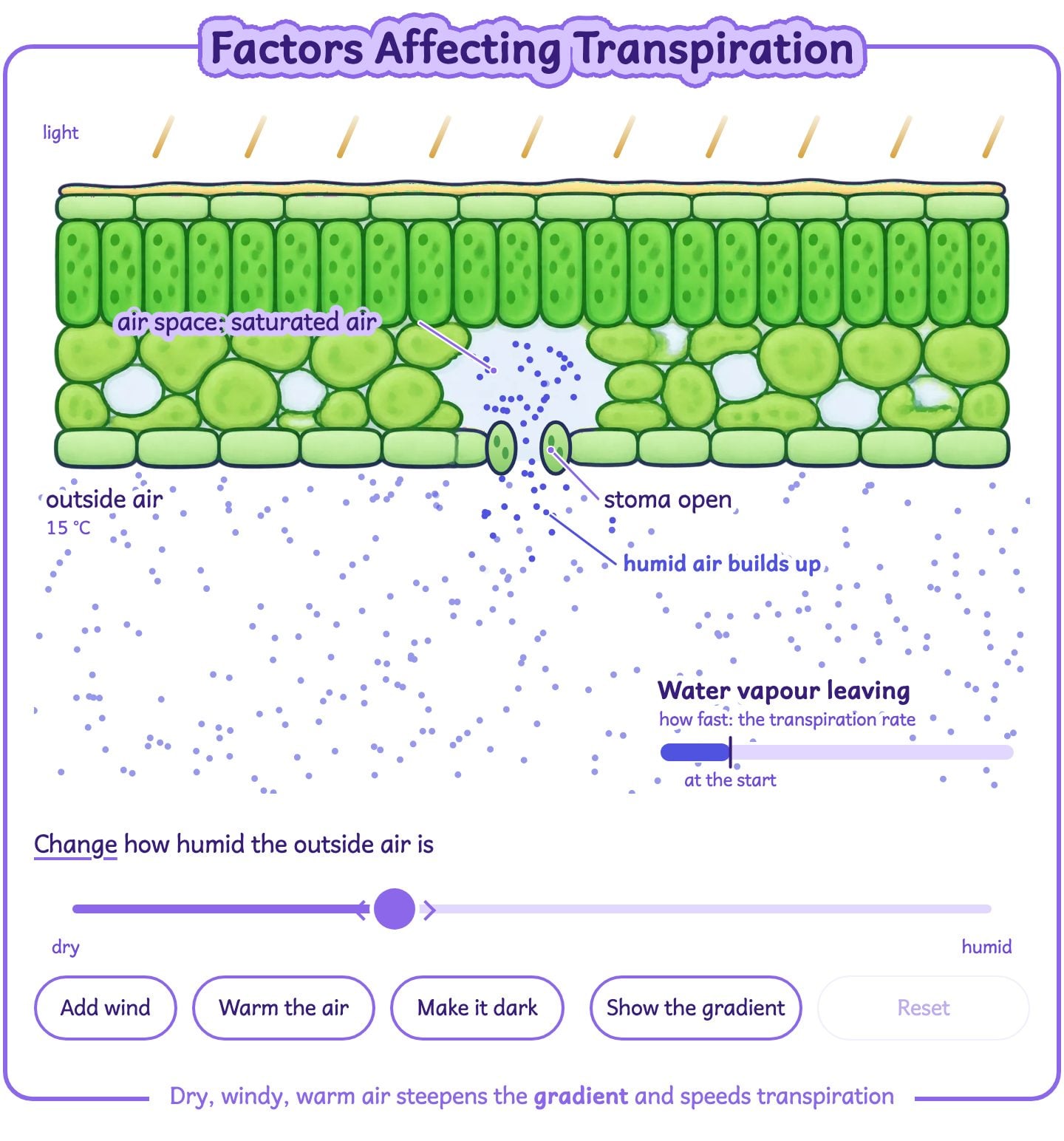
Change the temperature and wind speed and watch how fast the plant loses water.
Measure transpiration with a potometer
- Cut a leafy shoot under water and keep the cut end submerged, so no air is drawn into the xylem.
- Fill the potometer with water under water as well, checking there are no air bubbles trapped inside.
- Fit the shoot into the rubber tubing and seal every joint with petroleum jelly so the apparatus is airtight.
- Lift the open end of the capillary tube out of the water for a moment to let a single air bubble form, then lower it back.
- Record the starting position of the air bubble against the ruler.
- Time how far the bubble moves along the capillary tube in a fixed time, for example one minute.
- Open the reservoir tap to push the bubble back to the start, then repeat and take a mean.
- Calculate the rate of water uptake using rate=distance movedtime\text{rate} = \dfrac{\text{distance moved}}{\text{time}}rate=timedistance moved.
- To test temperature, move the whole apparatus to a warmer or cooler room and keep everything else the same.
- To test wind speed, use a fan or hair dryer on a cold setting and change only the air movement.
- Water uptake is used as a measure of the rate of transpiration, because nearly all the water taken up is lost from the leaves.
Self review
- Define transpiration.
- Describe how water vapour gets from inside a leaf to the outside air.
- State the effect of increasing wind speed on the rate of transpiration.
- Why is water uptake used as a measure of transpiration in a potometer?
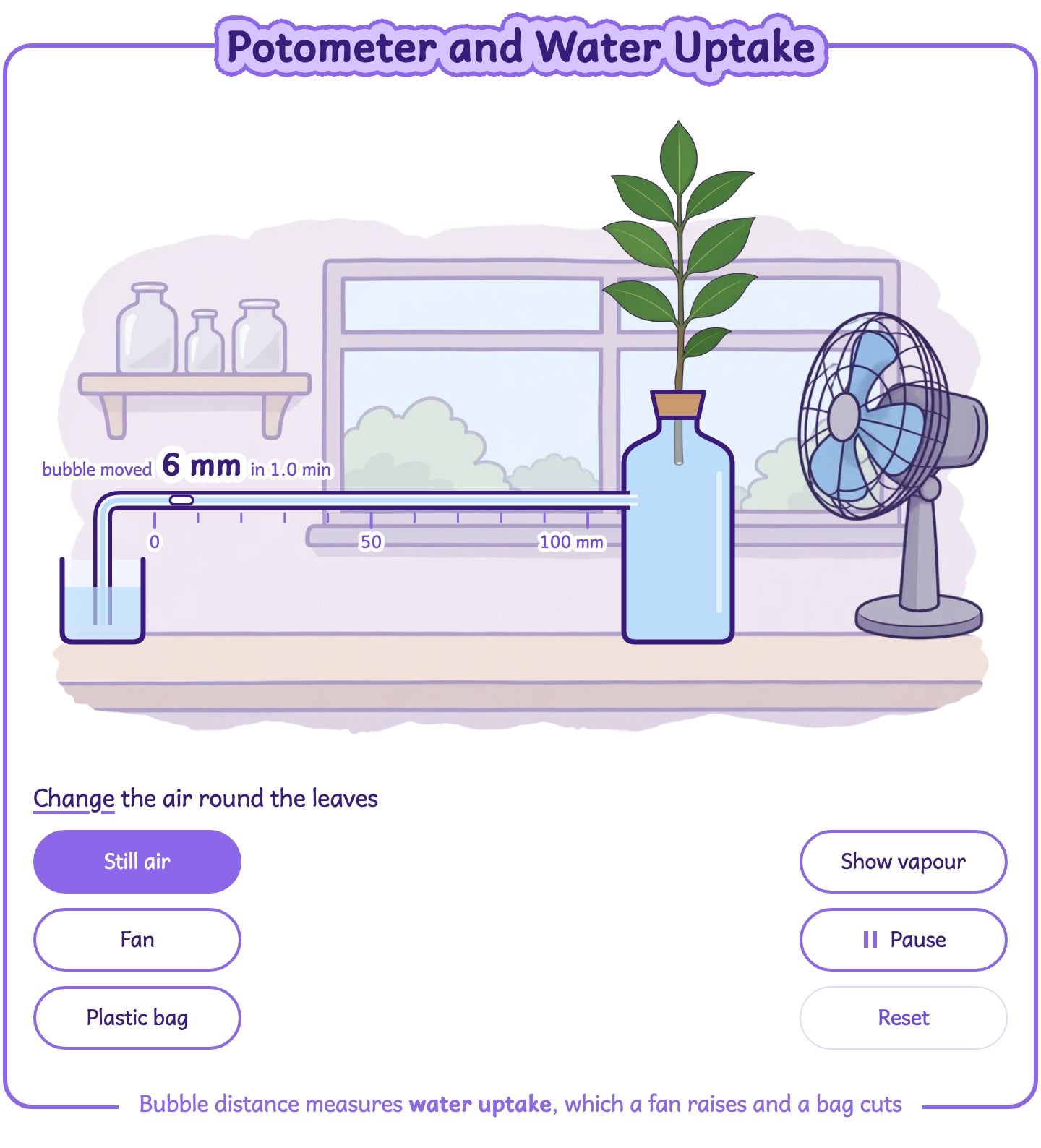
Change the conditions and watch how far the bubble moves as the shoot takes up water.