The enzyme-substrate complex
Enzyme-substrate complex
An enzyme-substrate complex is the structure formed when a substrate binds to the active site of an enzyme.
- When a substrate binds to the active site, the enzyme and substrate together form an enzyme-substrate complex.
- Within this complex, the substrate is converted into products.
- The products no longer fit the active site and are released, leaving the enzyme unchanged and ready to bind another substrate.
Extended only: the enzyme-substrate complex and the explanation of specificity in this article are Supplement content, assessed on the Extended papers (Papers 2 and 4).
The lock-and-key model
Lock and key model
The lock-and-key model describes enzyme action as a substrate fitting its enzyme's active site like a key fitting one particular lock, so only a complementary substrate can bind.
- The lock-and-key model pictures the active site as a lock and the substrate as the key.
- Just as only the correctly cut key fits a lock, only a substrate whose shape is complementary to the active site fits into it.
- When the matching substrate enters, it binds to the active site and forms the enzyme-substrate complex, like a key turning in its lock.
- Held in this position, the substrate is converted into products, which have a different shape.
- The products no longer fit the active site, so they are released, and the active site returns to its original shape.
- The enzyme is unchanged, so, like a lock, it can be used again with another substrate molecule.
A padlock opens only for its own key; in the same way, an enzyme's active site accepts only its own substrate.
Enzymes are specific
Enzyme specificity
Enzyme specificity is the property that each enzyme catalyses only one type of reaction, because only a substrate with a complementary shape fits its active site.
- Each enzyme is specific: it catalyses only one type of reaction and acts on one type of substrate.
- Specificity arises because only a substrate with a shape complementary to the active site can bind to it.
- A substrate of the wrong shape cannot fit the active site, so no enzyme-substrate complex forms and no reaction takes place.
- This is why the enzyme that breaks down starch has no effect on a protein, whose shape does not fit its active site.
An enzyme's specificity comes from the complementary shape and fit between one substrate and the enzyme's active site.
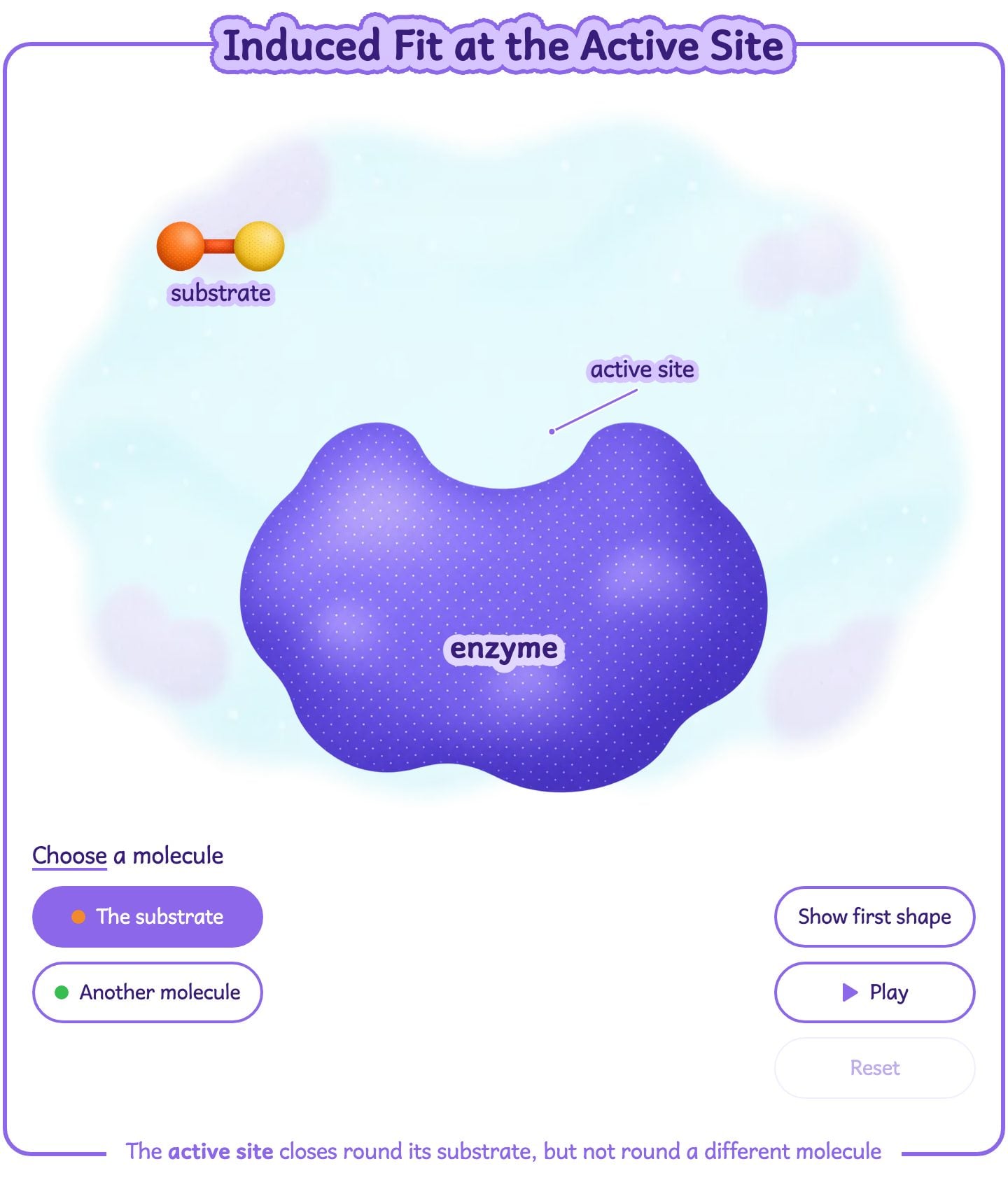
Try the substrate and a different molecule, and notice that only one fits the active site.
Why the exact fit matters
- Because the fit between active site and substrate must be exact, anything that changes the shape of the active site stops the enzyme working.
- This is the basis for how temperature and pH affect enzyme activity, covered in the next article.
- What is an enzyme-substrate complex?
- In the lock-and-key model, what do the lock and the key represent?
- What is meant by saying an enzyme is specific?
- Explain, in terms of shape and fit, why a substrate of the wrong shape does not react.
- Why does changing the shape of the active site stop the enzyme working?