The active site fits the substrate
Definition
Active site
The active site is the region of an enzyme with a shape complementary to its substrate, where the substrate binds and the reaction takes place.
- Each enzyme has a region called the active site, a pocket with a particular shape.
- The molecule an enzyme acts on is called the substrate.
- The shape of the active site is complementary to the substrate, so the two fit together.
- Only a substrate with the matching shape can fit a particular active site.
Note
Complementary means the shapes fit together, not that they are identical.
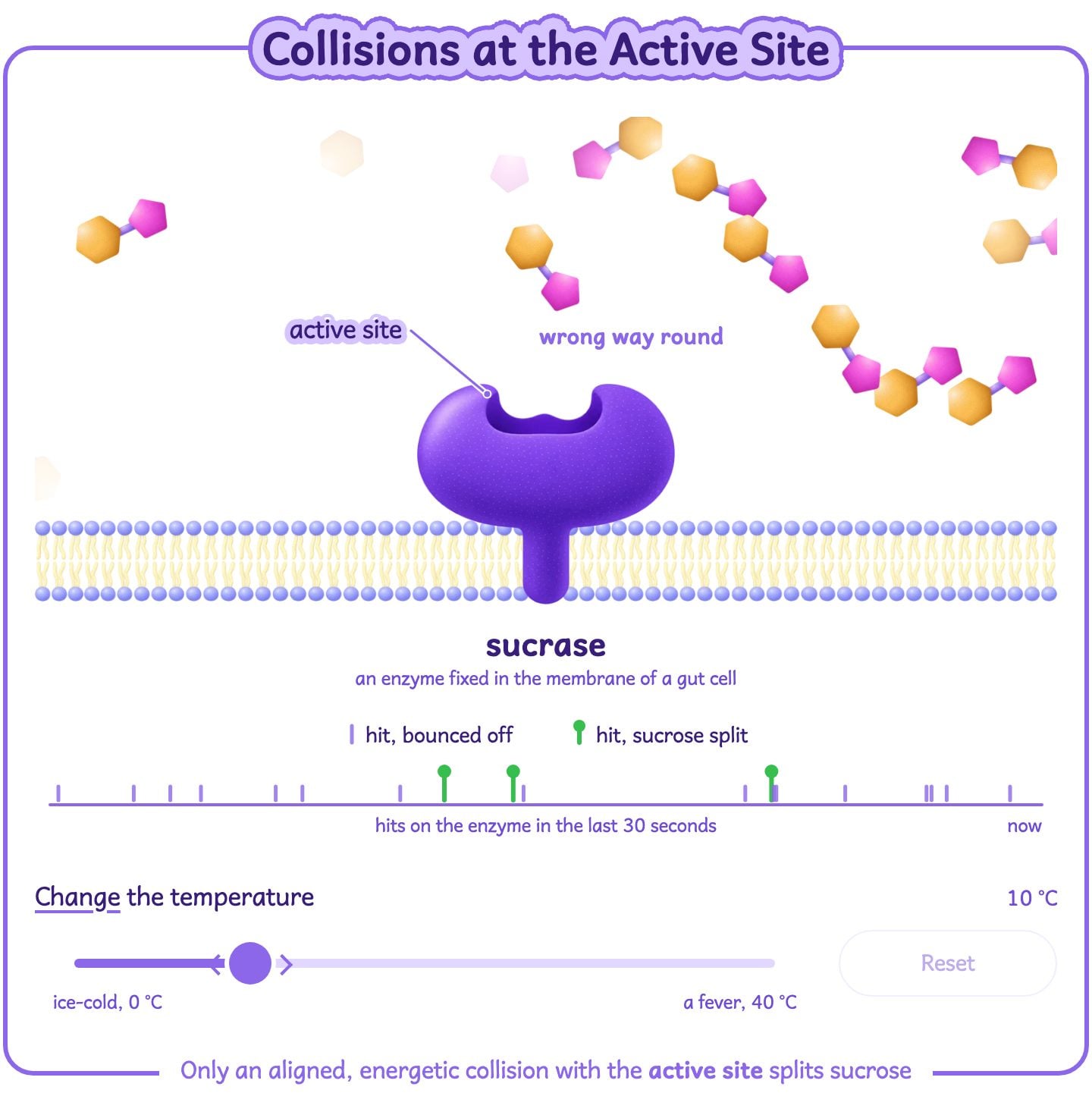
Run the collisions and notice that only a correctly aligned substrate fits the active site and splits.
How an enzyme forms products
Definition
Substrate
A substrate is the molecule that an enzyme acts on, binding to the enzyme's active site.
- The substrate binds to the active site, holding the two closely together.
- This is often shown as the lock-and-key model: the substrate is the key and the active site is the lock.
- While held in the active site, the substrate is changed into one or more new molecules called products.
- The products no longer fit the active site, so they are released.
Key Idea
An enzyme holds its substrate in the complementary active site, converts it into products, and then releases them.
One enzyme, many reactions
Definition
Product
A product is a substance formed when an enzyme converts its substrate during a reaction.
- The enzyme itself is unchanged by the reaction, so its active site is free to bind another substrate molecule.
- This is why one enzyme molecule can convert a large amount of substrate.
- Some enzymes break down a large substrate into smaller products, as in digestion; others build a large product from small substrates.
Self review
- What does it mean that the active site is complementary to the substrate?
- Why can a substrate with the wrong shape not react?
- What are the products of an enzyme reaction, and what happens to them?
- Why can one enzyme molecule work on many substrate molecules?