Temperature changes the rate of reaction
Optimum temperature
The optimum temperature is the temperature at which an enzyme catalyses its reaction at the fastest rate.
- As temperature rises towards the optimum, the rate of an enzyme reaction increases.
- The molecules gain more kinetic energy, so they move faster and there are more frequent effective collisions between substrate and active site.
- The rate is fastest at the optimum temperature, which is about 37 °C for many human enzymes.
- Above the optimum, the rate falls sharply because the enzyme is denatured.
- The high temperature changes the shape of the active site, so the substrate no longer fits and fewer enzyme-substrate complexes form.
- On a graph, the rate rises to a peak at the optimum temperature and then falls towards zero.
Above the optimum the enzyme is denatured, not "killed"; enzymes are molecules, not living things.
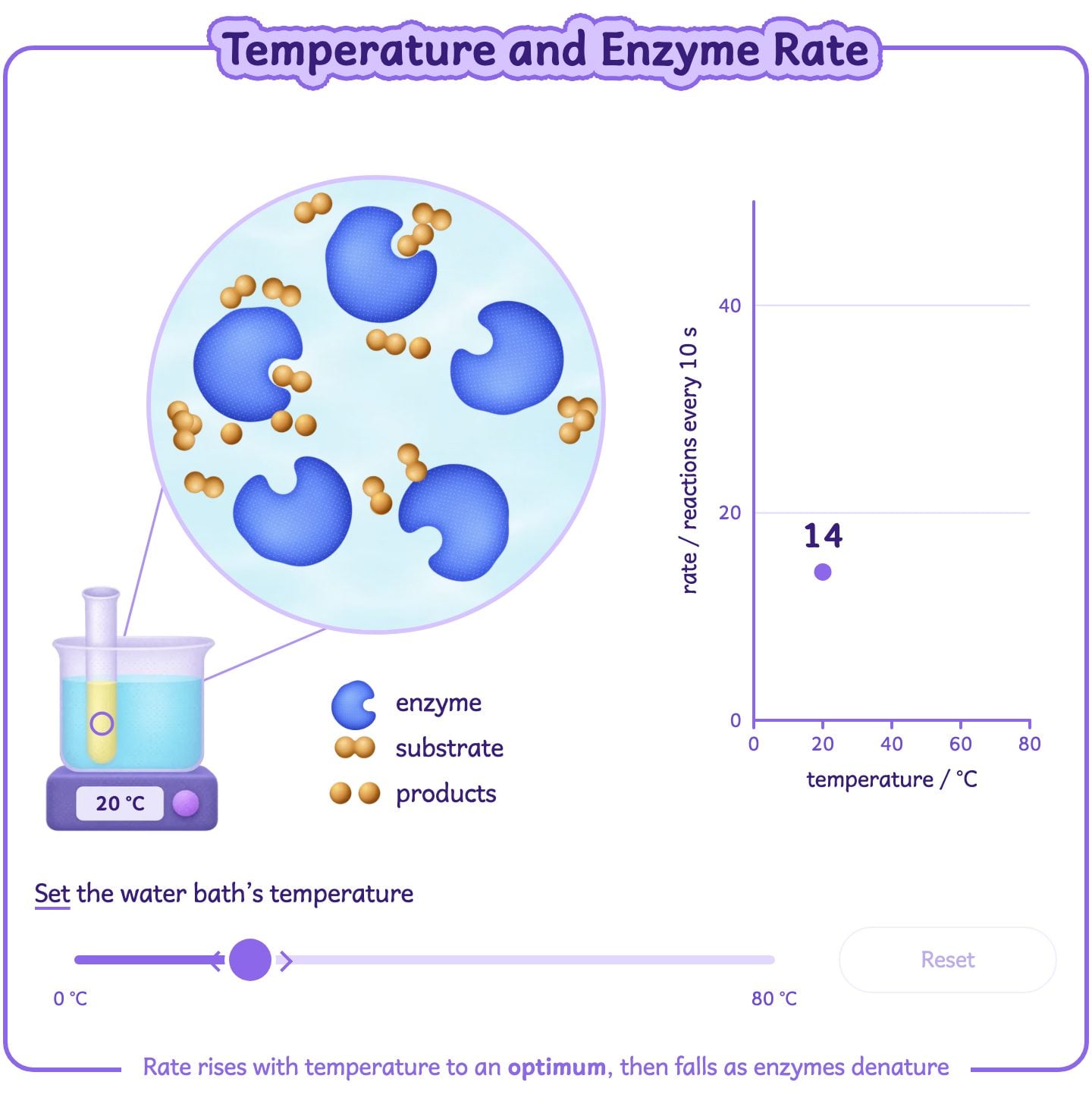
Raise the temperature and watch the rate climb to an optimum, then fall as the enzyme denatures.
pH changes the rate of reaction
Optimum pH
The optimum pH is the pH at which an enzyme catalyses its reaction at the fastest rate.
- Each enzyme works fastest at its own optimum pH.
- As the pH moves above or below the optimum, the rate of reaction falls.
- A pH far from the optimum changes the shape of the active site so the substrate no longer fits, which is denaturation.
- Different enzymes have different optima: stomach protease works best at about pH 2, while enzymes in the small intestine work best in alkaline conditions.
- On a graph, the rate rises to a peak at the optimum pH and falls on either side.
A stomach enzyme and a small-intestine enzyme have very different optimum pH values because they work in different conditions.
Investigating the effect of pH on amylase
- Use the same iodine-and-spotting-tile method, keeping the temperature constant in one water bath.
- Add a different buffer solution to each starch sample to fix a range of pH values, for example pH 4, 6, 7, 8 and 10.
- Mix amylase with each buffered starch sample, start the stop-clock, and sample a drop into iodine every 30 seconds.
- Record the time for the iodine to stay orange-brown at each pH.
- Keep the temperature, volumes and concentrations the same so that pH is the only variable.
- The pH with the shortest time is the enzyme's optimum pH.
Denaturation changes the active site
Denaturation
Denaturation is the permanent change in the shape of an enzyme's active site, caused by high temperature or extreme pH, so the substrate no longer fits and the enzyme stops working.
- Denaturation is a change in the shape of an enzyme's active site.
- It is caused by high temperature above the optimum, or by a very high or very low pH.
- Once the active site has changed shape, the substrate no longer fits, so the enzyme stops catalysing the reaction.
- Denaturation is permanent: cooling a denatured enzyme does not restore its shape.
- Remember that denaturation changes the active site's shape; it does not break the enzyme into pieces.
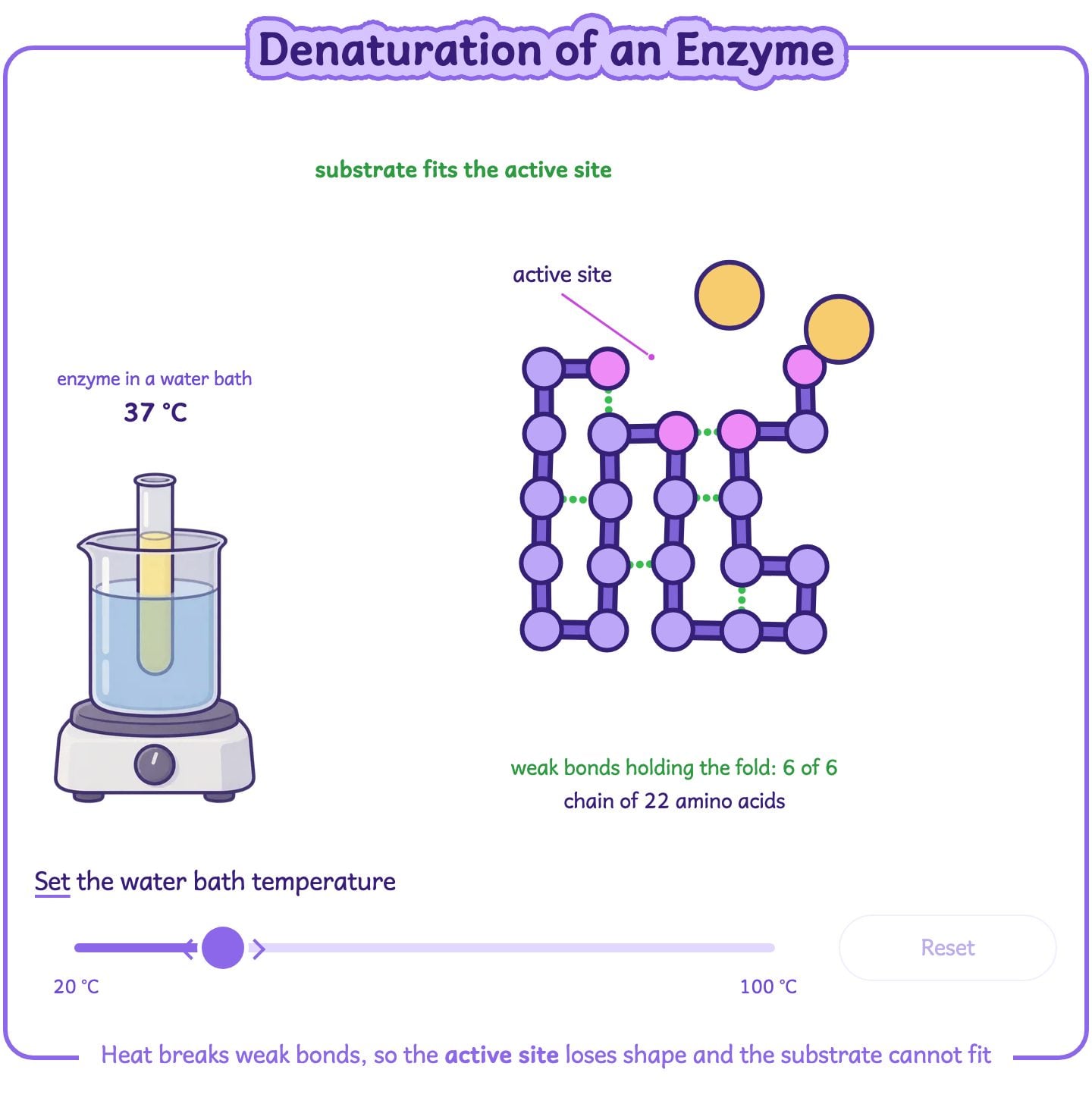
Heat the enzyme and watch the active site lose its shape so the substrate no longer fits.
Investigating the effect of temperature on amylase
- Place a drop of orange-brown iodine solution in each well of a spotting tile.
- Set up water baths at a range of temperatures, for example 10, 20, 30, 40 and 50 °C.
- Put a tube of starch solution and a tube of amylase in a water bath and leave them to reach the set temperature.
- Mix the amylase with the starch, start a stop-clock, and return the mixture to the water bath.
- Every 30 seconds, remove a drop of the mixture and add it to a fresh well of iodine.
- While starch is present the iodine turns blue-black; record the time when it first stays orange-brown, showing all the starch has been digested.
- Keep the pH, volumes and concentrations the same at every temperature so that temperature is the only variable.
- Repeat at each temperature and calculate a mean time.
Working out the rate from your results
- A shorter time to digest the starch means a faster reaction.
- Work out the rate as the reciprocal of the time, rate=1000t\text{rate} = \dfrac{1000}{t}rate=t1000, where ttt is the time in seconds.
- Multiplying by 1000 turns a small fraction into a convenient whole number.
- For example, if the starch is digested in 50 s, the rate is 100050=20\dfrac{1000}{50} = 20501000=20 (in s−1\text{s}^{-1}s−1).
- The temperature or pH that gives the highest rate, and so the shortest time, is the optimum.
- Extended (Papers 2 and 4) only: explaining these effects in terms of kinetic energy, the frequency of effective collisions, and the changing shape of the active site.
- Core and Extended: the rise to an optimum and the fall beyond it, the optimum temperature and pH, denaturation, and the investigation itself.
- Explain, below the optimum, why raising the temperature increases the rate.
- Explain why the rate falls above the optimum temperature.
- What happens to the active site when an enzyme is denatured?
- Why must the pH be kept constant in the temperature investigation?
- How do you calculate the rate of reaction from the time taken?