What active transport is
Definition
Active transport
The movement of a substance against its concentration gradient, from a lower to a higher concentration, using energy released by respiration.
- Active transport is the movement of particles through the cell membrane from a region of lower concentration to a region of higher concentration.
- This is movement against the concentration gradient, the opposite direction to diffusion.
- Moving particles against the gradient needs energy, which comes from respiration.
- Cells that carry out a lot of active transport therefore contain many mitochondria.
Note
Active transport lets a cell take in a useful substance even when there is already more of it inside than outside.
Active transport versus diffusion
Definition
Concentration gradient
The difference in the concentration of a substance between a region of higher concentration and a region of lower concentration.
- Diffusion moves particles down the concentration gradient and needs no energy from respiration.
- Active transport moves particles up the concentration gradient and does need energy from respiration.
- Both processes move substances across the cell membrane.
- A cell uses diffusion when a substance can move down its gradient, and active transport when it must move against it.
Common Mistake
Only active transport uses energy from respiration; diffusion and osmosis are both passive.
Self review
- Define active transport.
- In which direction does active transport move particles, relative to the concentration gradient?
- Where does the energy for active transport come from?
- Give one difference between diffusion and active transport.
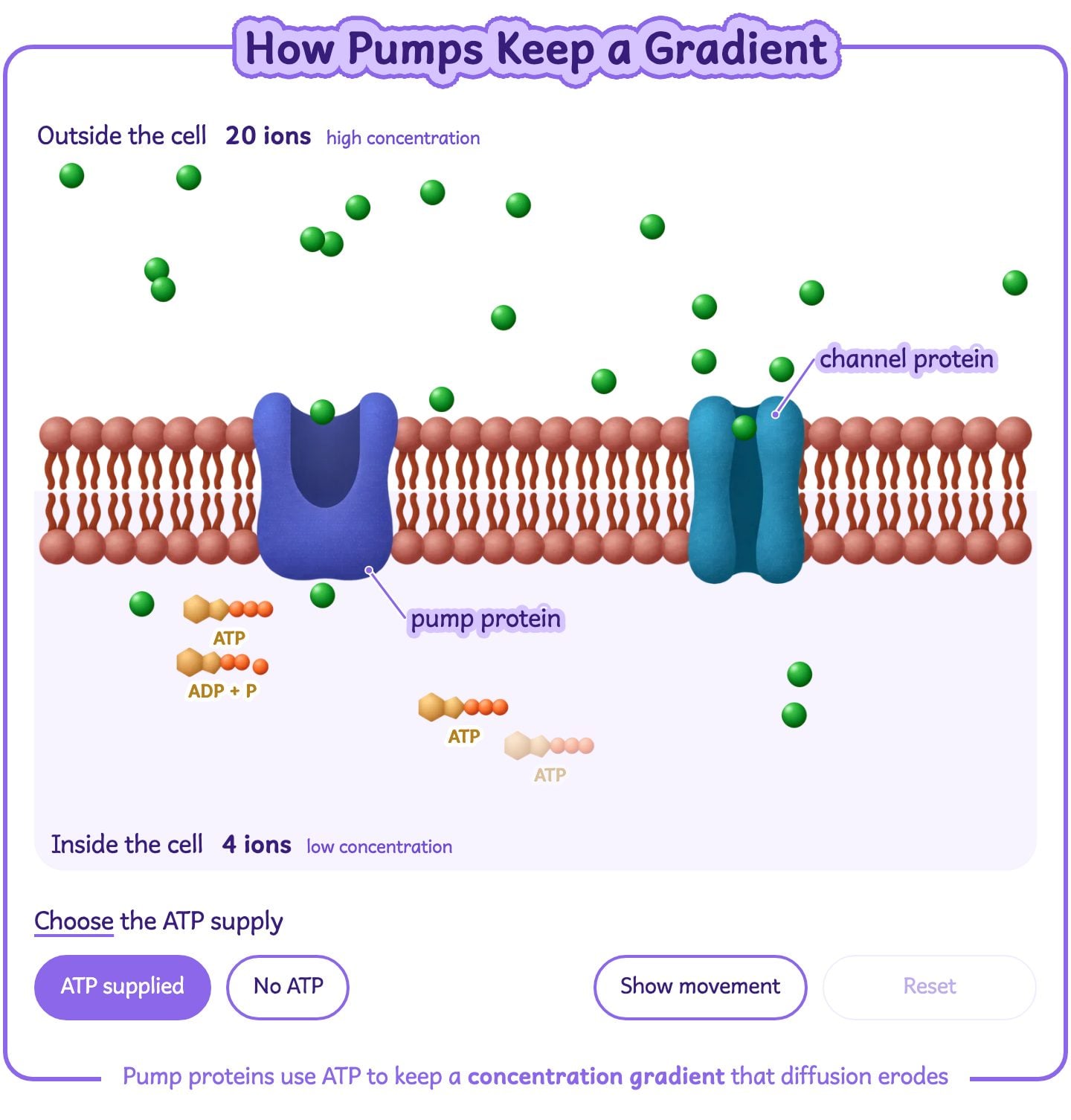
Compare diffusion with the pump, which uses energy to move particles against the gradient.