How carrier proteins work
Definition
Carrier protein
A protein in the cell membrane that moves specific molecules or ions across it, used in active transport.
- Active transport across the membrane is carried out by carrier proteins in the cell membrane.
- A carrier protein first binds the specific molecule or ion that is to be moved.
- Using energy from respiration, the carrier protein changes shape and moves the particle across the membrane.
- The particle is released on the other side, and the carrier protein returns to its original shape.
- Each carrier protein moves only its own specific molecule or ion.
Note
Carrier proteins are the reason active transport can move a chosen substance against its concentration gradient.
Why active transport matters
Definition
Active transport
The movement of a substance against its concentration gradient, from a lower to a higher concentration, using energy released by respiration.
- Active transport lets cells absorb substances that are in short supply outside, against the concentration gradient.
- Root hair cells take up mineral ions from the soil by active transport, even though the soil is more dilute than the cell.
- This lets a plant gather enough nitrate and other ions for healthy growth.
- In humans, active transport helps absorb glucose and other nutrients from the small intestine into the blood when their concentration there is low.
Note
This importance of active transport, including ion uptake by root hairs, is Extended-only (Supplement) content.
Self review
- What kind of protein carries out active transport, and where is it found?
- How does a carrier protein move a particle across the membrane?
- Why can each carrier protein move only certain substances?
- How do root hair cells take up mineral ions from dilute soil?
- Give one example of active transport in humans.
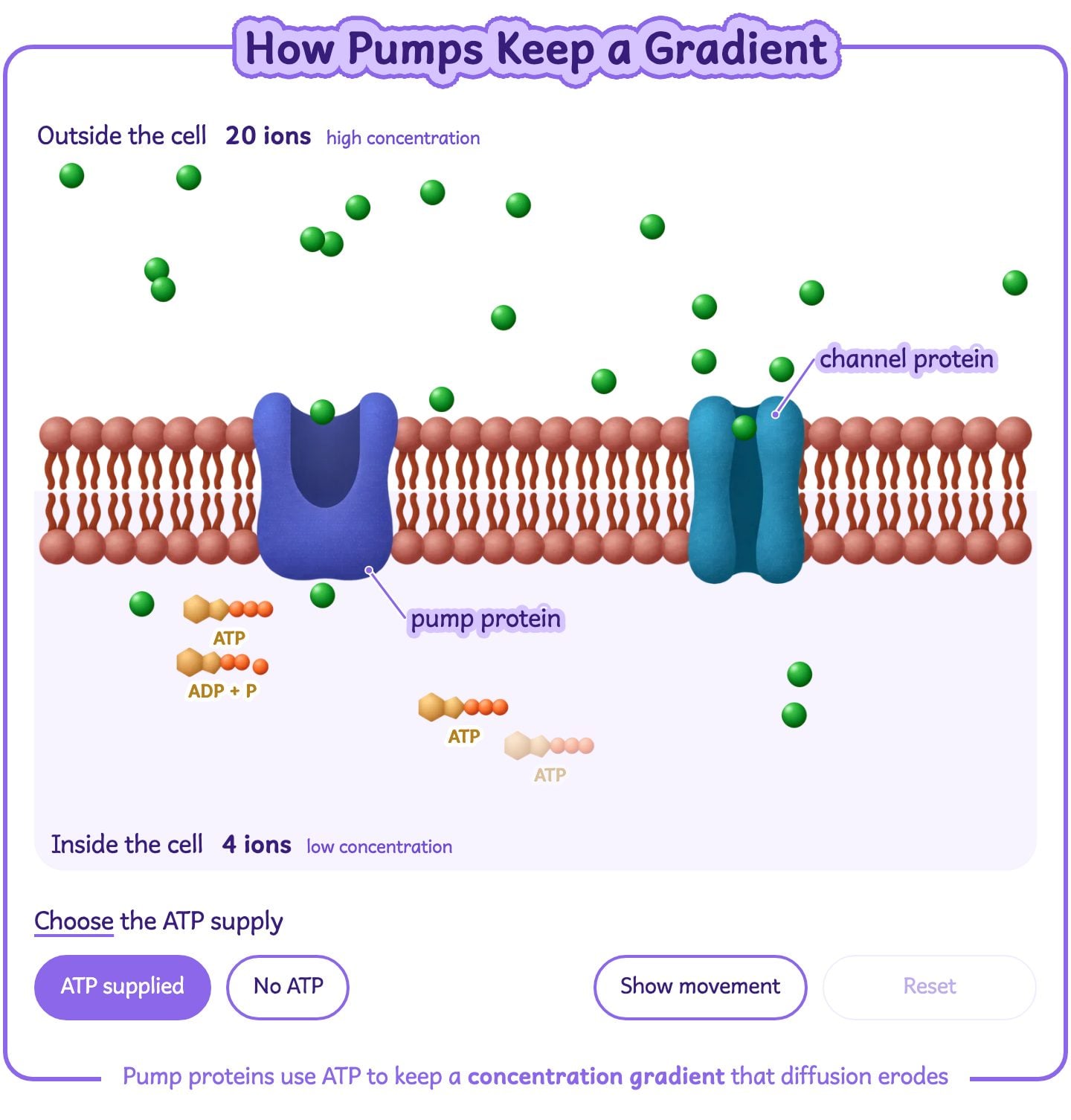
Watch the pump use energy to keep a concentration gradient that diffusion would otherwise remove.